


"What Is Orthomolecular Medicine?" / a collection of essays on orthomolecular medicine, Richard A. Kunin, M.D., circa 2000.
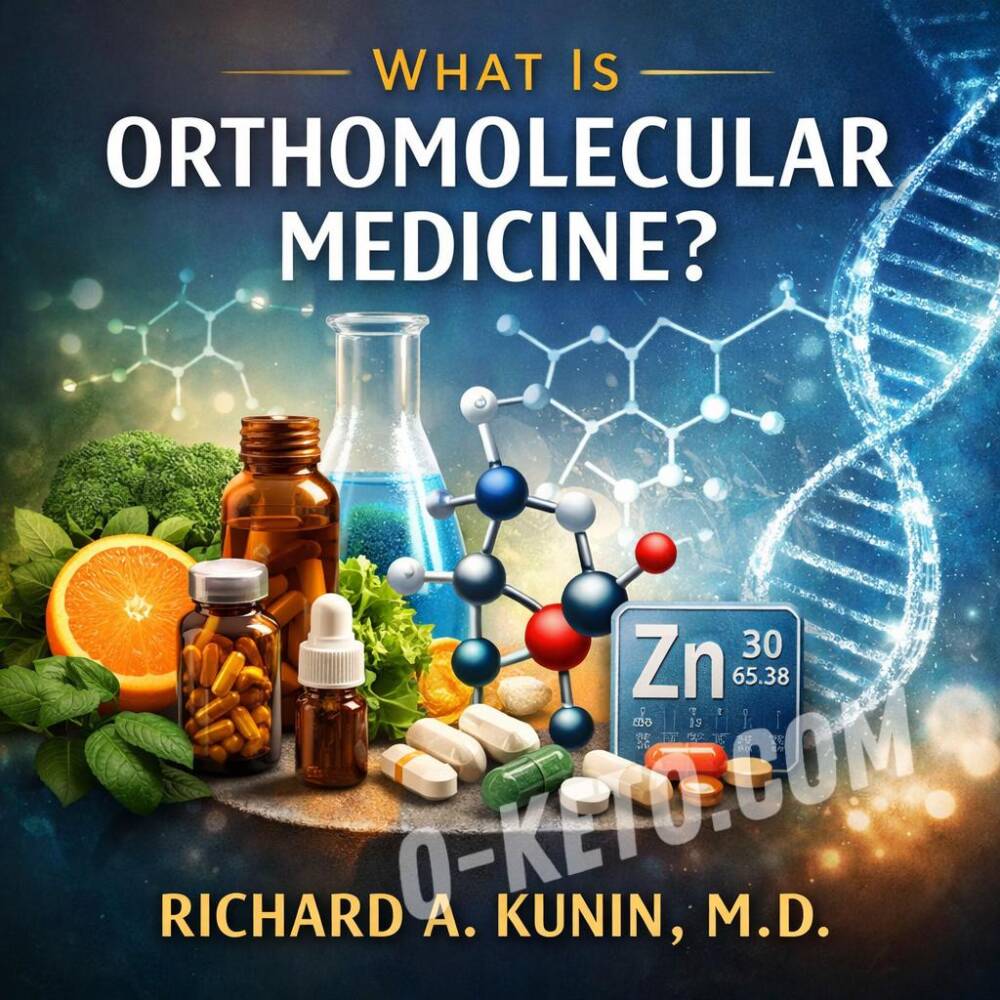
This book is a manifesto of orthomolecular medicine, written by a practicing physician and a student of Linus Pauling's ideas. Kunin consistently shows that most chronic and "unexplained" diseases are related not to a deficiency of drugs, but to a deficiency of the right molecules—vitamins, minerals, amino acids, fatty acids—and to chronic toxic load.
The author criticizes orthodox medicine for ignoring nutrition, trace elements, and individual biochemistry, describing clinical cases of successful use of megadoses of vitamins (B₃, B₆, B₁₂, C, A), correction of mineral deficiencies, elimination of food allergies and toxins. Special attention is given to the role of B vitamins in psychiatry, homocysteine, DNA repair, antioxidants, and the myths about the toxicity of vitamins.
The conclusion of the book: diagnosis and treatment should start with nutrition and biochemistry, not end with them; the orthomolecular approach is not an "alternative," but a scientifically grounded, physiological medicine focused on

29.01.2026. "The Proof: Successes with Cellular Nutrients Confirm Vitamin Research Findings," Matthias Rath, 2012
The book is a collection of documented testimonies from patients with various oncological diagnoses who used the approach of cellular...

27.01.2026. "Road Map to Health," Matthias Rath, 2007
The book is a manifesto of orthomolecular and cellular medicine, in which Matthias Rath asserts that the main chronic diseases of mod...

In this book, Abram Hoffer — one of the founders of orthomolecular psychiatry — summarizes over half a century of experience working...

24.01.2026. "Progesterone in Orthomolecular Medicine," Raymond Peat, 1993
In this work, Raymond Peat considers progesterone not as a "reproductive hormone," but as a universal protective and regulatory facto...

This book is a comprehensive collection of works and clinical observations by 65 leading specialists in the field of orthomolecular m...

In this book, one of the founders of orthomolecular psychiatry elaborates on the biochemical concept of schizophrenia and an approach...

This book is a systematic and practical introduction to orthomolecular medicine — an approach based on the use of optimal, rather tha...

20.01.2026. Orthomolecular Medicine: Healing Cancer, Abram Hoffer, Linus Pauling, 2004
The book is dedicated to the orthomolecular approach in the treatment of oncological diseases and considers cancer not only as a loca...

19.01.2026. "Ortho-Molecular Nutrition: New Lifestyle for Super Good Health," Abram Hoffer, Morton Walker, 1978
This book is one of the key practical expositions of the orthomolecular approach to health, based on the idea that for the normal fun...

18.01.2026. Nutrition and Mental Illness: An Orthomolecular Approach, Carl C. Pfeiffer, 1988
In the book, the author systematically presents the orthomolecular approach to mental disorders, considering them as a consequence of...
1. What Is Orthomolecular Medicine?
Orthomolecular medicine is defined as an approach to the treatment and prevention of diseases through the restoration of the optimal balance of molecules naturally present in the body: vitamins, minerals, amino acids, fatty acids, and other nutrients. Unlike pharmacology, which intervenes in biochemistry with foreign substances, the orthomolecular approach works with what is already built into metabolism.
The key idea is that disease arises not from a "lack of drugs," but from deficiencies, imbalances, and toxic overloads that disrupt normal cell biochemistry.
2. History of Orthomolecular Medicine
Modern orthomolecular medicine developed in the second half of the 20th century and is closely associated with the name of Linus Pauling, who coined the term orthomolecular - "correct molecules."
The author emphasizes that before the era of antibiotics and hormonal therapy, nutrition and nutrients were a natural part of medicine. After World War II, medicine shifted towards drugs and surgery, and nutrition was pushed aside and declared "unscientific," despite the growing body of biochemical and clinical data.
3. Criticism of Orthodox Medicine
Kunin harshly criticizes orthodox medicine for its symptomatic approach, ignoring individual biochemistry and chronic deficiencies. He shows that standard laboratory "norms" often do not reflect the real needs of tissues, and the fear of vitamins and minerals is largely dictated by the regulatory and insurance systems. As a result, patients are treated for years with medications that do not address the root cause of the disease.
4. Megavitamin Therapy
Megavitamin therapy is viewed as the therapeutic, rather than preventive, use of vitamins - in doses significantly exceeding the RDA. The author explains that RDAs are calculated to prevent gross deficiency diseases, not to restore disrupted biochemistry in chronic conditions. Clinical examples are provided where high doses of vitamins produced rapid and sustained effects where medication therapy was ineffective.
5. B Vitamins and the Nervous System
Particular emphasis is placed on B vitamins as key regulators of the nervous system, energy metabolism, and methylation. Deficiencies in B₃, B₆, B₁₂, and folate are linked to depression, psychosis, chronic fatigue, cognitive impairments, and increased homocysteine levels. Kunin emphasizes that many psychiatric and neurological conditions have a nutritional nature and can significantly improve with targeted correction of deficiencies.
6. Vitamin B12: Deficiency, Myths, and Clinics
Vitamin B12 is described as one of the most underrated factors in neurological and mental health. The author links B12 deficiency to impaired DNA synthesis and hematopoiesis, methylation problems (via the folate cycle and SAM), accumulation of homocysteine, and damage to myelin. This manifests as pain, sensory disturbances, weakness, cognitive decline, and depressive/paranoid states. The "systemic skepticism" is analyzed separately: narrow criteria for prescribing B12 and the habit of relying solely on laboratory thresholds lead to missed deficiencies and late diagnoses when neurological damage has already occurred.
7. Antioxidants and DNA Protection
Antioxidants are viewed not as a trendy term, but as nutritional tools for protecting cells and the genome from oxidative stress.
Vitamin C is presented as a factor that potentially supports DNA repair systems and reduces markers of oxidative damage; the author engages in detailed debate with "scare stories" about the alleged genotoxicity of vitamin C, showing how individual laboratory markers are interpreted one-sidedly, ignoring the overall balance of damage/recovery.
The idea of the block: if a person has high oxidative stress (smoking, inflammation, deficiencies), then antioxidant support becomes not cosmetics, but protection for fertility, vessels, and long-term health.
8. Vitamin A: Toxicity - Myths and Reality
The author criticizes the approach where vitamin A is "scared" by toxicity without a qualitative analysis of causes and context. He emphasizes that many stories about toxicity are poorly documented, and some risks are attributed to vitamin A itself, although similar disorders (including fetal development issues) may be related to zinc deficiency and general imbalances.
The main point: excessive reduction of "acceptable" doses and fear of vitamin A can lead to untreated deficiencies, decreased resistance to infections, and impaired recovery processes.
9. Minerals and Trace Elements
Minerals are described as the "hidden foundation" of enzymes, hormones, immunity, and detoxification. The author emphasizes that deficiencies can be functional (at the tissue level) even with "normal" tests, and toxic metals can disrupt the functioning of competing minerals. He highlights the interconnections: for example, the role of zinc in activating vitamin-dependent processes, the balance of copper and iron, and the influence of trace elements on energy metabolism and the nervous system.
The practical conclusion is that minerals need to be assessed systematically and corrected purposefully, rather than "at random."
10. Toxic Load (Toximolecular Medicine)
The toximolecular part of the book is based on the idea: health depends not only on what we add (nutrients) but also on what needs to be removed (toxins).
The author particularly highlights chronic low-level exposures to heavy metals and pesticides: even if each toxin is "below the threshold," the cumulative effect can produce pronounced symptoms. He criticizes standard practice for the rarity with which doctors seek such causes and emphasizes the value of targeted testing and removal of the source of exposure as a fundamental step towards recovery.
11. Hair, Blood, and Urine as Diagnostic Methods
The author emphasizes that standard blood tests reflect only short-term conditions and poorly indicate tissue deficiencies and chronic intoxications. Hair mineral analysis is viewed as a way to identify long-term disturbances in mineral metabolism and the accumulation of toxic metals that may remain unnoticed in serum. Urine tests complement the picture, allowing for the assessment of the excretion of metabolites, organic acids, and toxins.
The key idea is that no single method is self-sufficient; the clinical picture can only be understood by combining different biological media and patient symptoms.
12. Nutrition, Allergies, and Food Reactions
The book thoroughly examines hidden food reactions that do not fit into the framework of classical IgE allergies but can cause chronic inflammation, swelling, fatigue, headaches, and digestive disorders.
Particular attention is paid to gluten, insufficient stomach acidity, and digestive enzyme deficiencies as causes of poor nutrient absorption.
The author shows that dietary correction and the elimination of individually intolerable products are often a decisive factor in recovery, even without aggressive medication therapy.
13. Clinical Cases
A significant part of the book is built on clinical observations: psychiatric conditions, chronic fatigue, ophthalmological problems, anemia, infertility, recovery disorders after injuries. These cases illustrate the practical value of the orthomolecular approach - searching for deficiencies, correcting nutrition, eliminating toxic load, and monitoring dynamics, rather than suppressing symptoms. The author emphasizes that it is the clinical result, not adherence to dogmas, that is the criterion for treatment effectiveness.
14. Politics, Regulation, and the War on Vitamins
Kunin sharply criticizes regulatory bodies, medical journals, and insurance companies for creating an atmosphere of fear around vitamins and nutritional therapy. He shows how the concepts of "evidence" and "safety" are selectively used to limit patients' access to relatively safe and inexpensive methods of health support. As a result, vitamins are presented as a threat, while the real risks of deficiencies are ignored, and doctors find themselves under pressure from the system.
15. The Future of Medicine
In the conclusion of the book, the author formulates a forecast: if medicine continues to ignore nutrition, biochemistry, and individual needs, patients will increasingly turn to alternative practices. He sees the future in integration - medicine that places nutrition and nutrients at its core, uses laboratory diagnostics wisely, and respects clinical experience. The orthomolecular approach is presented not as "opposition," but as a logical return of medicine to physiology and common sense.