


The Telomerase Revolution, Michael Fossel, 2015
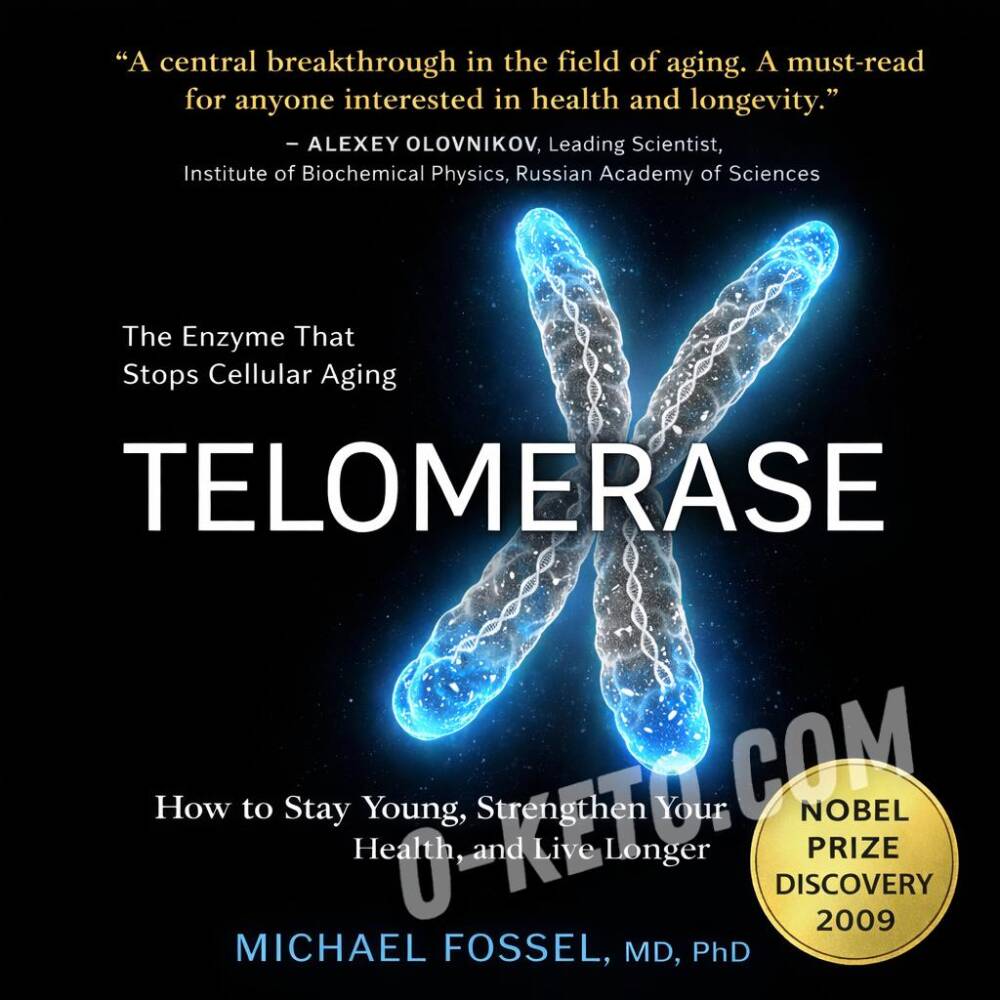
In this book, Michael Fossel systematically unfolds the idea that aging is not an abstract "wear and tear of the organism," but a specific biological process directly linked to the shortening of telomeres and the loss of cells' ability to divide and regenerate. The key thought of the author is that it is the decrease in telomerase activity that underlies most age-associated diseases — cardiovascular, neurodegenerative, immune, and metabolic.
Fossel shows that aging and age-related diseases are essentially the same phenomenon, and therefore they cannot be effectively treated separately without addressing the root cause. The author argues that the activation of telomerase can not only slow down aging but potentially reverse age-related changes at the cellular and tissue levels, restoring organ functions.
Ultimately, the book concludes that the medicine of the future will inevitably shift from "patching symptoms" to treating the very mechanism of aging, and telomerase will become the central tool of this rev

19.01.2026. "Ortho-Molecular Nutrition: New Lifestyle for Super Good Health," Abram Hoffer, Morton Walker, 1978
This book is one of the key practical expositions of the orthomolecular approach to health, based on the idea that for the normal fun...

The book is a carefully curated collection of texts in which Linus Pauling articulates his key ideas — from fundamental chemistry and...

26.10.2025. David Perlmutter, Kristin Loberg "The Gut and the Brain: How Gut Bacteria Heal and Protect Your Brain," 2017
The book claims that the state of the gut microbiome directly affects brain health and diseases — from mood to neurodegenerative diso...

07.11.2025. Abram Hoffer "Vitamin B-3 and Schizophrenia: Discovery, Recovery, Controversy," 1998
The book is a manifesto of the orthomolecular approach to psychiatry. Hoffer systematizes the experience of using high doses of niaci...

The book explains why "happiness" is not a constant state, but rather short bursts of neurochemistry that the brain turns on and off...
Chapter One. Theories of Aging
Aging is viewed not as a random or "natural wear and tear," but as a biologically programmed process.
The author examines classical theories — damage accumulation, free radical, genetic, metabolic — and shows their limitations: they describe individual manifestations of aging well but do not explain why the organism systematically loses its ability to recover. The key conclusion of the chapter is that aging cannot be reduced to the sum of damages; there must be a single controlling cause that determines when and how tissues cease to renew.
Chapter Two. Telomere Theory of Aging
The focus is on telomeres as a "counter of cell divisions" and telomerase as the enzyme that determines their regenerative potential. Telomere shortening leads to the cessation of division, cellular aging, and functional decline of tissues. The author emphasizes that it is the telomeric mechanism that links aging, decreased regeneration, and the development of age-related diseases into a single chain.
An important thought: telomeres are not just a marker of age, but an active causal factor that governs the speed and depth of the organism's aging.
Chapter Three. Why We Age
Aging is explained as a consequence of an evolutionary compromise: high telomerase activity is beneficial for recovery but increases the risk of uncontrolled cell division. Therefore, in somatic tissues, telomerase is suppressed, which over time leads to a loss of the ability to repair and renew.
The author emphasizes that age-related diseases are not separate pathologies, but manifestations of the same problem: the inability of tissues to maintain their structure. Hence, a fundamental conclusion follows — treating aging and treating age-related diseases cannot be done separately.
Chapter Four. In Search of Immortality
The author examines historical and modern attempts to conquer aging — from myths of immortality and hormonal experiments to transplantation and gene therapy. It is shown that all approaches that do not address the mechanism of cellular renewal are doomed to temporary or cosmetic effects.
The central idea of the chapter: extending life is only possible through restoring the ability of tissues to regenerate, not through "maintaining" aging cells. Biological immortality is not the endless life of a single cell, but the constant renewal of tissues, similar to what occurs in a young organism.
Chapter Five. Immediate Aging: The Avalanche Effect
Immediate aging is described as a process in which telomere shortening leads to the cessation of cell division, their senescence, and loss of function. These cells do not just stop working — they actively worsen the surrounding environment by releasing pro-inflammatory signals.
An avalanche effect arises: the more of such cells there are, the faster the tissues around them age. The author emphasizes that aging accelerates not linearly, but exponentially, which explains the sharp decline in health in old age.
Chapter Six. Indirect Aging: Innocent Bystanders
Indirect aging concerns cells and structures that do not actively age themselves but suffer due to the degradation of surrounding tissues. Blood vessels, the nervous system, and immune mechanisms begin to function worse not because they "wear out," but because they receive signals from senescent cells and lose support from the regenerative environment.
The author shows that many symptoms of aging — chronic inflammation, decreased immunity, fibrosis — are secondary effects of telomeric depletion, not independent causes.
Chapter Seven. How to Slow Down Aging
Slowing down aging is viewed as an attempt to slow the loss of the regenerative potential of tissues, not as a remedy for individual age symptoms. The author emphasizes that lifestyle, nutrition, inflammation control, and metabolic load can only reduce the rate of telomere shortening but cannot stop the process itself. These measures work as a delay, reducing the avalanche accumulation of senescent cells and extending the period of functional health; however, they do not eliminate the fundamental cause of aging — the suppression of telomerase in somatic cells.
Chapter Eight. Reversing Aging
In this chapter, the author makes a fundamental shift from prevention to therapy. Reversing aging is linked to restoring telomerase activity and returning cells' ability to divide and renew. Data from experimental models are discussed, showing the restoration of tissue functions upon reactivation of telomerase without loss of cellular specialization.
The key conclusion: aging is a reversible biological state, not an irreversible decay. The author emphasizes that future medicine will not focus on treating individual age-related diseases but on restoring the young functional state of the organism through managing the mechanisms of cellular aging.