
A good waffle maker in a home kitchen should be more than compact and visually attractive. It should be reliable, stable, and easy to live with in regular use. Once people start making low-carb waffles more often, whether with cottage cheese, cheese, eggs, almond flour, or higher-protein mixtures, the difference between machines becomes obvious very quickly. One model gives even browning and wipes clean in minutes, while another overheats at the edges, smells of plastic, grips the batter, and turns a simple recipe into a nuisance.
That is why it makes sense to choose a waffle maker by practical kitchen criteria rather than by a discount tag or a polished product photo. Plate material, coating quality, body stability, heating behavior, cleaning access, and the actual shape of the grids matter much more than a glossy promise on the box. In a kitchen where the machine may be used often, those details affect safety, comfort, and the final texture of the waffles every single time.
Why safety matters more than looks
A waffle maker has several risk points that people often ignore when buying too quickly. The first is the coating on the plates. If it scratches easily or behaves inconsistently after only a short time, the appliance stops being convenient very fast. People start adding extra fat, prying at the plates more aggressively, and struggling to judge doneness. The second risk point is the overall plastic and body construction. A harsh chemical smell, a handle that becomes too hot, or a lid that closes with wobble are all signs of a weak model.
For regular home use, the better choice is the machine that asks for fewer compromises. Safety here is not only about the absence of an outright defect. It is also about avoiding the repeated little problems that push the cook toward careless handling. A waffle maker should sit firmly on the counter, stay stable while opening, and close without twisting or misalignment. If the appliance already feels doubtful in the hand, it rarely becomes a favorite tool later.
What to check in the coating and working surface
The most practical plates usually have an even nonstick layer with no rough patches, bubbles, or suspicious seams along the edges. Even before the first use, it is worth examining whether the coating looks uniform. If there are visible flaws from the start, they usually become more noticeable with heat and cleaning. This matters especially with low-carb batters because mixtures based on eggs, cheese, cottage cheese, almond flour, or other nut flours behave differently from standard wheat batter and can expose a weak nonstick surface much sooner.
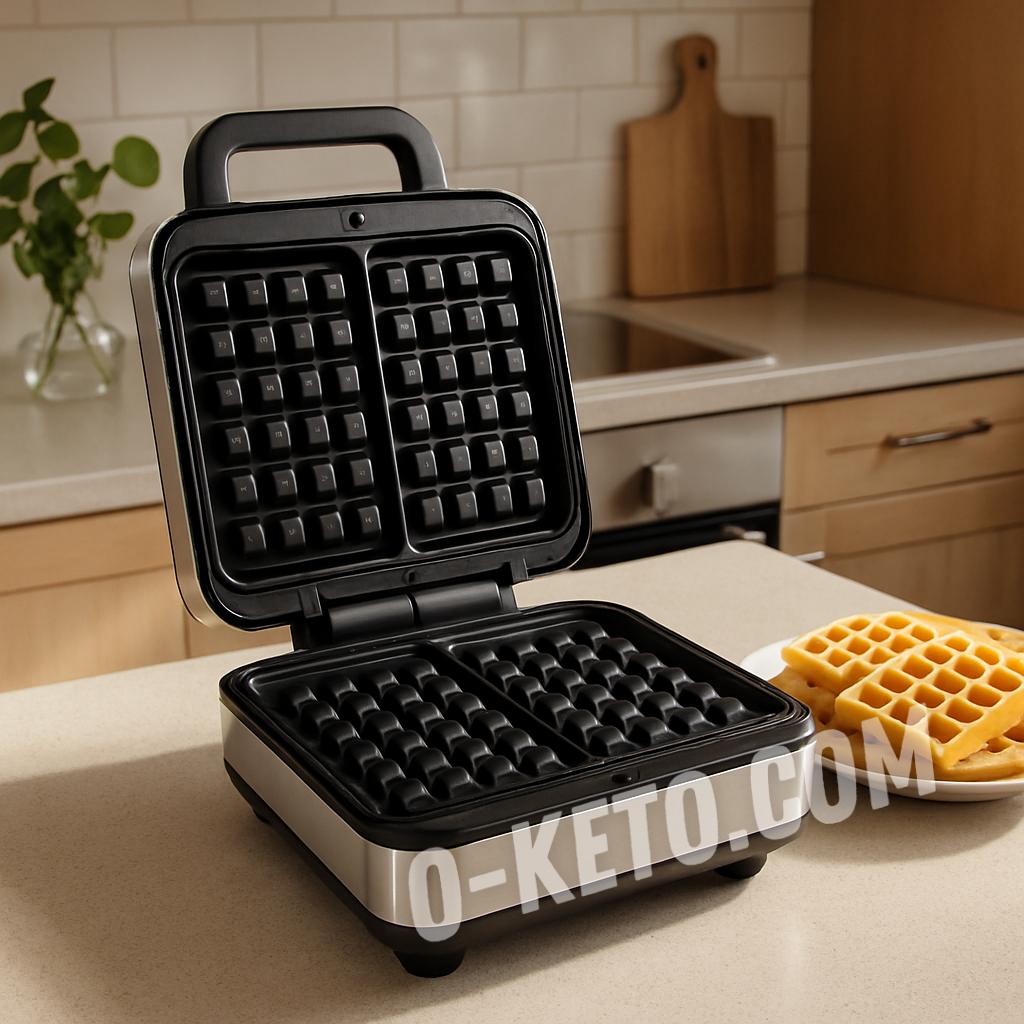
It also helps to think about how easy the corners and grooves will be to clean. A dramatic deep pattern does not make a waffle maker better by itself. If baked protein or browned crumbs stay trapped in the channels after every batch, washing becomes unpleasant very quickly. That often leads to harsher cleaning and a shorter life for the coating.
Are removable plates worth it
For frequent home cooking, removable plates are usually a real advantage. They are easier to rinse thoroughly, easier to dry fully, and make it less tempting to do a rushed half-cleaning just to avoid dealing with the body of the appliance. This is especially useful if the machine will be used not only for sweet waffles, but also for savory cheese, fish, or richer protein-based recipes that can leave more residue behind.
If the plates are fixed, it becomes much more important to assess whether a soft sponge and cloth can actually reach the surface comfortably. Some models make that awkward because the rim around the plates is too narrow or shaped badly. That may not feel like a major problem after one use, but over time it turns into an everyday irritation.
Power and heating stability
A waffle maker that is too weak often produces pale soft sheets instead of properly browned waffles. In practice, not only the wattage number matters, but also how evenly the appliance maintains heat. If the center browns too fast while the edges stay pale and damp, the heating pattern is uneven. That is especially frustrating with low-carb batters, which are already more sensitive to drying out or overcooking than standard flour batter.
A good machine behaves predictably from batch to batch. You learn roughly how many minutes it needs, when it is safe to open, and how the surface color changes near the edges. That kind of repeatability matters more than an extra decorative feature on the control panel. If the appliance acts differently every time, even a solid recipe becomes harder to trust.
Grid shape and pocket depth
Before buying, it helps to decide what kind of waffles you really want to make at home. Thin crisp waffles need one type of surface, deep Belgian-style waffles need another, and cottage cheese, cheese, or protein-heavy low-carb batters often work best in a moderate grid depth that cooks the center through without leaving it wet. A very deep shape is not always an advantage. Dense low-carb batters can take longer to cook in those pockets and may need more careful spreading.
If savory waffles are part of the plan, it is often more convenient when the pattern is not too tiny or overly sharp. That makes the waffles easier to release, less prone to tearing, and more practical for serving with eggs, fish, sauces, or savory toppings. The visible pattern matters far less than the ability of the plates to cook the mixture evenly and release it cleanly.
How to evaluate a model early
If there is a chance to inspect the machine before buying, it is worth checking whether the lid closes evenly, whether the hinge feels loose, and whether the handle feels steady rather than fragile. Cable length matters too, because a very short cord can make the machine awkward to place on a real kitchen work surface.
After purchase, the first warning signs usually show up quickly. It is worth noticing whether the appliance gives off an unpleasant smell during the first heating cycles, whether the waffles release easily, and whether the same zones consistently brown darker than the rest. There is a big difference between a device that simply needs a little practice and one that already shows weak construction and annoying maintenance on day one.
Which functions are truly useful
The most useful features are usually the simplest ones: a clear heating indicator, a steady closing mechanism, enough power, and removable plates. A temperature control can also help if you really plan to work with very different batters. Gentler settings can be useful for delicate cottage cheese or protein waffles, while denser nut-based recipes may need a firmer bake.
Many other extras are mostly marketing noise. If a machine is presented as an all-in-one miracle but has inconvenient cleaning and a questionable coating, that is a poor trade. In everyday use, a straightforward waffle maker with sensible geometry often outperforms a more complicated model loaded with functions that do not improve the actual cooking experience.
Conclusion
A safe waffle maker is one that heats evenly, closes calmly, does not give off a worrying smell, cleans without drama, and handles repeated home use without constant stress on the coating. In a low-carb kitchen, it should work well not only with classic sweet batter but also with richer egg-, cheese-, or almond-based mixtures. When the focus shifts from glossy presentation to coating quality, cleaning, heating, and day-to-day comfort, it becomes much easier to choose a machine that will actually stay useful.