


Canned fish is often treated as emergency food: something you keep in the cupboard, open when you are busy, and use mainly for convenience. In reality, good canned fish can be a legitimate part of a strong everyday diet. It stores for a long time, needs no cooking, and can make it much easier to put together a real meal instead of reaching for random processed snacks. That is one reason it can fit well into keto or LCHF eating, where practical protein-and-fat options matter.
The nutritional value of canned fish does not depend only on the fact that it comes in a can. It depends on what fish was used, what was added around it, and how the product was packed and processed. One can may be a simple, nutrient-dense food. Another may be a low-quality mixture of fish scraps, cheap oil, sugar, starch, and sauce that turns a useful product into something far less interesting nutritionally.
What canned fish still preserves
The first major benefit is protein. Many canned fish products still provide around 15 to 25 grams of protein per 100 grams, depending on the species. That puts them in the same practical range as fresh fish and many meat products. Protein matters for satiety, muscle maintenance, and meal structure, and that alone can make canned fish much more useful than people expect.
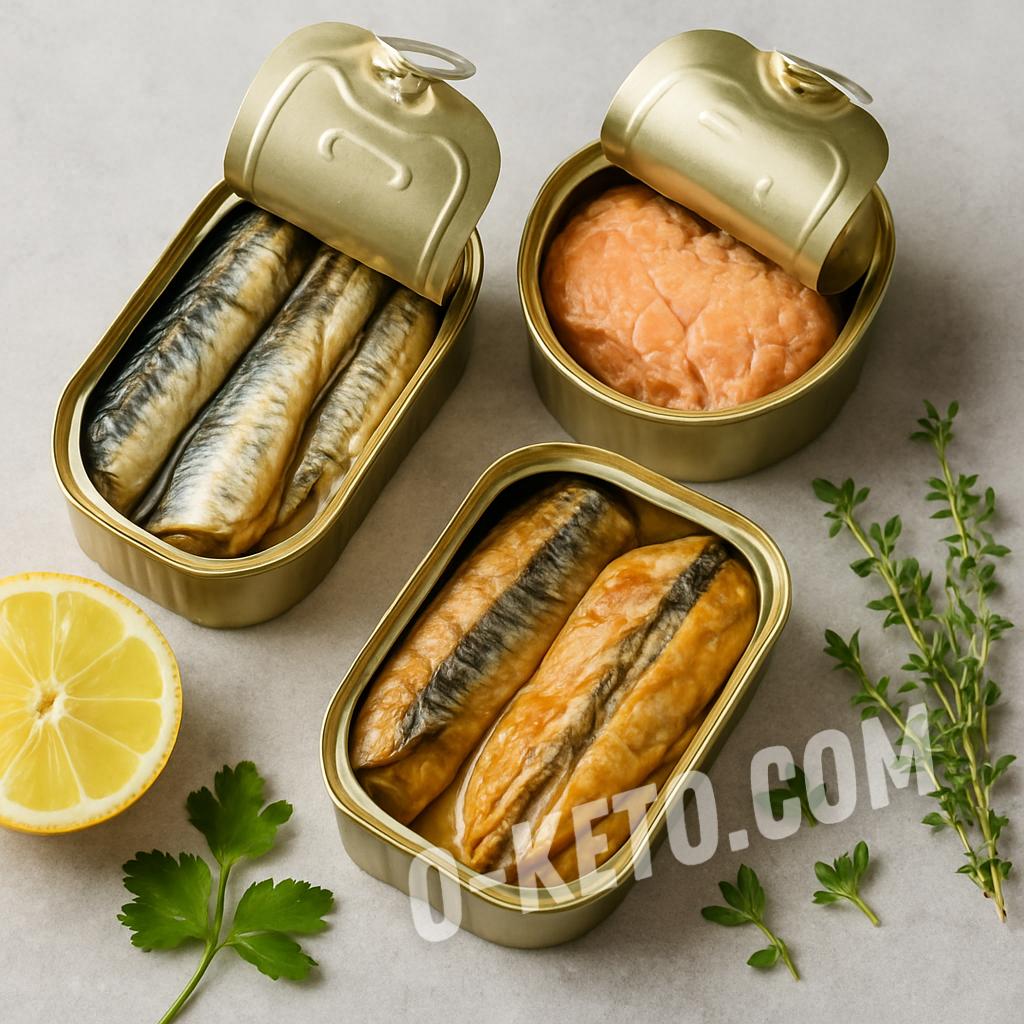
Fatty fish in cans can also retain meaningful omega-3 content. This is especially relevant for mackerel, sardines, salmon, and pink salmon. If someone does not cook fresh fatty fish very often, canned versions can be one of the simplest ways to get EPA and DHA into the routine. That makes them useful not just for shelf life, but for actual dietary quality.
There is another important point that many people miss. When fish is canned with bones and those bones become soft enough to eat, the product can also supply calcium and phosphorus. Sardines are a classic example. In addition, canned fish can still carry vitamin D, vitamin B12, selenium, and iodine. So the idea that the can automatically destroys all nutritional value is simply wrong. The real question is which fish you buy and how carefully you choose the product.
Which canned fish is worth buying first
Sardines, mackerel, salmon, and pink salmon are usually the strongest everyday options. They combine useful protein with better fat quality and often have a simpler identity as products. Sardines are especially attractive if you want calcium from softened bones. Mackerel is helpful for people who want a richer, fattier fish. Salmon and pink salmon are often easier for people who prefer a milder taste and want something flexible for salads, spreads, patties, or quick hot dishes.
Tuna deserves a more careful approach. It is convenient and high in protein, but the species matters. For more regular use, light tuna or skipjack is usually preferred over larger, higher-mercury options. That does not mean tuna must be avoided, only that it should not be the only fish in the pantry. Rotating it with sardines, mackerel, and salmon is a more balanced strategy.
Pregnant and breastfeeding people, as well as children, should be especially careful to choose fish with lower mercury levels and limit species that accumulate more mercury. This does not mean avoiding all fish: a safer pattern is to vary species and not make bigeye or bluefin tuna, shark, swordfish, or king mackerel a regular staple.
How to read the ingredient list instead of the front label
A strong basic ingredient list is simple: fish, water or its own juice, and salt. Fish packed in oil can also be a good option, but then it becomes important to look at the type and amount of oil. If the goal is fish first and not a heavily engineered sauce, shorter and clearer is usually better. Long lists full of flavor enhancers, added sugar, starch, and vague stabilizers should make you cautious.
The wording on the can also matters. If the product is labeled in a vague way, something closer to a generic “fish product” than a clearly named species, that is already a warning sign. For everyday use, it is better when the species is stated plainly and the product identity is obvious.
Tomato sauce is another detail worth checking carefully. Tomato itself is not the problem, but many tomato-based fish products contain added sugar. The same is true for sweet marinades, glossy sauces, and strongly seasoned fillings. For keto or lower-carb eating, fish in water, its own juice, or a decent oil is usually much easier to work with. You can always add your own vegetables, herbs, eggs, or mayo at home rather than paying for a sugary factory sauce.
What matters with home-preserved fish
If the topic is not a store-bought can but fish preserved at home, the logic changes a little. Then it is not only the species that matters, but also how clean the jars were, how much oil and salt went into the batch, whether the jar was overloaded with vegetables or sweet sauces, and whether the heating time was long enough. Home fish preserves are safer and clearer when the composition stays simple: fish, salt, a modest amount of oil, bay leaf, pepper, and, if needed, a tomato or acidic element without sugar.
Fish preserved in oil at home can be convenient because the oil helps the pieces stay juicier and reduces direct contact with air inside the jar, but it should not be poured in recklessly. Spices should support the fish rather than hide doubtful raw material. If a home jar has too much sweet tomato base, suspiciously watery liquid, cloudy oil, or fish packed so tightly that it released almost no natural juices, that preserve should not be considered successful just because the lid sealed.
What to inspect on the can itself
Even a good ingredient list is not enough if the can is damaged. It should not be swollen, leaking, rusty, or badly dented. A bulging can is a hard stop. Visible seam damage, liquid leaks, or an abnormal smell after opening are also reasons to discard the product. Convenience is never a reason to ignore a basic food-safety risk.
It is also worth checking the production date and overall freshness. Very old stock is not automatically unsafe, but fresher products usually have a better texture and taste. If the packaging gives a clear production standard, a clearer origin, or a more transparent description of processing, that is usually a good sign. Many people also prefer fish from colder, cleaner waters and from producers that identify the product more precisely.
Storage conditions matter too. If the cans spent a long time in heat, under direct sun, or near a strong heat source, that is already not a great sign even when the shelf life still looks normal. For home-preserved fish the rule is even stricter: after cooling, the jars should be kept in a cool dark place, and once opened, any leftovers should be moved quickly to glass or another food-safe container and refrigerated rather than left sitting in an opened tin.
Labeling, Packing Liquid, and Can Defects: What Else Matters
After the ingredient list and the fish species, look closely at the can itself. A bulging lid, leaks, rust around seams, or deep dents are not cosmetic flaws but reasons to skip the product. Cans with a visibly deformed top or bottom deserve special caution because this becomes a safety issue, not only a taste issue.
The packing liquid matters as well. Fish in water or its own juice is usually easier to evaluate for salt and overall composition, while oil-packed products depend heavily on what oil was used. Tomato sauces can be convenient, but they often carry more sugar and thickeners than you want in an everyday low-carb routine.
Clear production labeling is another useful signal. If the can states that the fish was processed at sea or directly from fresh catch, that is often preferable to products made from repeatedly chilled raw material. For tuna, smaller species such as skipjack are usually the safer routine choice because they tend to accumulate less mercury than large bluefin tuna.
When canned fish is especially practical
In real life, canned fish becomes most useful in three situations. First, as a reliable protein backup at home when you do not have time to cook. Second, as a base for salads, spreads, fillings, patties, or quick hot meals. Third, as a way to avoid falling into poor snack choices on busy days.
For keto, this practical role matters a lot. A can of sardines or mackerel, a couple of eggs, some cucumber or greens, and a little olive oil or mayonnaise can become a real meal in minutes. That only works well, however, when the fish itself is not loaded with sugar, starch, or low-quality sauce.
Conclusion
Canned fish can absolutely be useful and nutritious food when you choose it with the same care you would use for fresh fish. Focus on the species, the ingredient list, the packing liquid, the physical condition of the can, and the freshness of the batch. Sardines, mackerel, salmon, pink salmon, and carefully chosen light tuna are usually the safest starting points. The simpler the ingredients and the clearer the product identity, the better the odds that you are buying something genuinely worthwhile rather than just a convenient package.
Sources
- Advice about Eating Fish — U.S. Food and Drug Administration and U.S. Environmental Protection Agency
- Omega-3 Fatty Acids — Health Professional Fact Sheet, National Institutes of Health Office of Dietary Supplements
- Nutrition Information for Cooked Seafood and Canned Seafood with Bones — U.S. Food and Drug Administration
- Shelf-Stable Food Safety — U.S. Department of Agriculture Food Safety and Inspection Service
- Clostridium botulinum and Botulism — U.S. Department of Agriculture Food Safety and Inspection Service
- Dietary Guidelines for Americans, 2020–2025 — U.S. Department of Agriculture and U.S. Department of Health and Human Services