

Cheesecake pops look simple in photos, but in practice they combine several technical tasks at once. The filling must stay creamy enough to taste good, but solid enough to hold a clean shape. The stick must support the dessert without loosening it. The glaze must set quickly, and the frozen dessert itself must keep its geometry without melting before the shell is finished. That is why this format has its own internal mechanics, and those mechanics decide whether the final result looks clean and stable.
The good news is that you do not need professional equipment if you understand the sequence. The mistakes are usually predictable: a filling that stays too soft, a stick inserted at the wrong moment, incomplete freezing, uneven layers, or coating applied before the dessert is ready for it. Once the process is broken into stages, most of these failures become much easier to prevent.
Many of the same rules are useful outside the pop format as well. They help with a classic baked cheesecake, portioned slices, a ganache top, a berry gel layer, and even the final cut. Once you understand when a dessert only needs normal chilling, when it benefits from a short pre-freeze, and when it should simply be left alone until the next stage, the result becomes much more controlled.
What makes a cheesecake pop stable from the start
The foundation of this format is not just flavor but structure. A cheesecake pop mixture has to keep its shape after chilling and especially after freezing. If the filling is too loose, too fatty without support, or too watery, the dessert can look good in the mold and still lose stability the moment it is unmolded or dipped.
That is why it helps to know in advance what gives the recipe its support. It may be gelatin, pectin, agar, cream cheese, ricotta, thick yogurt, chocolate, or a combination of several of those. Fruit layers need the same respect. If they are too watery or not stabilized, they add moisture that later interferes with freezing and coating.
It is useful to think of a cheesecake pop as a layered construction with several strength zones. The base, the creamy filling, the fruit insert, and the glaze all work together. If even one layer is weak, the whole dessert becomes less reliable.
When to insert the sticks and why timing matters
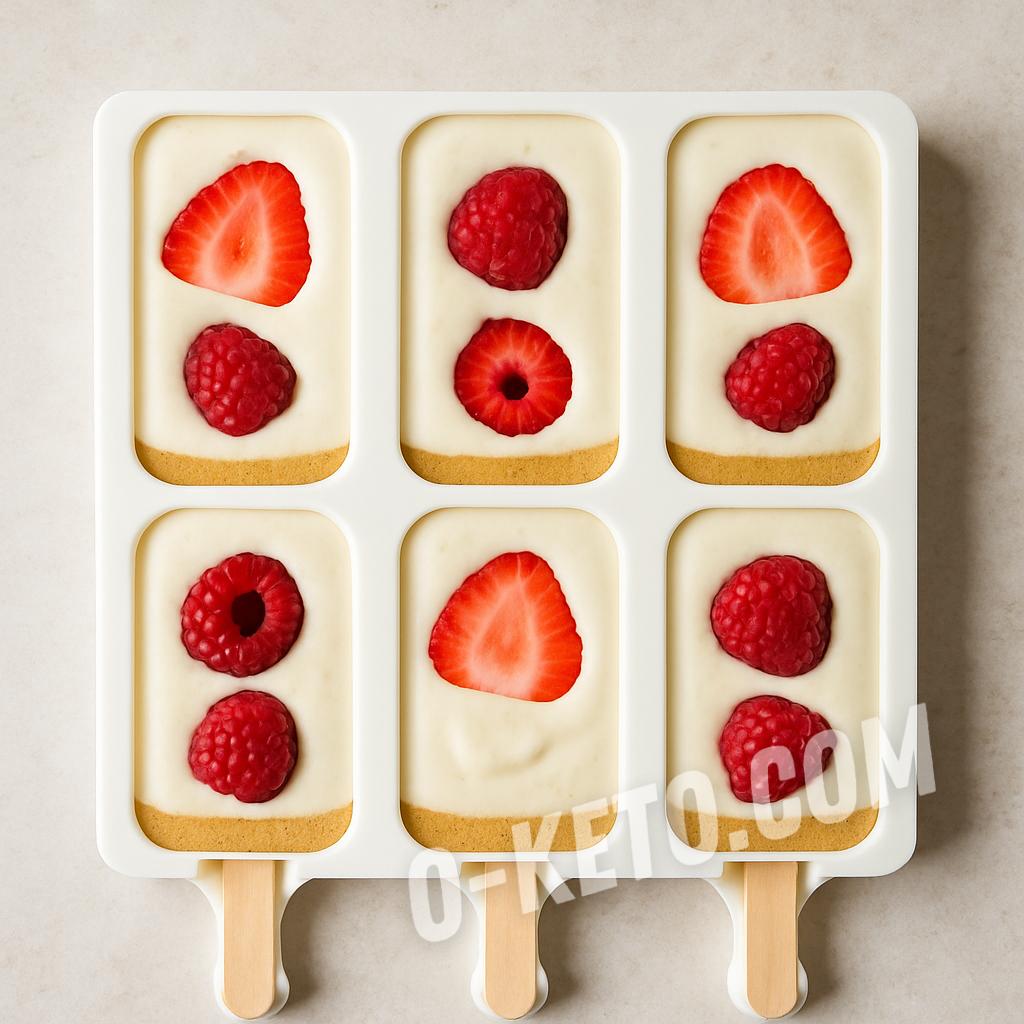
The stick looks like a small detail, but it often determines how easy the later stages will be. If it goes into a completely loose filling, it can shift, tilt, or float upward. If it is inserted too late, when the filling is already close to firm, the mass may crack or the stick may end up off center.
The best moment is usually between those extremes, when the main filling has started to stabilize but is still soft enough to accept the stick cleanly. Then the stick stays centered and grips firmly. This matters even more in taller or heavier pops where a small tilt becomes very visible during glazing.
The stick is best treated as the axis of the whole dessert. It should pass through the most structurally reliable zone. If there is a softer insert in the center, the stick should still be anchored through a denser surrounding layer. That reduces twisting and makes the dessert less likely to slide downward under its own weight.
How to build layers so they do not interfere with each other
In a cheesecake pop, assembly is not only about placing one layer on top of another. Each layer needs its own short stage of stabilization. If a fruit layer is poured over a cream layer that is still too soft, the border becomes blurry. If the base is added while the upper mass is still warm, it may absorb moisture and lose texture. These things become especially obvious in the cut surface.
For that reason, short intermediate chilling stages are often helpful in a home kitchen. Each step does not need to be frozen solid, but letting a layer become steady enough to hold the next one cleanly makes a big difference. It reduces texture smearing and helps keep the straight visual lines that look good after slicing.
When the dessert includes components with very different moisture levels, watch the behavior of the filling, not only the clock. A good intermediate stage is one where a layer no longer flows when the mold is tilted lightly, but still accepts the next layer without cracking. This matters a lot for berry, citrus, or sea buckthorn components that naturally carry more water and acidity.
Why a baked cheesecake is better cooled gradually in the oven
For a classic baked cheesecake, a sudden temperature drop is often more dangerous than the oven itself. While the dessert is still hot, the internal structure remains soft. The proteins and dairy mass are still finishing their set, and the center is usually more delicate than the edges. If the cheesecake is pulled into a cold environment too quickly, the top can crack and the middle can sink sharply.
That is why it often helps to leave a baked cheesecake in the switched-off or slightly open oven for a while. The dessert cools down more gently, and the internal structure has time to settle without shock. This is not a ritual for its own sake. It is simply a way to guide the cheesecake from a hot fragile state into a dense chilled one more safely.
This matters especially in tall cheesecakes and in formulas with a lot of cream cheese, eggs, and cream. The thicker and softer the mass, the more useful gradual cooling becomes. In thinner or smaller formats the risk is lower, but the same principle still applies: a controlled temperature transition is usually safer than a sudden one.
How to freeze the dessert before glazing
Full freezing before coating is not just about making the dessert cold. It is about control. A deeply frozen pop holds its shape better, turns less on the stick, and lets the glaze set almost instantly. If the center is still soft, the shell can crack and the dessert may deform slightly while you are holding it in the air.
In a home freezer it is especially important not to rush. The surface may feel firm after only a few hours, but the center often needs more time to freeze evenly. It is better to allow a full overnight freeze than to try glazing a dessert that is icy outside but still creamy in the middle.
The mold matters too. Silicone is convenient because it releases the dessert gently without heavy pressure. But the softer the mold, the more important full freezing becomes. If the dessert cannot support itself yet, it may bend at the exact moment when it looks almost ready to use.
When simple refrigeration is enough and when a short pre-freeze helps
Not every cheesecake or cheesecake layer needs to go straight into the freezer. If the only goal is to let the mass stabilize before the next gentle layer, normal refrigeration is often enough. Before a berry gel, a light cream, a sour-cream top, or a thin ganache, the dessert often only needs enough chilling to become firm and level, not to turn icy.
The refrigerator is usually enough when the cheesecake already supports itself and the next stage does not apply mechanical stress. If the next step is simply pouring a top layer, smoothing it, and returning the form to the cold, a deep freeze is often unnecessary. In some cases a fully frozen base even creates extra condensation and makes the upper layer harder to spread neatly.
A short pre-freeze helps in different situations: when the cheesecake must be glazed quickly, removed from a soft mold, sliced into especially clean portions, or topped with a denser layer that could press into a soft surface. In that case 20 to 30 minutes in the freezer can provide just enough extra rigidity. The key is to treat pre-freezing as a technical tool, not as an automatic step for every dessert.
Why the cheesecake should stabilize before ganache or a top layer
If ganache, berry gel, caramel, or another finishing layer is added to a cheesecake that is still warm or too soft, the surfaces start pulling on each other. The top can blend into the base, press the center downward, slide toward the edges, or lose a clean border. That is why it helps to let the lower layer stabilize separately before the finish goes on.
In a baked cheesecake this usually means complete cooling after baking followed by several hours in the refrigerator. During that time the filling becomes denser, the top evens out, extra moisture settles, and the surface becomes more suitable for the next layer. This matters especially with ganache. If the cheesecake itself cannot hold its shape, even a well-made ganache will not rescue the final look.
The same logic applies to no-bake cheesecakes. First the creamy layer should set on its own. Only then should a fruit top, jelly, glaze, or thicker cream be added. That approach not only makes the dessert look cleaner, but also improves the later slicing because the layers remain distinct instead of smearing into one soft mass.
What matters during coating and final handling
After the freezer comes the final technical stage. The dessert is removed, briefly stabilized in the refrigerator if needed, dipped quickly into the glaze, and transferred straight onto a cold surface. This stage is much easier when the station has been prepared in advance: the glaze is ready, the tray is cold, and there is already a place for excess coating to drip away.
If the glaze is too thick, it weighs the dessert down and hides the clean inner structure. If it is too thin, the shell becomes weak and may not hold decoration. Final assembly is therefore not only about flavor but also about the balance of temperature and viscosity. Ideally the shell should coat fast, stay thin, and not need later correction.
It is also better not to rush into heavy decoration. Let the base shell set first, then add lines, crumbs, or accents. That reduces the risk of pulling the surface or shifting a layer that has not yet fully stabilized.
Why a warm dry knife gives cleaner slices
Even a well-made cheesecake can be damaged at the final step if it is cut with a cold sticky knife. The creamy center, the glaze, the gel, or the ganache quickly cling to the blade and begin pulling at the next slice. The result is a ragged cut and blurred layer edges.
A warm dry knife works better because it passes through the chilled mass more cleanly and drags less through fatty or gelled sections. In practice it is usually enough to dip the knife into hot water, wipe it dry, and make one clean cut without sawing motions. Before the next slice, it helps to clean and warm the blade again. It seems minor, but this step often separates a messy home cut from a neat pastry-style portion.
This matters most when the cheesecake has a top layer, a berry insert, a chocolate shell, or a firm ganache. The more contrasting textures there are, the more important it becomes not to carry one layer into the next slice. If even a warm knife still crushes the cheesecake, the problem is usually not the knife but insufficient chilling or the need for a short pre-freeze before portioning.
Which mistakes break the format most often
The most common failures come from underestimating the construction itself. People often approach cheesecake pops like ordinary portioned desserts and forget that they must survive a stick, a deep freeze, and a glaze stage. That leads to the classic problems: a filling that is too soft, sticks inserted too early or too late, no intermediate stabilization between layers, and coating applied to a dessert that is not yet fully ready.
Another very common mistake is trying to speed up every stage. In this format, rushing is usually punished. A few extra minutes of chilling between layers and a full freeze before coating save far more time than later attempts to fix tilting, cracks, and messy runoff.
With ordinary cheesecakes the mistakes follow the same logic even if they look different. People rush the exit from the oven, add a top layer too early, slice before the dessert is fully stable, or treat the freezer as a universal answer for every stage. In reality, the best result usually comes not from the coldest possible treatment, but from the right kind of cold at the right moment.
Conclusion
The cheesecake pop format works best when it is built like a structure rather than treated as a decorative serving shape. It needs a stable filling, sticks inserted at the right moment, careful layer-by-layer assembly, and deep freezing before coating. Ordinary cheesecakes follow the same temperature logic: baked ones benefit from gradual cooling, top layers should go on only after separate stabilization, and clean slices are easier with a warm dry knife. When those steps are respected, the shell goes on more cleanly, the cut surface looks neater, and the dessert becomes much more reliable in a home kitchen.