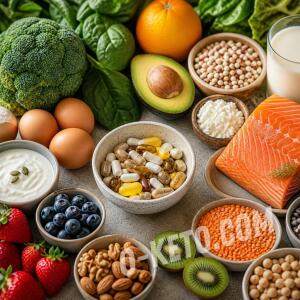




The immune system needs not “magic supplements,” but normal conditions to function. Immune cells must divide, produce antibodies and signaling molecules, maintain the barriers of skin and mucous membranes, control inflammation, and not destroy their own tissues. For all this, proteins, energy, fats, vitamins, and minerals are needed.
If the diet is poor, monotonous, or based on sugar, flour, and ultra-processed products, the immune system may work worse not because it lacks a miracle vitamin. More often, the problem lies in a combination of deficiencies: low protein, low zinc and selenium, low vitamins A, C, D, B group, low magnesium, poor fat balance. Therefore, it is wiser to look not at a single supplement bottle, but at the entire dietary system.
Vitamins and minerals: not stimulants, but working tools of the immune system

The immune system does not need to be “maximally strong” all the time. It needs precision: to recognize a threat in time, activate inflammation, limit damage, and then complete the reaction. Nutrients participate precisely in this precision.
Conditionally, their tasks can be divided as follows:
- maintain the barriers of the skin, respiratory tract, and intestines;
- assist in the maturation and activity of immune cells;
- participate in the synthesis of proteins, antibodies, enzymes, and signaling molecules;
- control oxidative stress and inflammation;
- support energy metabolism in cells.
Supplements can be useful when there is a deficiency, increased need, or limited diet. But they do not replace sleep, protein, normal sugar levels, movement, recovery, and treatment if needed.
Vitamin A: mucous membranes and the first line of defense
Vitamin A is important for epithelial tissues: skin, mucous membranes of the respiratory tract, intestines, and other barriers. These surfaces are the first to encounter the external environment. If the barrier is weak, the immune system has to work in emergency mode more often.
There are two main forms of vitamin A in food. Retinol and retinyl esters come from animal products, while carotenoids come from plant sources. For keto and LCHF, animal sources are especially convenient: liver, cod liver, eggs, butter, fatty fish. Plant carotenoids are also beneficial, but their conversion to active vitamin A varies among individuals (overall, the conversion rate is extremely low).
With vitamin A, moderation is important. Prolonged excess of retinol from supplements can be toxic, especially during pregnancy. Therefore, high doses without indications are a bad idea, while food sources and a reasonable assessment of the diet are usually safer.
Vitamin D: immune regulation, not just bones
Vitamin D is known for its role in bones, calcium, and phosphorus, but it also participates in immune regulation. For immunity, it is not the mere fact of taking a supplement that is important, but the normal status of vitamin D in the body. A person with a deficiency and a person with a good level of 25(OH)D will have different tasks.
Food sources of vitamin D are limited: fatty fish, cod liver, eggs, animal fats that have received enough sunlight. Therefore, many people’s levels depend on sunlight, season, body mass, age, gastrointestinal diseases, and supplement intake.
Practically, it is better not to take vitamin D blindly for months in high doses. It is wiser to focus on the analysis of 25(OH)D, diet, sunlight, and accompanying nutrients: magnesium, calcium, phosphorus, and vitamin K2. Magnesium is needed for vitamin D metabolism, while calcium and phosphorus are necessary for mineral metabolism.
Vitamin C: antioxidant protection, collagen, and immune cells
Vitamin C participates in antioxidant protection, collagen synthesis, leukocyte function, and tissue repair. It is water-soluble and does not store in the body like fat-soluble vitamins, so regular intake from food is important.
On a low-carbohydrate diet, vitamin C can be obtained not only from sweet fruits. Suitable sources include:
- bell peppers, greens, broccoli, and cauliflower;
- sauerkraut and other fermented vegetables without sugar;
- lemon juice, berries in moderation;
- liver and some offal as part of a nutrient-dense diet.
Vitamin E and Omega-3: membrane protection and inflammation balance
Immune cells are living cells with membranes, receptors, and signaling systems. Fats are important for them. Vitamin E helps protect membrane lipids from oxidative damage, while Omega-3 fatty acids EPA and DHA participate in regulating inflammatory mediators.
This does not mean that the more oil or capsules, the better. Balance is important. If the diet contains a lot of industrial oils with excess Omega-6 and little fatty fish, the inflammatory background may shift in the wrong direction. If the diet includes fatty sea fish, eggs, meat, offal, olive oil, butter, and less ultra-processed oils, the situation is usually better.
Sources to consider include:
- EPA and DHA: sardines, herring, mackerel, wild salmon, cod liver, quality fish oil;
- vitamin E: nuts, seeds, avocado, olive oil, products with natural tocopherols;
- phospholipids: egg yolks, caviar, fatty fish, lecithin.
B vitamins: energy, cell division, and antibodies
For immunity, it helps to think less about “B vitamins in general” and more about the actual jobs inside the chain. Vitamin B6 supports protein metabolism and immune-cell maturation, folate and B12 are needed for the division of rapidly renewing cells, and riboflavin supports enzyme systems involved in energy production and tissue repair.
In real life, deficiencies in this group usually come not from one missing superfood, but from gut issues, alcohol, a very monotonous diet, or chronic under-eating. So when infections recur, mucous membranes crack easily, recovery is slow, or appetite is poor, it makes sense to look beyond vitamin D alone and consider B12, folate, B6, protein intake, and overall nutrient density.
The immune response is energy-intensive. Cells need to divide quickly, synthesize proteins, enzymes, antibodies, and signaling molecules. Therefore, B vitamins are important not as “energy boosters,” but as cofactors for normal metabolism.
B6, B9, and B12 are often mentioned in the context of immunity. They are related to blood cell maturation, methylation, the nervous system, and normal cell division. A deficiency of B12 or folate may manifest not only as fatigue but also as changes in blood, mucous membranes, and recovery.
Good sources of B vitamins include meat, fish, eggs, liver, offal, seafood, greens, nuts, and seeds. On a keto diet, the deficiency of B vitamins is often not related to low carbohydrate intake itself, but to a monotonous diet consisting of just cream, cheese, and “keto desserts.”
Zinc: immune cells, skin, and protein metabolism
Zinc really does matter for immunity, but that does not mean high-dose supplements should be taken for months without thinking. Long-term excess supplemental zinc can interfere with copper absorption and create new problems of its own, from nausea and poor appetite to a secondary micronutrient imbalance.
If the diet is already limited and a supplement already contains zinc, it is usually smarter to review the full intake pattern and duration first rather than automatically raising the dose. The immune system benefits more from steady adequacy than from big swings in one direction.
Zinc is needed for the activity of many enzymes, protein synthesis, cell division, and the repair of skin and mucous membranes. Therefore, it often becomes the center of discussions about immunity. But zinc does not work separately from protein, copper, vitamin A, and overall nutrition.
The best food sources of zinc are oysters, red meat, offal, seafood, and eggs. Plant sources also exist, but phytates in grains, legumes, nuts, and seeds can significantly reduce absorption.
A typical mistake with zinc supplements is taking high doses for too long. Excess zinc can interfere with copper metabolism and create new problems over time. Therefore, long-term intake is better linked to tests, diet, and a clear reason.
Selenium: glutathione enzymes and thyroid
With selenium, balance matters. It is needed for antioxidant enzymes and thyroid function, but the distance between too little and chronically too much is not unlimited. That is why the idea that “more selenium is always better for immunity” is misleading.
This matters even more when someone both eats selenium-rich foods and takes a separate supplement. In that situation, the better strategy is to account for the total background exposure rather than stacking sources and turning prevention into chronic excess.
Selenium is part of selenoproteins, which include antioxidant defense enzymes. It is also important for the thyroid gland, and thyroid hormones influence energy, body temperature, recovery, and metabolism.
Selenium sources depend on soil and animal nutrition. In the diet, these include fish, seafood, meat, eggs, offal, and sometimes Brazil nuts. However, with Brazil nuts, it is easy to overdo it, as their selenium content is highly variable, and besides selenium, they may contain many harmful heavy metals.
Selenium is an example of a nutrient where “a little more” is not always better. It has an upper safe limit, and excess can cause unpleasant symptoms. Therefore, selenium is good as part of nutrition and targeted correction of deficiency, not as an endless “immune” supplement.
Magnesium, calcium, potassium, and phosphorus: electrolytes and energy
Immunity depends not only on rare trace elements. Macronutrients are also important because cells live in an electrical and chemical environment. Membrane potential, muscle contraction, nervous system function, mitochondria, water balance, and enzymes are tied to minerals.
| nutrient | role in the body | food sources |
| magnesium | energy metabolism, nervous system, vitamin D metabolism, muscle relaxation | greens, nuts, seeds, cocoa, mineral water, seafood |
| calcium | bones, muscles, nerve transmission, cell signaling | fish with bones, fermented dairy products, greens, bone broths as part of the diet |
| potassium | water balance, heart, neuromuscular conductivity | avocado, greens, mushrooms, fish, meat, celery, parsley root |
| phosphorus | ATP, phospholipids, bones, energy metabolism | eggs, fish, meat, caviar, liver, dairy products |
On a low-carbohydrate diet, electrolytes are especially important in the first weeks: excess water is lost, insulin changes, and along with water, sodium and some minerals are lost more easily. Therefore, weakness, headaches, and “keto flu” are often related not to a lack of sugar, but to electrolytes and adaptation.
Iron: an important but not universal nutrient for immunity
Iron is needed for hemoglobin, oxygen exchange, enzymes, and normal energy. But in the context of immunity, it cannot be treated roughly. The body knows how to limit available iron during inflammation because iron is associated with oxidative stress and the growth of certain microorganisms.
Therefore, iron is not a supplement to take “for immunity” without tests. Low ferritin, anemia, high CRP, changes in MCV, transferrin saturation, and symptoms require different interpretations. Sometimes a person really needs to replenish iron deficiency. Sometimes ferritin is elevated due to inflammation and does not indicate good reserves.
In the diet, it is better to obtain iron from red meat, liver, offal, fish, and seafood. Iron supplements should only be taken when it is clear what exactly is being corrected.
How to build a diet for immunity without chaos
Instead of a long list of capsules, one can start with a plate. A nutrient-dense diet usually addresses more issues than a set of supplements against a poor diet.
A practical foundation might look like this:
- sufficient protein from meat, fish, eggs, seafood, cottage cheese, or other tolerated sources;
- fatty fish or seafood several times a week;
- eggs, liver, offal, or other foods with high vitamin density;
- greens, low-carbohydrate vegetables, fermented vegetables without sugar;
- nuts, seeds, avocado, and quality fats without excess industrial oils;
- control of sugar and starch if they provoke glucose spikes, hunger, and inflammatory background.
If there are frequent infections, poor recovery, hair loss, weakness, cracks at the corners of the mouth, bleeding gums, cramps, severe fatigue, or chronic gastrointestinal problems, it is better not to guess supplements. In such cases, it is more beneficial to assess nutrition, sleep, stress, protein, gastrointestinal health, and basic tests.
Conclusion
For immunity, vitamins A, D, C, E, B group, zinc, selenium, magnesium, calcium, potassium, phosphorus, omega-3, and complete protein are important. But the point is not to take everything at once. The point is to eliminate deficiencies and provide the immune system with normal conditions for precise functioning.
The best immune diet is not a sterile list of “allowed” foods, but a diverse, nutrient-dense diet: fish, meat, eggs, offal, seafood, greens, vegetables, fermented products, quality fats, and minimal sugar. Supplements can complement this system but should not replace it.
Sources
- Dietary Supplements for Immune Function and Infectious Diseases — National Institutes of Health, Office of Dietary Supplements
- Vitamin A and Carotenoids — National Institutes of Health, Office of Dietary Supplements
- Vitamin D — National Institutes of Health, Office of Dietary Supplements
- Selenium and immune function: a systematic review and meta-analysis of experimental human studies — Advances in Nutrition
- Vitamin C and Immune Function — National Institutes of Health, Office of Dietary Supplements