


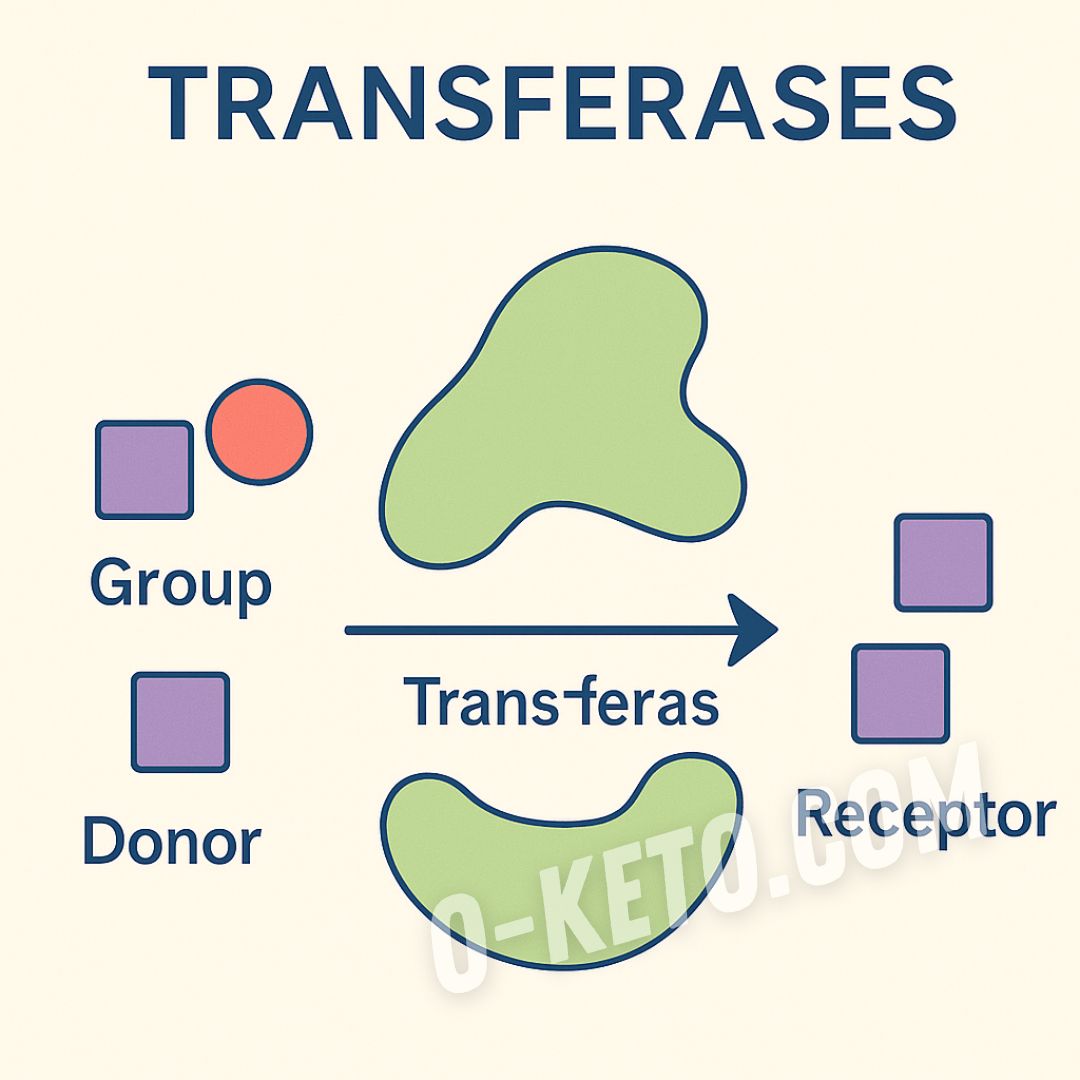

Transferases are enzymes that catalyze the transfer of functional groups (methyl, acyl, phosphate, etc.) between molecules.
They play a central role in metabolism, participating in the synthesis and breakdown of proteins, carbohydrates, and lipids, as well as in detoxification processes.
As a result, transferases ensure homeostasis and the normal functioning of cells. Changes in their activity serve as important diagnostic markers of the body’s condition.
Key Functions
- participation in the synthesis and breakdown of amino acids, carbohydrates, and lipids;
- regulation of energy metabolism;
- participation in DNA methylation processes and gene regulation;
- detoxification and neutralization of toxins.
Classification
Transferases are classified by the type of group being transferred:
- aminotransferases – transfer amino groups, participate in nitrogen metabolism;
- methyltransferases – transfer methyl groups, regulate epigenetic processes;
- glucosyltransferases – transfer glucose residues, participate in glycogen synthesis;
- phosphotransferases – transfer phosphate groups, important for cell energy.
Role in Metabolism
Transferases regulate key biochemical processes:
- amino acid metabolism – ensure the synthesis and utilization of proteins;
- carbohydrate metabolism – participate in glycolysis and gluconeogenesis;
- lipid metabolism – influence the synthesis and breakdown of lipids;
- synthesis of nucleotides – necessary for DNA and RNA replication.
Importance for Health
The activity of transferases reflects the condition of organs and systems:
- ALT (alanine aminotransferase) and AST (aspartate aminotransferase) serve as markers of liver health;
- glutathione S-transferase participates in protection against toxins and free radicals;
- increased activity may indicate inflammation or tissue damage;
- decreased activity is associated with vitamin deficiencies (e.g., B6) and metabolic disorders.
Enzymes used in therapy
Below are examples of enzymes from this class that are used in the treatment of various diseases:
Pathologies Associated with Altered Activity
With increased activity:
- hepatitis and cirrhosis;
- fatty liver disease;
- inflammatory and tumor processes.
With decreased activity:
- vitamin B6 deficiency;
- muscle diseases (myopathies);
- decreased protein and energy synthesis.
Diagnosis
The determination of transferase activity is conducted through biochemical blood tests.
The most common indicators include:
- ALT and AST – markers of liver and heart condition;
- enzymatic tests and spectrophotometry for assessing activity;
- immunochemical methods – for refined diagnostics.
Thus, transferases are not only key participants in metabolism but also important diagnostic indicators that help identify pathologies at early stages and adjust treatment.
Why transferases are especially important in practical medicine
Transferases are one of the most practical enzyme classes because liver tests, methylation, detoxification, and growth signaling all run through them. If oxidoreductases are more about electron transfer, transferases are about moving functional groups correctly, without which the cell loses part of its ability to regulate metabolism in an orderly way.
That is why this class becomes relevant at the same time in hepatology, neurology, oncology, and nutritional medicine. ALT and AST, COMT, glutathione-S-transferases, DNA methyltransferases, and many kinases all sit here.
Connection with methylation, neurotransmitters, and detoxification
Methyltransferases and COMT are especially important in practice. They participate in methyl-group transfer, catecholamine inactivation, and epigenetic regulation. When these processes are inefficient, a person may experience poorer stress tolerance, mood instability, stronger reactions to stimulants, and an unfavorable homocysteine profile.
Glutathione-S-transferases form another key direction. They help make toxins more water-soluble and easier to eliminate. That is why this branch of the system may become a bottleneck under toxic burden, inflammation, or inadequate sulfur-amino-acid supply.
What supports normal transferase activity
Different transferases need different cofactors, but in practice attention often goes to vitamin B6, folate, B12, riboflavin, magnesium, choline, methionine, and overall protein status. Without them, the cell has a harder time transferring amino groups, methyl groups, and phosphate residues at the needed speed and precision.
The practical takeaway is this: if ALT/AST are elevated, methylation looks impaired, stimulants are poorly tolerated, detox capacity seems low, or medications provoke exaggerated responses, transferases are worth viewing not as an abstract class but as a central hub of biochemical adaptation.