


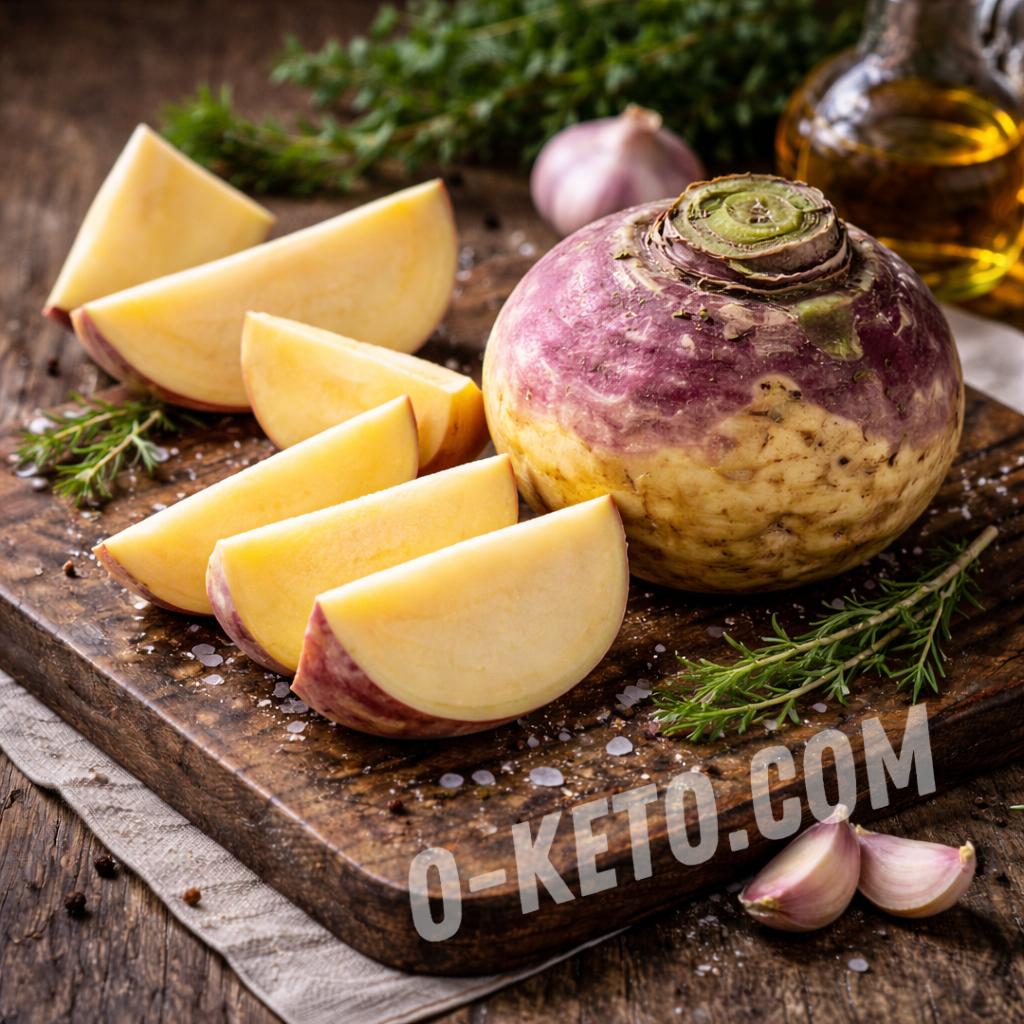

Swede, also called rutabaga in many countries, is a firm root vegetable from the cabbage family. Its flavor sits somewhere between turnip, young cabbage, and an unsweet carrot: mildly sweet, slightly peppery, and dense enough to keep its shape during stewing and roasting. In Northern and Eastern European cooking it has long been used in soups, stews, mash, baked dishes, and simple side dishes for meat.
For a low-carb diet, swede is not as unrestricted as leafy greens, zucchini, or cucumber. It contains a noticeable amount of carbohydrates, but it is still less sweet and less starchy than potato. That makes it a portion-controlled root vegetable rather than a base for the whole plate: useful in a side dish, stew, or mash when you want density and flavor without the heaviness of potatoes.
Nutritional value
Raw swede usually provides about 35–40 kcal per 100 g. It contains little protein and almost no fat, while most of its energy comes from carbohydrates. On average, 100 g contains 8–9 g of carbohydrates and about 2 g of fiber. Exact values vary with variety, maturity, and storage conditions: large older roots are often denser and sweeter, while younger ones may be juicier and milder.
Swede contains vitamin C, small amounts of B vitamins, potassium, calcium, magnesium, and phosphorus. As a cruciferous vegetable, it also contains glucosinolates, the plant compounds that give a cabbage-like note to the flavor. During long boiling, some water-soluble compounds move into the cooking liquid, which is fine for soup. For a side dish, roasting, steaming, or stewing often keeps the taste more concentrated.
Fits keto and LCHF
Swede can fit LCHF and moderate keto eating when the portion is measured. A practical serving is about 70–120 g cooked as part of a meal, especially alongside meat, fish, eggs, poultry, butter, or another fatty component. A large bowl of mash made only from swede can bring too many carbohydrates for a strict keto day.
If your daily carbohydrate target is very low, it is better to mix swede with cauliflower, celeriac, or zucchini instead of serving it as a large standalone portion. This keeps the root-vegetable flavor while making the total carbohydrate load of the plate easier to manage. If you track glucose after meals, test your own response to your portion and cooking method.
How to cook
Swede has a tough skin, so it is usually peeled with a knife and then cut into cubes, slices, or sticks. Smaller pieces cook faster. For mash, cook the pieces in water or steam until completely tender, then mash with butter, salt, pepper, and a little cream. The flavor becomes softer if part of the swede is replaced with cauliflower.
For roasting, toss the pieces with fat, salt, garlic, thyme, rosemary, or smoked paprika, then cook until the edges brown. In stews, swede tolerates long cooking with beef, lamb, poultry, mushrooms, and broth. In soups it adds body and does not fall apart as quickly as potatoes, so it should go into the pot before more delicate vegetables.
Pairings
Swede works best with rich ingredients. Good partners include butter, ghee, sour cream, heavy cream, bacon, brisket, beef, duck, chicken, porcini mushrooms, onion, garlic, mustard, thyme, rosemary, bay leaf, and black pepper. A little acidity also helps: apple cider vinegar, lemon juice, or fermented vegetables make the natural sweetness of the root less flat.
Raw swede is used less often in salads, but it can be grated finely and mixed with radish, cabbage, herbs, and a thick dressing. In this form the flavor is sharper and more cabbage-like, so a small portion usually works better. For a calmer side dish, cooking is usually the more pleasant option.
How to choose and store
A good swede feels heavy for its size, firm, and free from soft patches, cracks, mold, or a strong fermented smell. Very large roots can be fibrous, so medium ones are often easier for home cooking. The skin may be yellowish, purple, or greenish near the top; color matters less than firmness and a fresh cut surface.
Whole swede keeps well in a cool dark place or in the vegetable drawer of the refrigerator. Once cut, it should be wrapped and used within a few days: the cut surface dries out and the aroma becomes sharper. Cooked mash or stewed swede should be stored in a closed container in the refrigerator and reheated gently with a little butter or broth.
Substitutes
For a similar role in a side dish, use turnip, celeriac, a small amount of parsnip, or a mixture of cauliflower with a little carrot. For stricter keto, cauliflower, zucchini, or daikon are usually easier choices because they tend to bring fewer carbohydrates. In stew, swede can be replaced by celeriac or turnip, but the flavor will change: celeriac is more aromatic, turnip is sharper, and cauliflower is milder and more neutral.


