


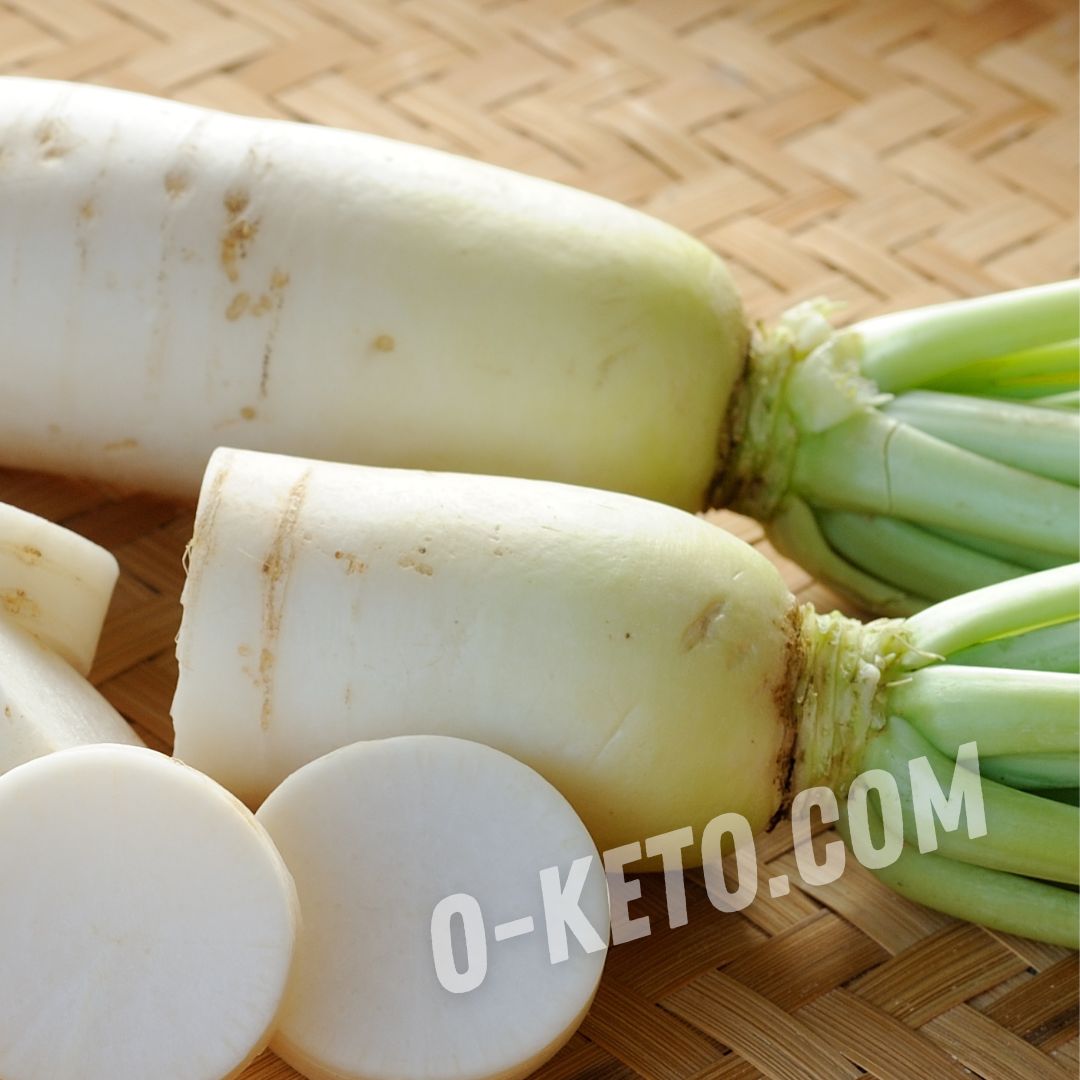

Daikon is a large white radish with juicy crisp flesh and a milder flavor than black radish or sharp red radishes. It is eaten raw, pickled, added to salads, soups, meat and fish dishes, and used as a fresh side in Japanese, Korean, Chinese and everyday European cooking. For keto and LCHF, daikon is convenient because it provides volume and crunch with a low carbohydrate load.
Daikon contains vitamin C, B vitamins, potassium, magnesium and fiber. These components do not make it a special functional food, but they help explain why daikon differs from starchy root vegetables. Unlike potatoes, sweet potatoes or parsnips, it remains watery, light and lower in carbohydrates.
Nutrition
Per 100 g of daikon, common values are about 18 kcal, 1.1 g of protein, 0.1 g of fat and around 4.1 g of carbohydrates. The glycemic index is often listed around 15, and glycemic load around 0.6. This makes daikon one of the more convenient root vegetables for a carbohydrate-controlled diet.
- Calories: about 18 kcal per 100 g;
- Protein: about 1.1 g;
- Fat: about 0.1 g;
- Carbohydrates: about 4.1 g;
- Glycemic index: about 15;
- Glycemic load: about 0.6.
The main role of daikon is not protein or fat, but juicy volume, freshness, fiber and mild sharpness. It can be used when crunch is needed without bread, croutons, sweet vegetables or a starchy side dish.
Is It Keto-Friendly?
Fresh daikon usually fits keto well by carbohydrates. A 50-150 g serving gives noticeable volume to a salad or side dish while staying much lighter in carbohydrates than most starchy roots. On strict keto, the portion is still worth counting, especially if the dish also includes onion, carrot, sauces or dairy.
In LCHF, daikon can be used more flexibly: in salads, cold appetizers, soups, quick stir-fries and sugar-free pickles. It pairs well with fatty foods because its fresh sharpness balances oil, meat, fish, eggs, cheese and mayonnaise-based sauces.
The main trap is ready-made pickled daikon. Japanese and Korean versions often contain sugar, rice syrup, sweet vinegar or sweetened brine. Such a product should be judged by the label, not by the word “daikon” alone.
How to Use It
Raw daikon can be cut into thin strips, grated, shaved into ribbons or diced. If the flavor seems too sharp, sliced daikon can be kept briefly in cold water, lightly salted or mixed with a fatty dressing. In hot dishes it becomes softer and resembles a neutral root vegetable, but without the density of potatoes.
Practical options include:
- daikon salad with cucumber, greens, sesame and oil;
- thin strips next to fish, meat or eggs instead of a bread-based side;
- daikon in broth or soup instead of part of the potatoes;
- a quick stir-fry with meat, mushrooms or cabbage;
- a sugar-free marinade with vinegar, salt, spices and a little oil.
How to Choose and Store
Choose a firm heavy root without soft spots, cracks, mold or wet patches. The skin should be even, and the cut surface juicy, without gray cavities or a harsh unpleasant smell. Very large daikon can be fibrous, so medium roots are often easier for salads.
Store daikon in the refrigerator, away from strongly aromatic foods. If it has green tops, remove them: they pull moisture from the root faster. Cut daikon should be wrapped or placed in a container because it dries out quickly and transfers odor.
Substitutes
If similar crunch is needed, radish, red radishes, cucumber, kohlrabi, celery stalks, cabbage or turnip in a moderate serving can work. If a mild base for soup is needed, cauliflower, zucchini or a little celeriac may fit. The substitute depends on the dish: in salad, crunch matters; in soup, shape and texture matter.
If daikon is replacing a starchy side dish, it is better not to swap it for sweet carrot or potatoes. In a low-carb plate, its job is to provide volume and freshness without taking a large part of the daily carbohydrates.
Raw, Cooked and Pickled Daikon
Raw daikon gives the most crunch and fresh sharpness. It is best sliced thinly and dressed close to serving because salt quickly draws out juice. For a milder flavor, the slices can be placed in cold water for a few minutes, then dried and mixed with oil, vinegar, sesame or sugar-free mayonnaise.
In hot dishes, daikon becomes calmer: sharpness fades and the flesh turns tender, though it stays more watery than potato. For keto pickling, use vinegar, salt, spices and a sugar-free sweetener if needed; ready yellow pickles and Korean appetizers should always be checked by ingredients.


