


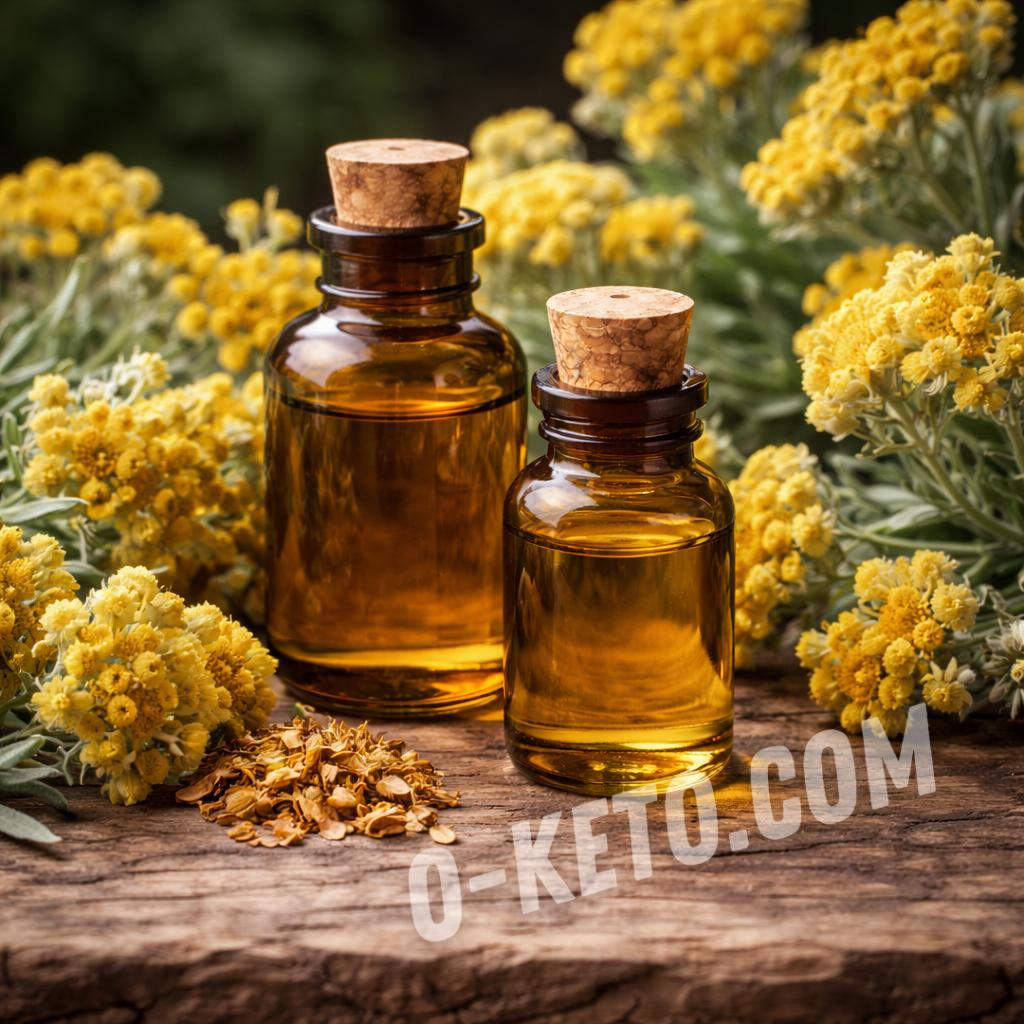

Italian immortelle essential oil is obtained from the flowering tops of Helichrysum italicum by steam distillation. It is an expensive and aromatically complex oil: yield is low, harvesting depends on region and season, and the scent is quite different from common herbal oils. The aroma usually has warm dry, herbal, honeyed, slightly tobacco-like, and balsamic nuances.
Italian immortelle grows in sunny rocky Mediterranean areas, including Italy, Corsica, France, the Balkans, and other coastal regions. The dried flowers keep their color and shape for a long time, but the essential oil is made from fresh or properly prepared plant material. This is a concentrated aromatic product, not an herbal infusion and not a culinary oil.
Aroma And Composition
The oil profile depends on origin and batch. It may contain neryl acetate, gamma-curcumene, alpha-pinene, sesquiterpenes, italidiones, and other volatile components. This is why one bottle may smell more honeyed and soft, while another can be dry, spicy, and almost mineral.
Good oil smells clean, warm, herbal, and slightly balsamic. A rancid, sour, musty, or solvent-like note is a reason not to apply it to skin or use it in blends. Because immortelle is expensive, it is often stretched or replaced with fragrance materials, so the botanical name and producer reputation matter.
Is It Suitable For Keto
For keto and LCHF, this is not a dietary fat source. Immortelle essential oil is not used as a dressing, not added to food, and not counted as a macronutrient. If the bottle has no specific food-use labeling and exact instructions, it should not be taken internally.
In practice, the product belongs to aromatic and cosmetic ingredients. It may be used in oil blends, creams, perfume compositions, a diffuser, or targeted aromatic formulas, but only with attention to concentration and individual tolerance.
How To Use
Because of its intensity and price, the oil is usually added by the drop, not for volume. In aromatic blends, immortelle combines well with lavender, frankincense, neroli, cypress, chamomile, rose, sandalwood, cedarwood, and soft citrus oils. It gives a warm dry depth and can smooth overly sharp herbal notes.
For skin, it is first diluted in a carrier oil, cream, or another base. Small test batches are useful: they make it easier to judge the aroma, texture, and skin response. Undiluted oil should not be applied to the face, mucous membranes, the eye area, or freshly irritated skin.
In home cosmetics, immortelle is most often used in face and body blends at very low concentration. It fits formulas with jojoba oil, squalane, almond oil, rosehip oil, or a neutral cream without a strong fragrance.
How To Choose
The label should include Helichrysum italicum, plant part, extraction method, country of origin, volume, expiry date, and intended use. It is useful when the producer lists the batch and main analysis components. Names such as “immortelle fragrance” or “helichrysum aroma oil” may indicate a fragrance oil rather than a natural essential oil.
Choose a dark glass bottle with a dropper and a tight cap. A very low price for immortelle is suspicious: natural oil is usually expensive. If the product is intended for cosmetics, dilution advice, warnings, and the absence of aggressive marketing claims matter.
Limits
The essential oil is concentrated and may irritate skin, eyes, and airways. A patch test is needed before first use. Pregnancy, childhood, sensitive skin, allergy to plants in the daisy family, and regular medication use are reasons to discuss use with a qualified professional.
If burning, itching, redness, or headache from the scent appears after use, wash the blend off and do not use it again at that concentration. In a diffuser, use it briefly and moderately: the dense aroma fills a room quickly.
How To Store
Keep the bottle tightly closed, away from light, heat, and a damp bathroom. After opening, it is convenient to write the date on the bottle. Expensive oils are better bought in small volume if used rarely, so the aroma is less likely to change before the bottle is finished.
What To Use Instead
Immortelle has no exact replacement. For warm balsamic depth, use frankincense, sandalwood, or cedarwood; for a soft floral-herbal side, lavender, chamomile, or neroli; for a dry Mediterranean nuance, cypress or a small amount of rosemary. The blend should be adjusted to the goal because these oils do not match one to one.


