


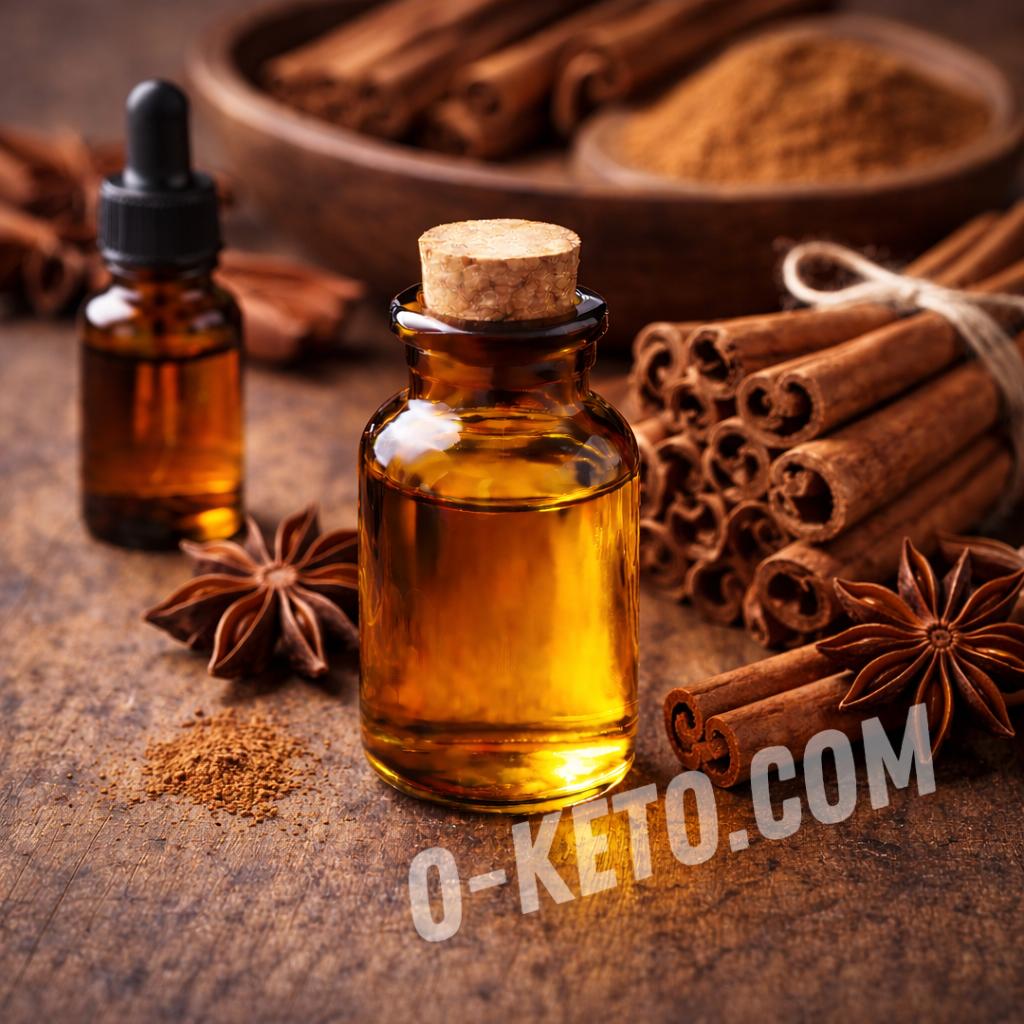

Cinnamon bark essential oil from Cinnamomum zeylanicum is one of the richest and sharpest aromatic concentrates. It is obtained by steam distillation of the bark, which gives it a warm, sweet-spicy, woody, and very persistent scent. It is not powdered cinnamon and not an oil to consume by the spoonful. In practical use it contributes almost no macros, because the dose is measured in drops, not grams.
This oil has an important feature: it feels much more intense than most kitchen aromas. Where ground cinnamon gives soft spice and a hint of sweetness, the essential oil can quickly become hot, intrusive, and irritating. For home cooking, body-care blends, and room scenting, it requires accurate dosing and strict dilution.
Composition and aroma
The main aromatic component of cinnamon bark oil is cinnamaldehyde; in bark material its share can be high, often listed around 60–75%. Eugenol, limonene, benzoates, and other phenolic compounds may also be present. This profile is why the oil is perceived as “hot” and very strong.
Cinnamon bark oil and cinnamon leaf oil are not the same product. Bark oil is usually sweeter, denser, and closer to familiar dessert cinnamon. Leaf oil is often rougher and more connected with eugenol. In recipes and blends, these products should not be swapped automatically: scent strength, irritation risk, and suitable concentration may differ.
Is it suitable for keto?
From a carbohydrate perspective, cinnamon essential oil has almost no effect on keto, but it is not a fat source for LCHF either. Its role is aroma. In keto desserts, the cinnamon note can pair with cream, cocoa, coffee, vanilla, almond flour, cream cheese, a small serving of pumpkin, and sugar-free sweeteners. In savory dishes it is used more cautiously: with meat, creamy sauces, marinades, and spiced drinks.
For food, use only a product clearly marked for food use. Aromatic oils sold for diffusers, bath blends, or cosmetics should not be added to dishes. Even food-grade oil does not replace ground cinnamon one for one. If you need cinnamon flavor in baking, a drink, or a cream, powder or a cinnamon stick is often the better choice: dosing is easier, flavor is softer, and the risk of ruining a batch is lower.
How to use it
The main rule is dilution first, then adding. One drop can be mixed into several teaspoons of neutral oil, alcohol-based extract, or another suitable base, and then only part of that mixture is used. Do not drop the oil directly into a small cup of cream or a drink: even one drop may be too strong. This is especially noticeable in cold dishes, where aroma spreads more slowly.
For room scenting, cinnamon oil is also used minimally. One drop in a blend with orange, mandarin, cedar, vanilla, clove, or cardamom is often enough. Long diffusion, a small room, children, pets, and sensitive airways are reasons for extra caution.
Where it fits
Cinnamon aroma works where a warm spicy note is wanted: sugar-free coffee cream, rich cocoa drink, almond cookies, creamy glaze, spiced tea, pork marinade, duck sauce, or a winter room blend. With fish, delicate seafood, and light green sauces it is usually too heavy.
Limits
Cinnamon essential oil is an irritating concentrate. Do not apply it to skin undiluted, use it near eyes or mucous membranes, leave it within reach of children, or take it internally without food-use labeling. Pregnancy, breastfeeding, childhood, a tendency to skin reactions, asthma, seizure conditions, regular medication use, and elevated blood pressure are situations where a qualified professional should be consulted before use.
For skin, cinnamon oil is suitable only in very weak dilution in a carrier oil and after a small patch check. Burning, redness, itching, coughing, headache, or nausea are reasons to stop using it immediately. For the face and damaged skin, this concentrate is usually not chosen.
How to choose and store
The bottle should list the Latin name Cinnamomum zeylanicum, “bark,” extraction method, country of raw material, shelf life, and intended use. It should be dark glass with a dropper and tight cap. Store it closed, in a cool dark place, away from the stove, children, and cleaning products. If the smell becomes rancid, solvent-like, or sharply different, do not use the oil in food or on skin.
What can replace it?
In food, the best replacement is ground cinnamon or a cinnamon stick. For a similar warm profile, cardamom, clove, nutmeg, star anise, vanilla, and orange zest can also work. In aromatic blends, cassia or clove oil may be used, but they are also concentrated and require careful dilution. For a gentle culinary flavor, the spice is almost always more reliable than the essential oil.


