


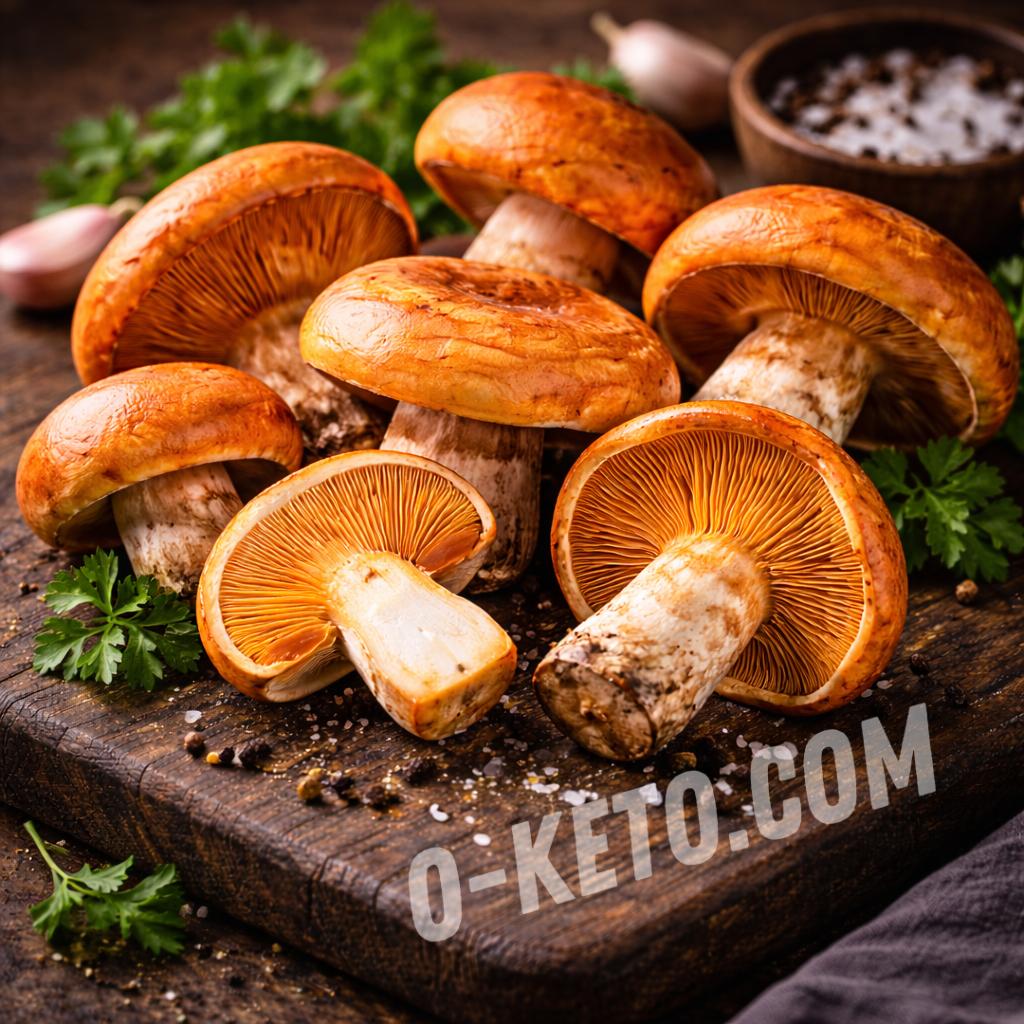

Saffron milk caps are edible forest mushrooms from the Lactarius genus, known for an orange or reddish-orange cap, firm flesh, and orange milky sap when cut. Most often this refers to true, pine, or spruce saffron milk caps. They are valued for their bright mushroom aroma, good texture, and ability to hold shape during frying, salting, and pickling.
These mushrooms grow in coniferous and mixed forests, forming a relationship with pine, spruce, and other trees. The season usually falls in late summer and autumn. Young mushrooms are firmer, cleaner in taste, and convenient for salting whole, while larger specimens are more often sliced for frying, braising, or mushroom spread.
Description and features
The cap is usually 5–12 cm, first convex and later funnel-shaped or slightly depressed in the center. Concentric rings are often visible on the surface. The gills under the cap are orange, and the stem is firm, cylindrical, sometimes with small pits.
When damaged, the mushroom releases orange milky sap. The flesh may turn greenish or darker during storage, cutting, and heating; for saffron milk caps this is a normal property, not a sign of spoilage by itself. But slime, sour smell, worm damage, collapsing flesh, or doubt about identification are reasons not to use the product.
Nutritional value
Fresh saffron milk caps are low in calories. In 100 g there are usually about 20–30 kcal, 2–3 g protein, about 0.5 g fat, and 3–4 g carbohydrates. Exact values depend on moisture, mushroom age, and cooking method. After salting, sodium changes, while after drying all nutrients become more concentrated per 100 g.
They contain fiber, potassium, phosphorus, magnesium, selenium, and B vitamins. The glycemic load of a normal portion of fresh mushrooms is low. At the same time, mushrooms should not be treated as a complete protein base: in a dish they mostly add volume, flavor, and texture.
Are they suitable for keto?
Saffron milk caps can fit keto and LCHF if cooked without flour, potatoes, sugar, and starchy sauces. They work well with eggs, meat, poultry, starch-free sour cream, cream, butter, cabbage, and herbs. Fried mushrooms with egg or braised with sour cream are clear low-carb options.
Salted and pickled saffron milk caps need an ingredient check. Marinade may contain sugar, and salt can be high even in a small portion. If the mushrooms are fried, they absorb fat, so oil, sour cream, and cream also count toward the total calories.
How to cook them
Before cooking, the mushrooms are cleaned of needles, sand, and damaged areas. Washing should be quick, without long soaking. Young mushrooms can be cooked whole, and large ones sliced. For frying, excess moisture is evaporated first, then oil, duck fat, or butter is added.
They are suitable for frying with a moderate amount of onion, braising in cream, mushroom spread, omelets, potato-free soups, casseroles with meat, and salting. Their taste is strong enough, so spices are better used moderately: black pepper, bay leaf, garlic, dill, parsley, and thyme.
How to choose
Good saffron milk caps are firm, without wet slime or a sharp sour note. The cap may be orange, reddish, or have greenish areas, but the mushroom should keep its shape. Very old specimens are often loose and wormy. Buy or gather only mushrooms you can identify confidently.
Forest mushrooms should not be gathered near roads, industrial zones, or polluted areas. If mushrooms are bought from private sellers, freshness, smell, cleanliness, and clear origin matter. When in doubt, cultivated champignons or oyster mushrooms are safer than an unknown forest mix.
What to pair them with
For a low-carb plate, eggs, chicken, turkey, beef, cabbage, cauliflower, zucchini, spinach, sour cream, cream, butter, garlic, dill, and parsley work well. In traditional cooking, saffron milk caps are often served with potatoes and bread, but those pairings usually do not fit keto.
Limitations
Mushrooms can be heavy for digestion, especially in large portions, with a lot of fat, or when not cooked enough. Children, pregnant people, older adults, and people with sensitive digestion should be more careful with forest mushrooms. Salted mushrooms are limited when salt needs to be reduced.
How to store them
Fresh saffron milk caps are best sorted and cooked on the day of gathering or purchase. In the refrigerator, they are kept briefly in a paper bag or open container. For long storage, salting, pickling, freezing after preliminary preparation, or drying are used. Cooked mushrooms are stored separately from raw foods and eaten quickly.
What can replace them?
By role in a dish, chanterelles, aspen boletes, birch boletes, porcini, slippery jacks, champignons, or oyster mushrooms can replace them. Forest mushrooms give a stronger aroma, while champignons and oyster mushrooms provide a milder taste and predictable availability. For salting, other gilled forest mushrooms are closer, but only with exact identification.


