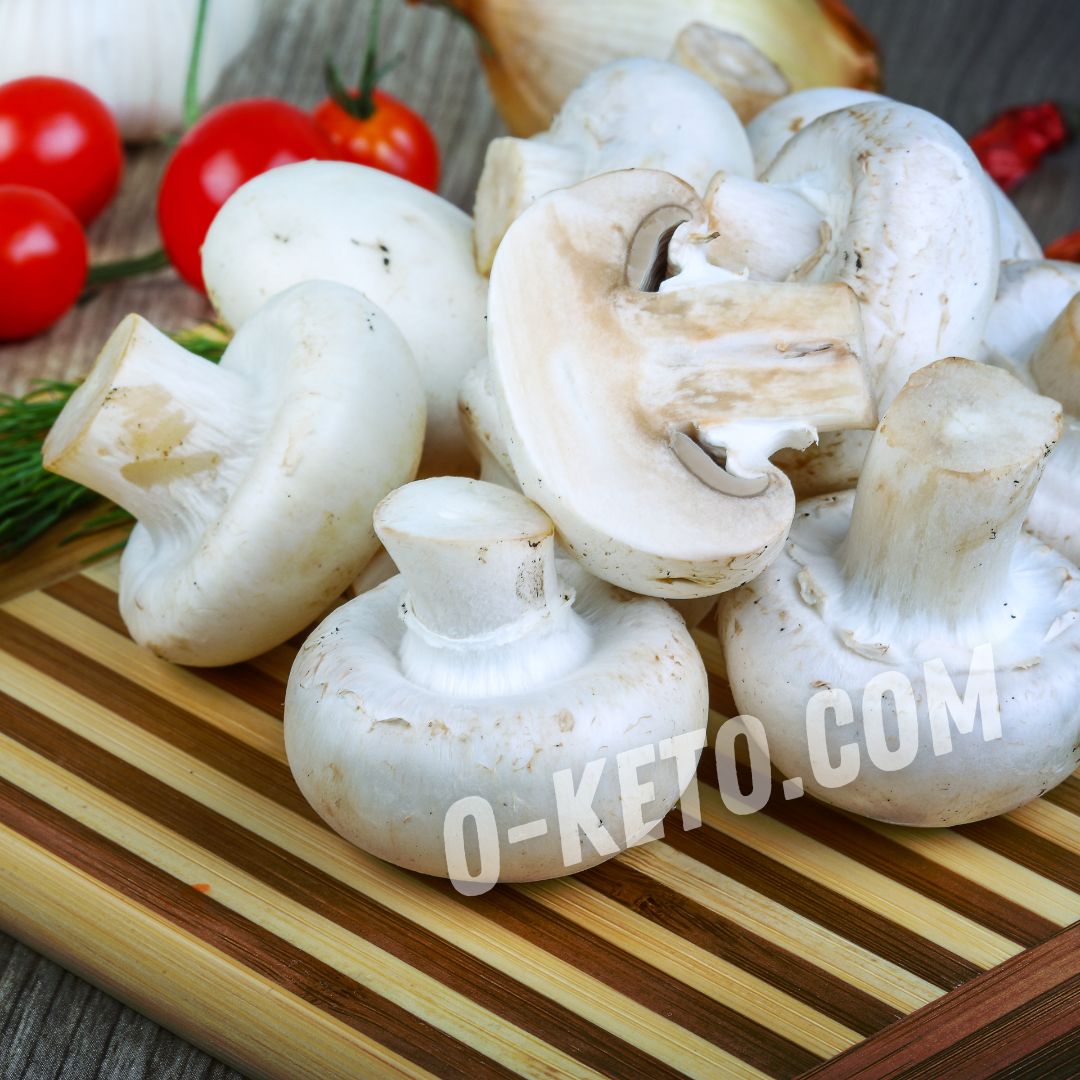

Champignons, or button mushrooms, are the most common cultivated mushrooms, with mild flavor, pale flesh, and firm texture. They can be eaten raw in thin slices, fried, stewed, roasted, and added to soups, omelets, sauces, salads, fillings, and side dishes. Unlike wild mushrooms, store-bought champignons are grown in controlled conditions, so they are easier to choose and cook.
Their flavor is gentle, but frying makes it deeper: excess water leaves, and a nutty mushroom note with browning appears. For keto and LCHF, they are useful because they give volume, umami, and texture while containing few carbohydrates. The main thing is not to bury them in sweet sauce or flour-based gravy.
Nutrition
In 100 g of fresh champignons there are usually about 20-25 kcal, roughly 3 g of protein, less than 1 g of fat, and about 3-4 g of carbohydrates, including around 1 g of fiber. The glycemic index is low, and a normal serving rarely interferes with a low-carb menu. If the mushrooms were exposed to ultraviolet light, they may contain more vitamin D, but this depends on the producer. For people sensitive to FODMAPs, the form matters: canned champignons may sometimes be tolerated better than fresh ones after the brine is drained, because some soluble carbohydrates move into the liquid.
Champignons contain B vitamins, potassium, phosphorus, selenium, and other micronutrients in small amounts. In practical cooking, however, they are mainly a low-calorie mushroom ingredient. To make a keto dish more filling, mushrooms are often paired with butter, cream, cheese, eggs, meat, or poultry.
After cooking, their weight falls noticeably because water leaves the mushrooms. This matters for portions: 300 g of raw champignons can become a small bowl after frying. If more volume is needed, they can be combined with cauliflower, zucchini, greens, or meat.
Fit for keto and LCHF
Champignons fit keto and LCHF well. They can be fried in butter or olive oil, added to omelets, cream sauces, stews, soups, salads, minced meat, flourless casseroles, or served with steak or chicken. They absorb fat and aroma well, so even a simple portion can taste expressive.
Additions matter. Breaded mushrooms, sweet marinades, flour-thickened sauces, or ready gravy may not suit strict keto. Canned champignons should also be checked by ingredients: mushrooms, water, salt, and acid are usually enough; sugar and starch are unnecessary.
How to cook them
The main mistake is cooking mushrooms over low heat in an overcrowded pan. Champignons release a lot of water and begin to steam instead of brown. It is better to cook them in batches, in a well-heated pan, first let moisture evaporate, and then add fat, salt, garlic, pepper, or herbs.
Salt is best added near the middle or end of frying if browning is desired. For a cream sauce, brown the mushrooms first and add cream or sour cream after that. Champignons pair well with thyme, parsley, garlic, a moderate amount of onion, black pepper, nutmeg, hard cheese, and sugar-free bacon.
For stuffed mushrooms, large caps are best, with the stems removed carefully. The filling can be made from cheese, herbs, browned stems, egg, minced meat, or cream cheese. For keto, breadcrumbs and sweet sauces from classic recipes are better left out.
If champignons are used for soup, part of them can be browned strongly on the side and added near the end. The flavor will be clearer than if all mushrooms are simply boiled in broth. For salads, raw slices are best mixed at once with lemon or a fatty dressing so they do not darken or dry out.
How to choose
Fresh champignons should be firm and dry on the surface, without slime, dark wet spots, or sour smell. A closed cap usually points to a younger mushroom; an open cap gives stronger flavor but a shorter storage life. Brown champignons are often denser and more aromatic than white ones.
Mushrooms should not be washed in advance and left wet because they absorb moisture and fry worse. If there is soil, rinse quickly and dry immediately, or wipe with a damp towel. Pre-sliced mushrooms are convenient but spoil faster than whole ones.
Limits
Cultivated store-bought champignons are usually more predictable than wild mushrooms, but they still need to be fresh. Slime, unpleasant odor, and dark wet surfaces are reasons to discard them. Raw champignons do not suit everyone’s digestion; with a sensitive gut, cooked mushrooms are often easier.
Wild mushrooms should not be treated like champignons in terms of safety: gathering unknown mushrooms is risky. For everyday cooking, it is safer to buy cultivated mushrooms from a clear supplier. If mushrooms cause discomfort, the portion can be reduced or the product avoided.
Storage and substitutes
Champignons keep best in the refrigerator in a paper bag or a container with some air flow. Tight closed plastic traps moisture and speeds slime formation. Cooked mushrooms are best eaten within a couple of days; after reheating they become softer and smell stronger.
They can be replaced with oyster mushrooms, portobello, shiitake, porcini, zucchini, eggplant, or cauliflower, depending on the dish. For mushroom aroma, portobello and shiitake are closer; for volume, oyster mushrooms and zucchini; for cream sauces, any firm mushrooms work.