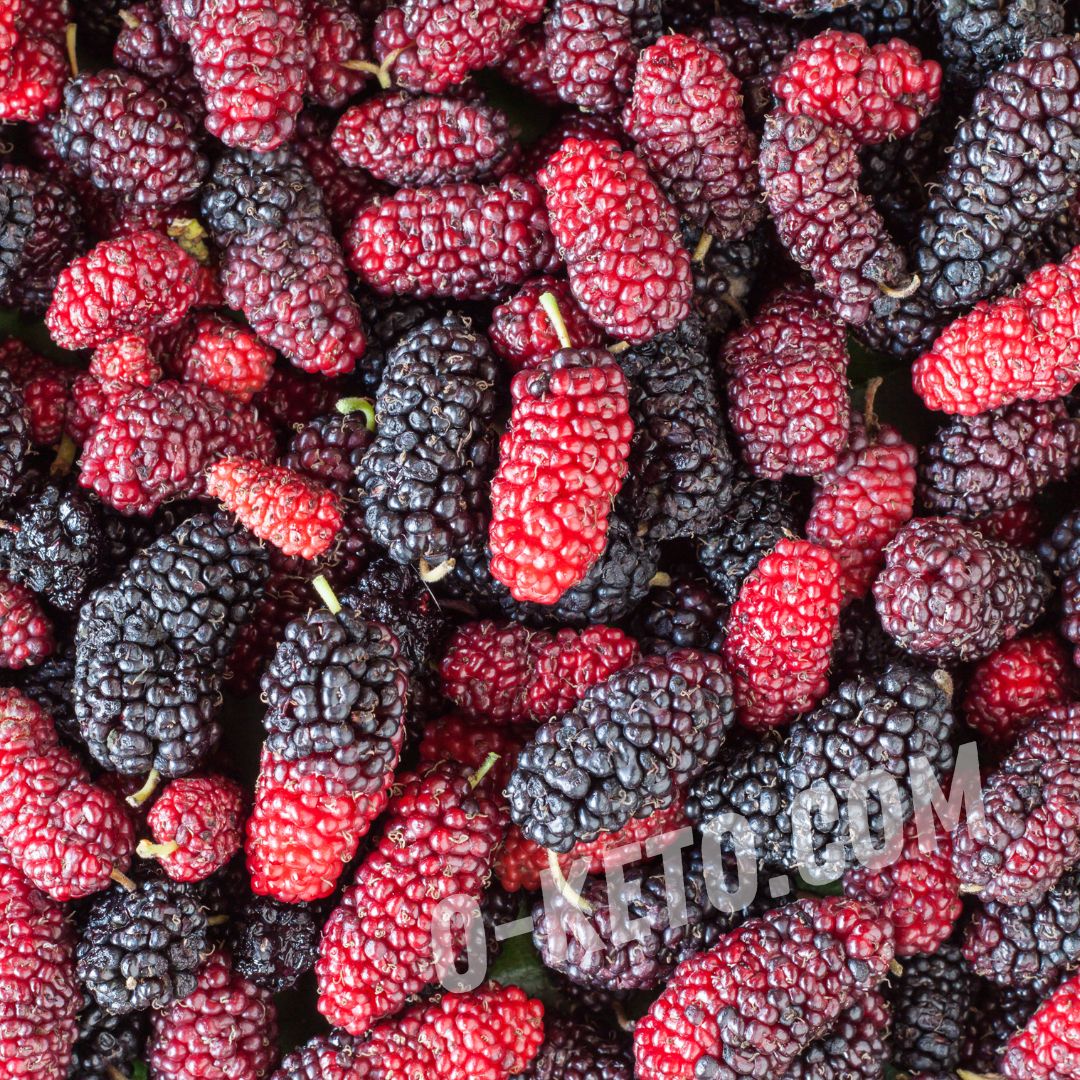

Mulberry is a sweet, soft berry with thin skin and a lot of juice. The fruits may be black, white, or red: black mulberries are usually richer and more wine-like in flavor, white ones are milder and sweeter, and red ones are juicy and aromatic. The berries are eaten fresh, dried, added to drinks, sauces, desserts, and homemade preserves.
For a low-carb diet, mulberries require a careful portion. They are not neutral greens or a tart berry with minimal sugar, but a sweet seasonal food. They can add beautiful flavor to yogurt, cream, cottage cheese, nuts, or a sugar-free dessert, but a large bowl quickly adds carbohydrates.
Nutrition
In 100 g of fresh mulberries there are about 43 kcal, roughly 2 g of protein, 0.4 g of fat, 9.8 g of carbohydrates, and about 1.7 g of fiber. Net carbohydrates are about 8 g per 100 g. The earlier text also listed a glycemic index of about 25; this is low, but it does not remove the carbohydrate mass of the serving.
The berries contain vitamin C, B vitamins, vitamin K, potassium, calcium, iron, organic acids, pigments, and plant polyphenols. In practice, mulberries are best viewed mainly as a sweet berry with fiber and bright flavor, not as a main source of minerals or vitamins.
Place in keto and LCHF
On strict keto, mulberries are used only in small portions. A serving of 20-30 g of fresh berries is a reasonable guide: enough to add flavor, color, and juiciness while keeping the carbohydrate load controlled. Dried mulberries are almost always less convenient for keto because the water is gone and the sugar is more concentrated.
Mulberries are better paired with fatty and unsweetened foods: thick cream, plain Greek yogurt, mascarpone, cottage cheese, almonds, walnuts, chia seeds, or coconut flakes. This makes the berries an accent rather than the base of the dish. Mulberry jam, syrups, and sweet sauces do not fit a low-carb menu unless the sugar is separately replaced.
How to use
Fresh mulberries are very delicate, so it is better not to wash them in advance. The berries bruise, release juice, and spoil quickly. Before serving, rinse them gently with cold water and dry them on a towel. In desserts, a small handful is enough for several portions of cream or yogurt.
Mulberries pair well with vanilla, cinnamon, lemon zest, mint, cream, cottage cheese, soft cheeses, almonds, hazelnuts, walnuts, and cocoa. In savory dishes, they can be used very selectively: for example, a few berries in a sauce for duck, pork, or blue cheese if the total carbohydrate calculation allows it.
Fresh and dried
Fresh mulberries provide juice, softness, and a more moderate sugar density by weight. Dried mulberries are more like raisins: sweetness is concentrated and the portion is easy to underestimate. A small handful of dried berries may contain much more carbohydrate than it appears visually.
If dried mulberries are used, weigh them rather than pouring by eye. For keto desserts, it is usually easier to use fresh berries or replace them with raspberries, blackberries, or strawberries in a small portion. These berries are often easier to fit into the daily limit.
How to choose
Good fresh mulberries should be aromatic and ripe, but not crushed. Berries that are very wet, sour-smelling, or moldy should be avoided. Black mulberries stain hands, boards, and fabric strongly, so handle them carefully.
When buying dried mulberries, check the ingredient list. Ideally it should contain only berries, without sugar, syrup, vegetable oil, or glaze. If the product is soft, sticky, and smells very sweet, it may have been additionally sweetened or processed.
Limits and storage
A large portion of mulberries may cause a laxative effect or abdominal discomfort, especially if the berries are very ripe or eaten together with other fruit. When carbohydrate handling is an issue and on strict keto, the portion is better weighed and individual response observed.
Fresh mulberries should be stored in the refrigerator in a shallow container, preferably in one layer or with a paper towel. Their shelf life is short: it is best to eat them within 1-2 days. For longer storage, freeze them on a tray and then transfer them to a bag so they do not stick into one lump.