


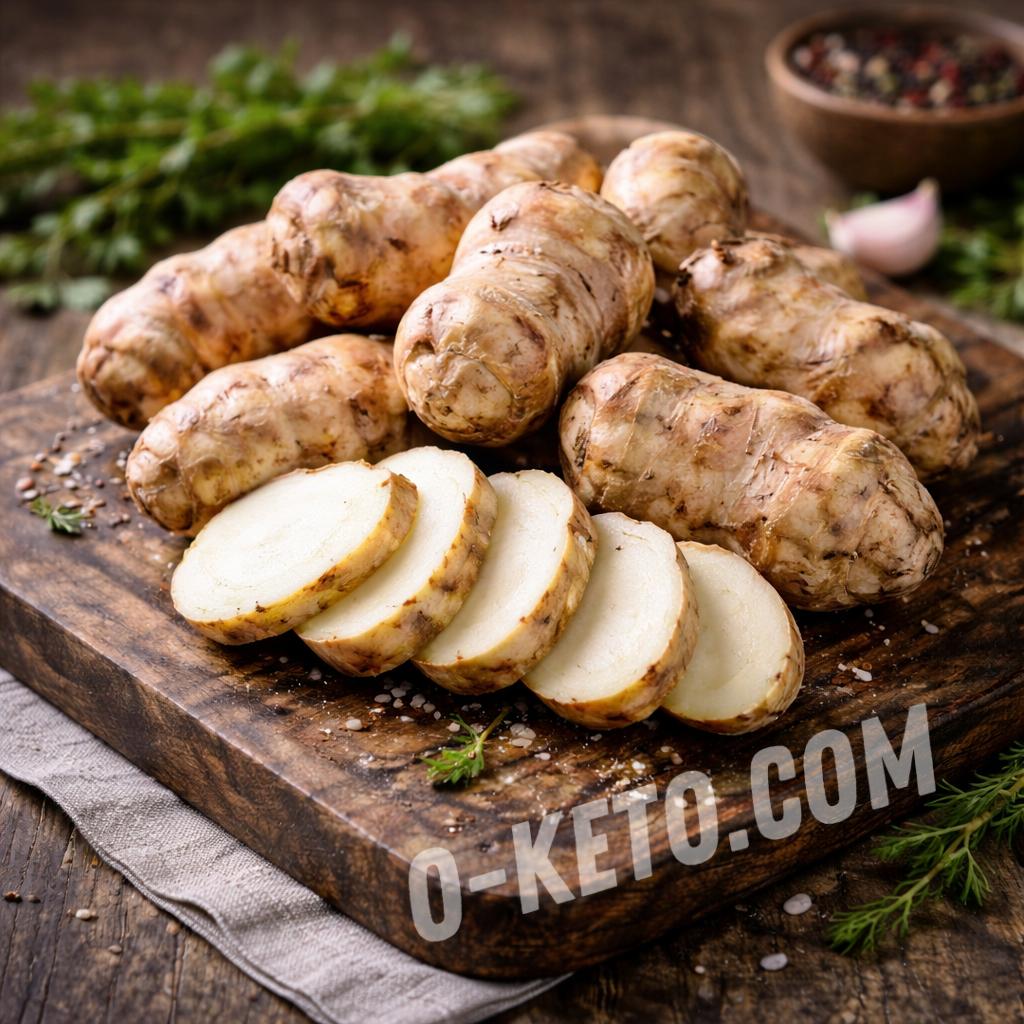

Jerusalem artichoke, also called sunchoke, is the tuber of a plant from the sunflower family. Despite the name, it is not related to the globe artichoke. Raw sunchoke is crisp, juicy, slightly sweet, and mildly nutty. After cooking, it becomes softer and sweeter, so it can be used in salads, soups, purees, side dishes, and oven dishes.
Its main feature is a high content of soluble dietary fiber, especially inulin. Because of this, its taste and tolerance differ from potato, parsnip, and other starchy root vegetables. For keto, it is a product that needs careful assessment: interesting in composition, but not a low-carb vegetable in a normal portion.
Nutritional value
Raw Jerusalem artichoke usually contains about 70-75 kcal per 100 g. Protein is around 2 g, fat is almost absent, carbohydrates are about 15-17 g, and fiber is around 4-5 g. Net carbohydrates are often estimated at about 11-13 g per 100 g, although the numbers can vary by variety, maturity, and storage conditions.
It contains potassium, phosphorus, magnesium, iron, vitamin C, and B vitamins. In practice, however, its value is often linked less to individual micronutrients and more to its texture and inulin content. Inulin is a soluble fiber and can noticeably affect satiety and recipe texture: puree becomes smoother, soup becomes thicker, and raw salad gets crunch and juiciness.
Is it suitable for keto?
Jerusalem artichoke is usually not suitable for strict keto. Even though part of its carbohydrates comes from inulin, the total carbohydrate amount remains high for a diet with a tight limit. A 150-200 g serving can provide too many net carbohydrates, especially if the same meal also contains onion, carrot, tomatoes, nuts, or dairy products with lactose.
On a moderate low-carb diet, sunchoke may sometimes be used in small amounts: thin slices in a salad, a few cubes in a vegetable mix, or as part of a side dish where most of the volume comes from cauliflower, zucchini, mushrooms, or leafy herbs. To keep carbohydrates low, it is better to calculate the portion in advance rather than estimate it by eye.
How to use it
Raw sunchoke can be cut into thin slices or matchsticks and added to salad. It pairs well with lemon juice, olive oil, parsley, dill, celery, cucumber, walnuts, and hard cheese. To slow browning, sprinkle the slices with acidic juice immediately after cutting.
For hot dishes, the tubers can be simmered, steamed, added to soups, or cooked in the oven with oil and spices. Butter, garlic, thyme, rosemary, black pepper, mushrooms, chicken, turkey, and fatty fish all support the flavor well. If a smoother texture is needed, the skin can be removed, but young tubers are often fine after thorough scrubbing.
How to choose
Good tubers are firm, without soft spots, mold, or wet patches. Their shape is often uneven, with knobs and curves; this is normal. Very shriveled tubers will be drier and less pleasant in fresh salads, though they may still work for soup or puree if there are no signs of spoilage.
Small tubers are more delicate but take longer to clean. Large ones are easier to slice, although older pieces may have a tougher skin. If sunchokes are sold washed, they should be used sooner: after washing, they store less well and lose moisture more easily.
Limitations
Because of inulin, Jerusalem artichoke can cause bloating, rumbling, or discomfort in some people, especially when a large portion is eaten at once. It is better to start with a small amount and observe tolerance. Cooking often makes it gentler, but it does not remove individual sensitivity completely.
For anyone tracking carbohydrates strictly, sunchoke should not be treated like a free vegetable such as leafy greens or cucumber. It is closer to root vegetables that require portion control. When the goal is to stay in ketosis, cauliflower, broccoli, zucchini, mushrooms, spinach, and salad greens are more reliable base sides.
Storage
Jerusalem artichoke loses moisture quickly, so it is best kept in the refrigerator in a bag or container rather than uncovered on a shelf. Unwashed tubers store longer than washed ones. Before cooking, they should be rinsed thoroughly, using a brush to remove soil from the uneven surface.
Cut sunchoke darkens in the air. If it needs to be prepared in advance, the slices can be placed briefly in cold water with lemon juice, then dried before cooking. A cooked dish is best eaten within 1-2 days: with longer storage the aroma becomes less fresh and the texture softer.
What to use instead
If a similar crunch is needed in a salad, kohlrabi, radish, daikon, celery, or cucumber can work. If the goal is a soft oven side dish, cauliflower, zucchini, mushrooms, or a small portion of turnip is usually a better choice. For a creamy soup, a low-carb base is often made from cauliflower with cream, butter, or cheese.
It is difficult to copy the nutty sweetness of Jerusalem artichoke exactly. The replacement is better chosen by function: crunch, volume, smooth puree, aromatic side dish, or lower carbohydrates. For keto, the priority is usually not exact flavor similarity, but keeping the meal satisfying without exceeding the carbohydrate limit.


