
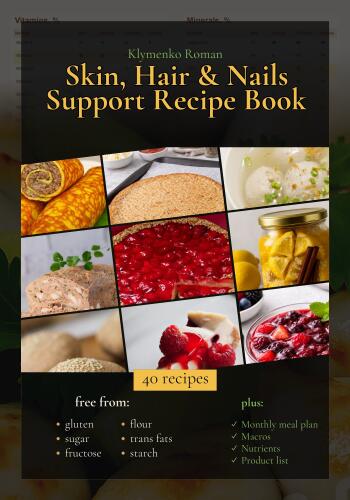
Recipe Collection for Skin, Hair and Nails

Recipe Collection for Skin, Hair and Nails

Free

Reissue date: 25 May 2026

Free from:

  • gluten
  • sugar
  • fructose
  • flour
  • trans fats
  • starch
About the book
Reviews

Introduction

Skin, hair, and nails often show whether the diet provides enough protein, fatty acids, vitamins, and antioxidants. Their condition depends not on one “beauty vitamin”, but on building materials and protection from oxidative stress.

Skin needs collagen and vitamin C, hair and nails need amino acids, biotin, zinc, and fat metabolism, while cell membranes need quality fatty acids and vitamin E.

This book is built around collagen, vitamin B7, DHA, vitamin E, and vitamin C: nutrients that support beauty through food, not empty promises.

Key nutrients for this book

The core nutrient markers in this collection are: Collagen, Vitamin B7, DHA (Omega-3), Vitamin E, Vitamin C. Below is why each one matters and which foods provide it most naturally.

Collagen

Collagen is the main protein of connective tissue. It matters for skin, tendons, ligaments, cartilage, and bone matrix; normal collagen formation also needs protein, vitamin C, and overall nutrient sufficiency.

How it supports this topic:

  • supports skin and connective-tissue structure;
  • matters for ligaments, tendons, and joints;
  • works together with vitamin C and amino acids.

When intake may be low:

  • protein and connective-tissue foods are limited;
  • skin, nails, or joints need support;
  • recovery after load is slow.

Best food sources:

  • bone and cartilage broths;
  • gelatin, aspic, fish or poultry skin;
  • meat, fish, eggs as amino-acid sources.

Vitamin B7

Vitamin B7, or biotin, participates in fatty-acid and amino-acid metabolism. It is often discussed for hair and nails, but works best within a complete diet with protein, zinc, vitamin C, and vitamin E.

How it supports this topic:

  • supports metabolism in skin, hair, and nails;
  • participates in energy metabolism;
  • works alongside protein, zinc, and fat-soluble nutrients.

When intake may be low:

  • nuts, seeds, avocado, and quality fats are limited;
  • fat absorption is impaired;
  • skin is dry or tissue recovery is slow.

Best food sources:

  • eggs, liver;
  • salmon, sardines;
  • nuts, seeds, mushrooms.

DHA (Omega-3)

DHA is especially important for nervous tissue, the retina, skin, and hormonal regulation. It is part of cell membranes, so its role is broader than “brain fat”: it supports cell structure and resilience.

How it supports this topic:

  • supports the brain, vision, and nervous system;
  • contributes to the quality of cell membranes in skin and other tissues;
  • works together with EPA in anti-inflammatory eating patterns.

When intake may be low:

  • marine fish is rarely eaten;
  • the eyes, nervous system, or skin are under higher stress;
  • the diet is monotonous and low in fat-soluble nutrients.

Best food sources:

  • salmon, sardines, mackerel;
  • herring and trout;
  • roe, seafood, cod liver.

Vitamin E

Vitamin E protects fatty acids in cell membranes from oxidation. It matters for skin, vessels, the nervous system, and tissues rich in lipids.

How it supports this topic:

  • supports antioxidant protection of membranes;
  • matters for skin, hair, and vessels;
  • works alongside vitamin C and omega-3 fats.

When intake may be low:

  • nuts, seeds, avocado, and quality fats are limited;
  • fat absorption is impaired;
  • skin is dry or tissue recovery is slow.

Best food sources:

  • almonds, hazelnuts, seeds;
  • avocado, olives;
  • fatty fish and eggs.

Vitamin C

Vitamin C is needed for collagen synthesis, cellular protection, immune function, and tissue repair. That makes it important for vessels, skin, gums, connective tissue, and recovery.

How it supports this topic:

  • participates in collagen formation;
  • supports immune cells and antioxidant defense;
  • improves iron absorption from food.

When intake may be low:

  • fresh vegetables, herbs, and berries are limited;
  • gums bleed, wounds heal slowly, fatigue is present;
  • infection load, stress, or smoking is high.

Best food sources:

  • bell pepper, herbs, broccoli;
  • berries, cranberry, blackcurrant;
  • citrus fruits and cabbage.

What this book is about

This is not a supplement manual and not a collection of vague wellness advice. It is a practical recipe collection built around foods that can provide meaningful amounts of the selected nutrients.

Each recipe includes ingredients, cooking time, macros, and vitamin/mineral tables per 100 g. This makes it easier to compare dishes and choose meals that fit your routine, taste, and goals.

Use the book as a food navigator: rotate protein sources, fish, eggs, vegetables, herbs, nuts, and other nutrient-dense foods, while paying attention to tolerance and variety.


Looking for a source of nutrients? Check out iHerb:
Витамин B7: Purity Products, MyBiotin, Hair, Skin & Nails Formula, 30 Vegetarian Capsules
Buy
≈ $26.95
Витамин B7: Nature's Life, Biotin, 2,500 mcg, 200 Vegetarian Capsules
Buy
≈ $28.79
DHA (Омега-3): California Gold Nutrition, DHA 700 Fish Oil, Ultra-Concentrated, 1,000 mg, 30 Fish Gelatin Softgels
Buy
≈ $10.83
Витамин E: Solgar, Naturally Sourced Vitamin E, 268 mg (400 IU), 100 Softgels
Buy
≈ $13.74
Витамин C: Solaray, Enhanced Absorption, Liposomal Vitamin C, 100 VegCaps
Buy
≈ $29.59
Витамин C: California Gold Nutrition, Buffered Gold C™, GOLD Standard Sodium Ascorbate (Vitamin C), 750 mg, 240 Veggie Capsules
Buy
≈ $13.86
Share:
Keto, LCHF: Recipes, Rules, Description $$$
Odessa