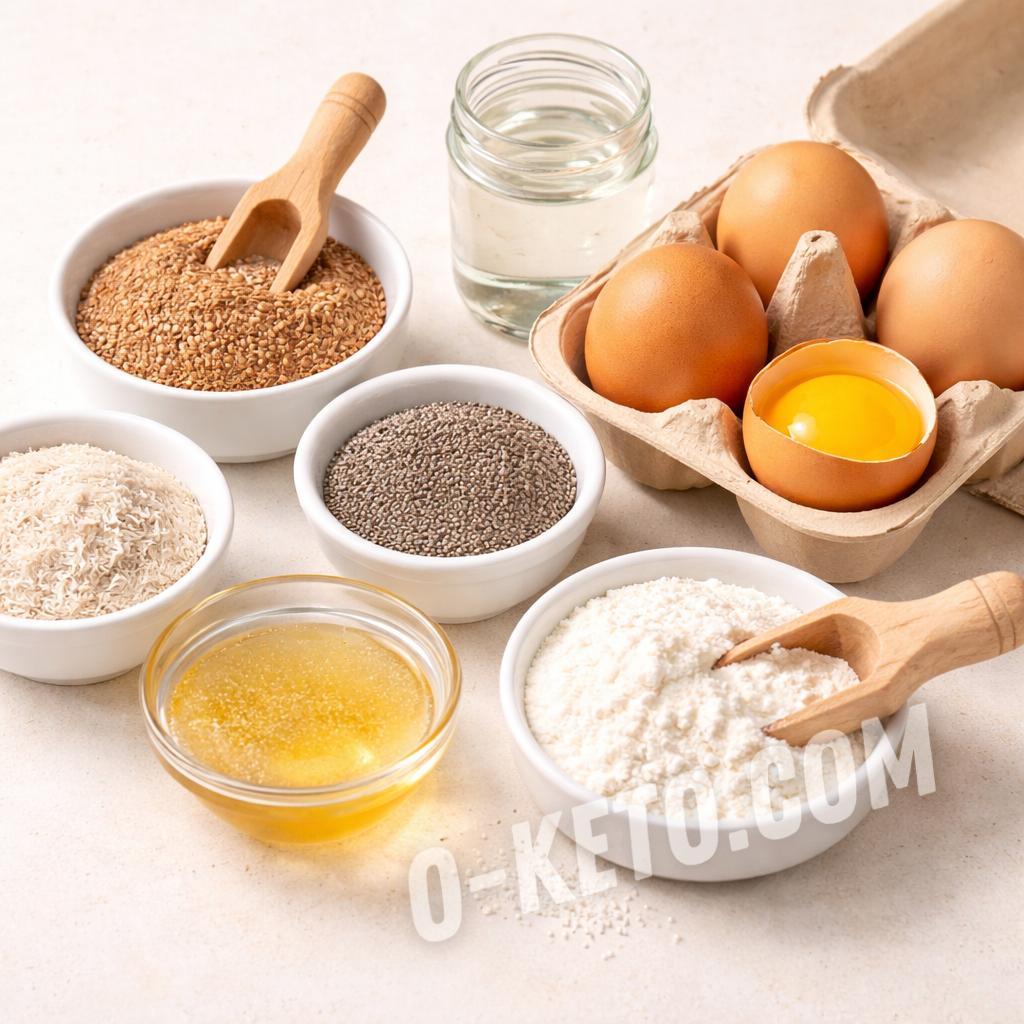

Working with eggs in recipes requires precision, especially in keto and low-carb baking. Eggs serve several functions: they bind ingredients, create structure, retain moisture, and contribute to texture formation. Therefore, it is important to understand not only their weight but also their behavior in different conditions, as well as to use substitutes correctly.
Weight of Eggs and Their Components
| Labeling | Weight whole egg, g | Weight egg white, g | Weight yolk, g | Egg category |
| C2 | ~45–55 | ~26 | ~14 | table second category |
| C1 | ~55–65 | ~33 | ~17 | table first category |
| C0 | ~65–70 | ~40 | ~20 | table selected |
| D | ~75+ | ~45 | ~22 | dietary |
The weight is given without the shell. On average, the egg white makes up about 58–60% of the egg’s mass, and the yolk about 30–32%.
Precise weight is not only about neatness. Keto baking usually contains less starch and no gluten, so any extra liquid, fat, or protein changes the structure quickly. The same “two eggs” can differ by many grams depending on the category, and that affects moisture, rise, and crumb density.
Why Accurate Weight Matters:
- different categories of eggs provide different volumes of liquid;
- baking is sensitive to excess or lack of moisture;
- in keto recipes, balance is especially critical due to the absence of gluten;
- the egg white and yolk perform different functions in the recipe.
Functions of Egg White and Yolk
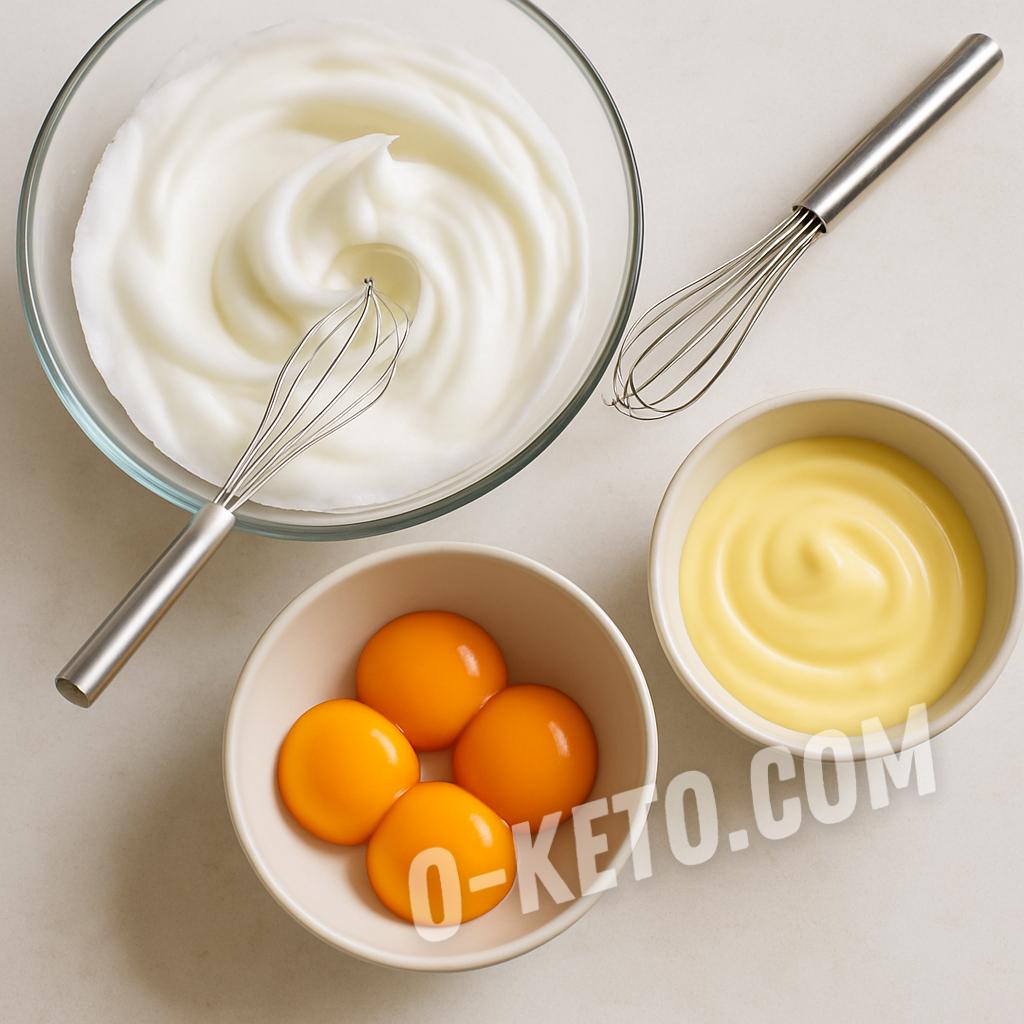
Egg white and yolk behave differently in dough, which is why recipes often separate them. The white is mostly water and proteins that trap air when whipped and then set the shape when heated. The yolk contains fats, lecithin, and fat-soluble pigments: it makes the texture softer, richer, and more plastic, but it also lowers the ability of the batter to rise strongly.
Egg White:
- creates structure when heated;
- retains moisture;
- participates in foam formation;
- makes texture lighter.
Yolk:
- contains fats and emulsifiers;
- makes texture soft and creamy;
- enhances flavor and color;
- stabilizes structure.
This is why some keto baked goods rely on whites specifically rather than whole eggs. It is especially obvious in sponge-style cakes, airy layers, gougères, focaccia made with whipped whites, and other bakes that need volume without a wheat gluten network. Whipped whites create a scaffold of many small air bubbles. If whole eggs are used instead, the batter becomes heavier and fattier, so the rise is weaker.
Yolk fat interferes with rise not because fat is “bad” by itself, but because it reduces foam stability. Protein strands hold air less effectively, bubbles merge faster, and the finished bake comes out lower, wetter, and denser. In recipes that need an even high crumb and a light feel, even a small trace of yolk in the whites can noticeably reduce the result.
Main Egg Substitutes
Substitution may be necessary in cases of intolerance, vegan recipes, or to change texture. However, it is important to understand what function the egg performs in a specific recipe. If the egg is there mainly for binding, one set of substitutes works. If it is needed to hold air and lift the dough, the choice is very different.
Dry Egg White (Albumin):
- used to replace egg white;
- has a high concentration;
- suitable for meringues and sponge cakes.
Reconstitution ratio:
- 1 g of albumin + 7 g of water;
- soaking time 20–30 minutes;
- water temperature around 20–22°C.
Fresh whites are useful when natural flavor, a softer structure, and predictable behavior in a small home batch matter most. Dry white is useful when you need precise grams, do not want to depend on egg size, or need a lot of white without extra yolks. For meringues, white-based layers, and recipes that require exact scaling, albumin is often more practical because it reduces variation in moisture.
Flaxseed or Chia “Egg”:
- 1 tbsp seeds + 2–3 tbsp water;
- suitable for dense baking;
- provides a heavier texture.
Psyllium:
- binds moisture;
- used in keto baking;
- it is important not to exceed the dosage.
Gelatin:
- provides structure;
- suitable for desserts and creams;
- does not create airiness.
Limitations of Substitution:
- substitutes rarely fully replicate the properties of eggs;
- texture and density change;
- whipped structures are harder to reproduce without egg white;
- the fats in yolk are difficult to replace without losing flavor.
What Most Often Breaks Egg-White Structure
Even a good recipe can fail at the white-whipping stage. Stable foam needs a reasonably dry environment, clean tools, and the right whipping level. Egg whites do not tolerate grease, extra water, or chaotic handling well, especially in baking that already lacks a gluten framework.
The most common problem is fat on the bowl, whisk, or in the whites themselves. Traces of yolk, oil, cream, or poorly washed tools make it harder for the proteins to open up and trap air. The mixture may still foam, but the peaks will stay weak and the bake will lose height in the oven.
Humidity also matters. If whites stand near steam, the bowl is still wet after washing, or the dry ingredients have already begun to absorb moisture from the air, the batter becomes less stable. In keto baking this is especially visible because psyllium, coconut flour, and other fibers bind water quickly and can start changing the texture before the foam is safely incorporated.
Under-whipped whites give the same kind of bad result as a weak batter: bubbles are large, unstable, and burst quickly. Over-whipping into a dry grainy mass is not good either because the foam folds in badly and the batter loses uniformity. For most home recipes, the practical target is a glossy dense foam that holds shape on the whisk without looking dry.
If a recipe depends on a very light structure, it helps to degrease the bowl and whisk first, separate the whites carefully one by one, and fold them into the base in parts. The first portion can be mixed in more actively to equalize density, while the next portions are folded gently with a spatula to preserve volume. This reduces the risk that a heavy fatty or fiber-rich base will immediately collapse the foam.
Conclusion
Accurate work with eggs is the foundation of stable results in baking. Understanding their weight, structure, and functions allows not only to correctly scale recipes but also to wisely use substitutes without compromising the quality of the dish.
Practical Recommendations:
- in complex recipes, it is better not to replace eggs completely;
- in whipped-white recipes, do not swap them for whole eggs without recalculating structure;
- use combinations of substitutes if you only need binding or moisture retention;
- control batter consistency, tool cleanliness, and whipping level, not just grams;
- always test the recipe before scaling.
Sources
- What You Need to Know About Egg Safety: U.S. Food and Drug Administration
- Assuring the Safety of Eggs and Menu and Deli Items Made From Raw, Shell Eggs: U.S. Food and Drug Administration
- Foaming Properties and Olfactory Profile of Fermented Chickpea Aquafaba and Its Application in Vegan Chocolate Mousse
- Microwave-Assisted Extraction Enhances Aquafaba Functionality: A High Value-Added Egg White Replacer in Vegan Meringue Production