


Serum uric acid
Serum uric acid reflects purine metabolism and helps assess the risk of gout, uric-acid stone formation, impaired renal excretion, and the broader metabolic setting.
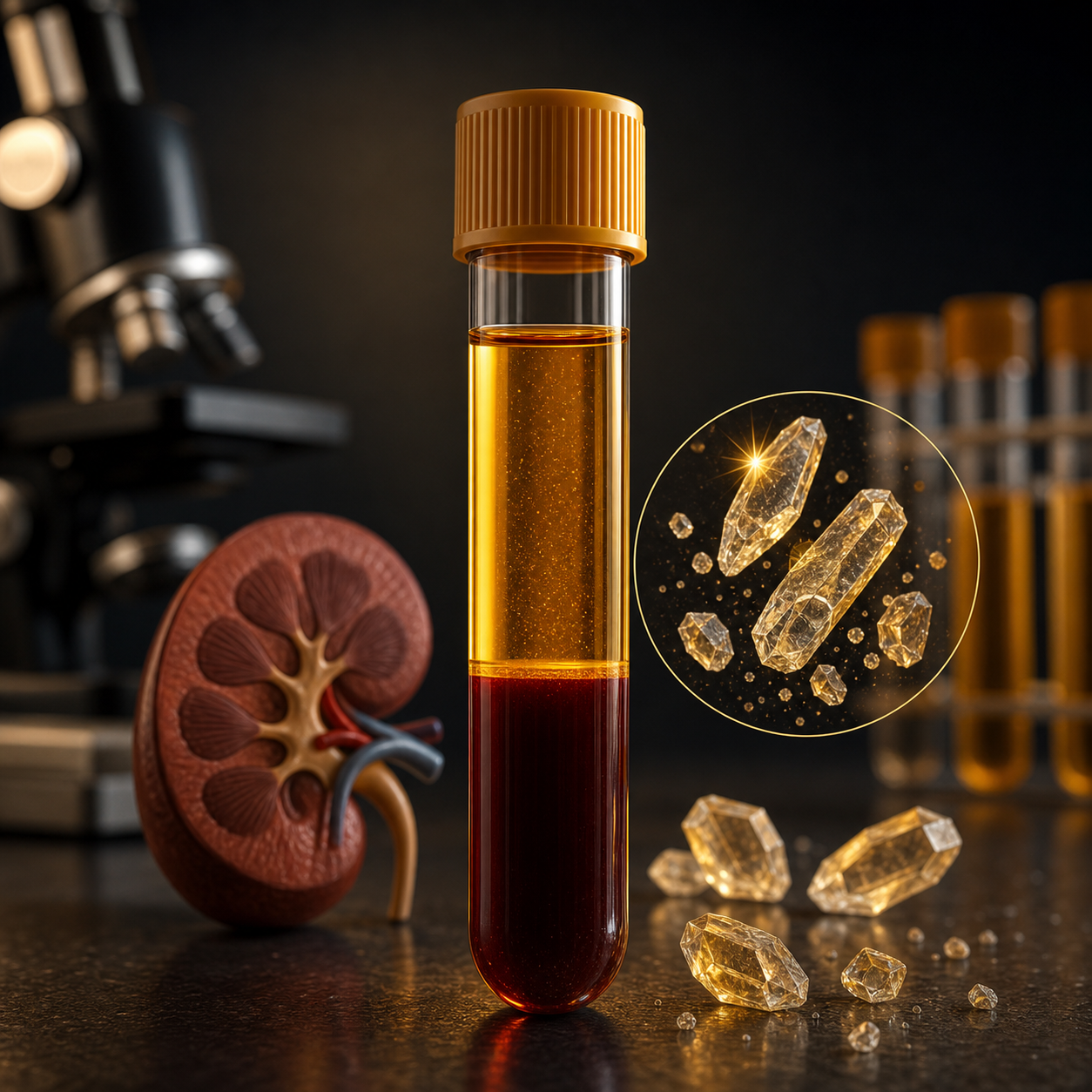
Serum uric acid shows how the body is handling the final stage of purine metabolism and how effectively the kidneys are clearing this compound. Most people associate the test mainly with gout, but its practical meaning is broader. It can point to a tendency toward urate accumulation, help assess the risk of kidney stones, and reveal the influence of diet, alcohol, obesity, insulin resistance, dehydration, and reduced renal filtration. One isolated number does not establish a diagnosis, but the marker becomes very useful when read together with symptoms, creatinine, urea, eGFR, urinalysis, and the overall metabolic context.
What the test reflects
Uric acid is formed during the breakdown of purines. Some purines come from food, while others arise from normal cell turnover inside the body. The resulting uric acid circulates in the blood and is excreted mainly by the kidneys. Because of that, the test reflects several processes at once: how much uric acid is being produced, how well the kidneys are excreting it, how hydrated the person is, and what broader metabolic conditions are present. If the level rises, the cause is not always the same. In one person the dominant factor may be alcohol and fructose intake, in another reduced kidney clearance, in another obesity, diuretics, or insulin resistance.
Low values are discussed less often, but they can still matter. Sometimes they appear in the setting of reduced protein reserve, certain liver problems, unusual dietary patterns, or specific medications. That is why the test should not be reduced to the simplistic rule that “lower is always better.” Its practical meaning appears only after comparison with neighboring markers and the clinical picture.
When the test is especially important
Serum uric acid is often ordered when gout is suspected, especially in people with sudden painful, red, swollen joints, classically involving the first metatarsophalangeal joint. But that is only part of its role. The test is also useful in people prone to kidney stones, chronic kidney disease, metabolic syndrome, obesity, insulin resistance, arterial hypertension, fatty liver, and in those taking drugs that may impair urate excretion.
It is also valuable in calmer situations without dramatic symptoms. A family history of gout, repeated past elevations, a diet high in fructose and alcohol, early keto adaptation combined with dehydration, or the combination of abdominal obesity, elevated triglycerides, and high blood pressure can all make the test more informative. In such cases it works best as one part of a broad metabolic assessment rather than as a stand-alone alarm signal.
What can raise uric acid
Elevated uric acid may be driven by excess purines and fructose in the diet, alcohol use, dehydration, increased cell breakdown, reduced kidney excretion, diuretics, chronic kidney disease, and some hematologic or oncologic states. Obesity and insulin resistance often contribute because they change renal handling of urate and shift the broader metabolic environment toward retention. In some people the elevation is transient, for example after intense exercise, fasting, fever, or a sudden change in diet.
For people using keto or LCHF patterns, one nuance matters particularly: uric acid can rise temporarily during the early adaptation phase because ketone bodies compete with urate for excretion. This does not mean that everyone on a low-carbohydrate diet will develop gout, but it is an important context, especially in someone with previous gout flares, uric-acid stones, reduced eGFR, or a strong tendency toward dehydration.
How to read it with other markers
If uric acid is elevated, one of the first questions is what is happening with kidney function. That is why creatinine, urea, estimated GFR, urinalysis, and sometimes 24-hour uric acid excretion are reviewed alongside it. If reduced filtration, proteinuria, hematuria, edema, or other renal abnormalities are present, the interpretation moves closer to a nephrologic problem. If kidney function is preserved, more attention shifts toward diet, alcohol, body weight, insulin, glucose, triglycerides, and the general inflammatory-metabolic background.
Even in suspected gout the number is not read in isolation. Clinicians consider the pattern of attacks, the location of pain, joint ultrasound, kidney-stone history, and sometimes synovial-fluid microscopy. A normal result between attacks does not always exclude gout, and an elevated result without symptoms does not automatically prove that the diagnosis is already established. The pattern matters more than the bare number.
What can distort the result
Uric acid is strongly influenced by dehydration, alcohol, fructose, fasting, very intense physical exertion, fever, some medications, and abrupt dietary shifts. Even attempts to “prepare perfectly” for the blood draw can make the result less honest if the person suddenly restricts food, drinks unusually large amounts of water, or comes in after several days of poor hydration. The most useful result is the one obtained under reasonably ordinary living conditions, because it better reflects the real trend.
Another common mistake is relying only on the printed reference range while ignoring the clinical context. In one person a high-normal value may already matter because of gout flares and stone history, while in another a moderate elevation will first point toward weight, hydration, diet, alcohol, and insulin-resistance workup. Serum uric acid is therefore best used not as a verdict on its own, but as part of a careful metabolic interpretation.
Why the marker matters in practice
In real life, serum uric acid helps detect when purine metabolism and urate excretion are moving under strain. That is a reason not for panic, but for checking hydration, fructose intake, alcohol exposure, body weight, kidney function, blood pressure, insulin resistance, and associated symptoms. If there are recurrent arthritis attacks, kidney-stone episodes, a decline in eGFR, or a persistently rising level over time, the marker becomes part of a more serious diagnostic pathway.
The most useful approach is to follow the trend and interpret the value against the person’s broader physiology instead of reacting to one isolated laboratory number. In that setting, serum uric acid becomes a practical marker of gout risk, urate stone formation, and systemic metabolic stress rather than just another line in a blood-test report.
If you have any questions about the term "Serum uric acid", you can ask them to AI. Please note, a low-cost OpenAI model is used. It may answer questions about disease treatment with errors!


 1 / 4
1 / 4


 1 / 4
1 / 4

 1 / 4
1 / 4