
Nitrite salt in homemade sausage is not used to make food “chemical”. It is a controlled curing tool. It helps preserve the familiar pink-red color, lowers the risk of dangerous microbial spoilage, slows fat rancidity, and creates the ham-like flavor that spices alone cannot reproduce.
At the same time, nitrite salt requires precision. It is not used everywhere, not by eye, and not for every sausage: the method matters, especially when comparing boiled sausage, ham, dry-cured products, and sausages cooked over high heat.
What nitrite salt is
Nitrite salt is ordinary salt mixed with a small amount of sodium nitrite. In industrial labeling, sodium nitrite is known as food additive E250. Pure sodium nitrite is toxic and should not be used directly in home curing; dilution in salt is what makes controlled dosing possible.
Many household nitrite salts contain about 0.6% sodium nitrite. Some standards allow higher concentrations, so the actual label matters before any calculation.
| what to check | why it matters |
| sodium nitrite percentage | it determines the curing calculation and dosing safety |
| expiration date | old or poorly stored salt may work worse for color and stability |
| storage conditions | it should be kept dry, closed, and protected from excess moisture |
Adding extra nitrite salt “just in case” is wrong. Good sausage technology relies on calculation, curing time, and temperature control, not on increasing the dose.
Typical home-use percentages
At home it is useful to separate product groups. Red meat, pork, and poultry often use nitrite-salt levels around 1.2-1.5% of the raw weight. Fish and seafood usually need only about 0.5-1% because their protein structure, storage logic, and heat treatment are different.
This does not mean nitrite salt should ever be added by guesswork. The whole point is controlled calculation: weigh the raw product first, calculate the percentage, and only then add the salt. That gives far more predictable flavor, color, and storage stability than salting by feel.
Why sausage turns gray without it
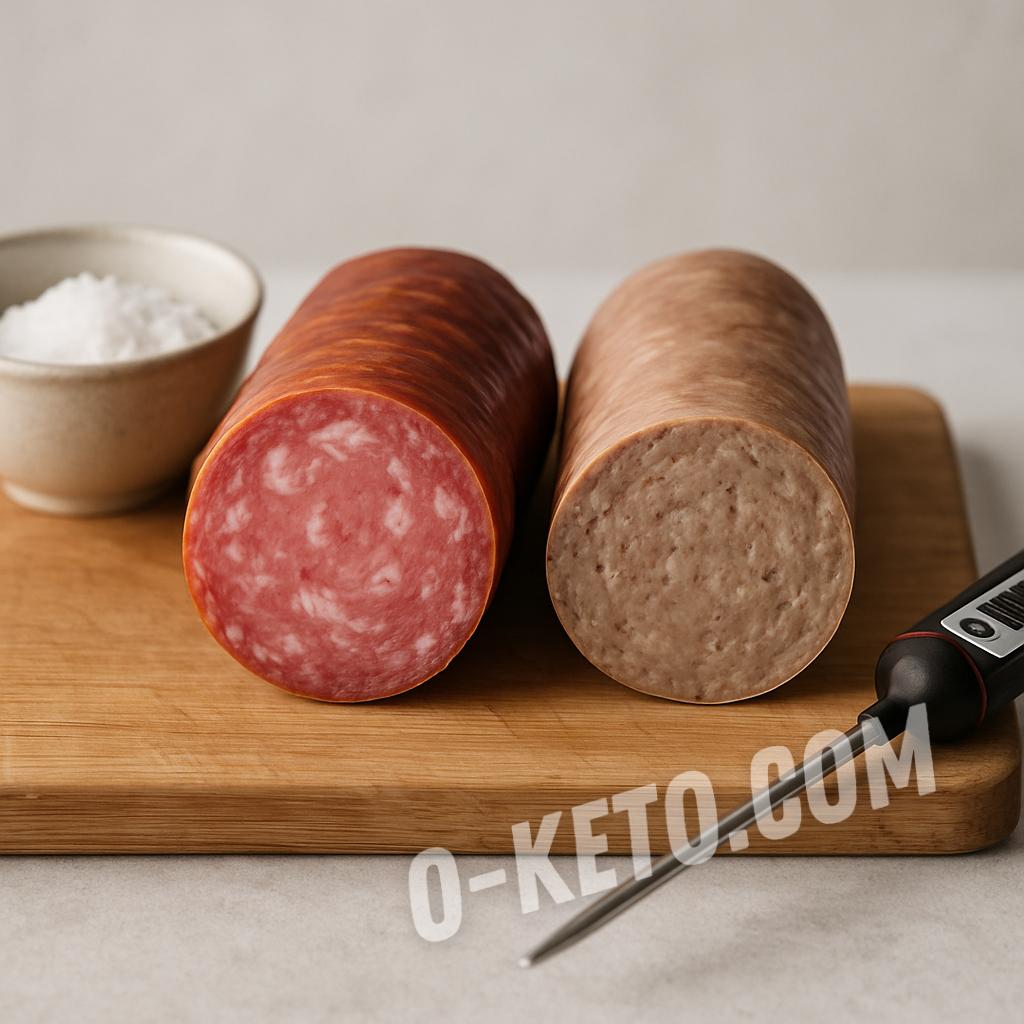
The pink color of ham, frankfurters, and boiled sausage is not only a property of meat. Sodium nitrite reacts with myoglobin, the muscle protein responsible for the red color of meat tissue. This reaction helps the finished sausage remain pink-red instead of turning gray-brown after heating.
Different cuts contain different amounts of myoglobin. Active muscles usually contain more, so poultry thigh sausage may look pinker than breast sausage. This does not automatically mean that one product contains more additive than another: color also depends on the raw material, curing, and heating regime.
How nitrite salt supports safety
The main reason to use nitrite salt in cured meat products is microbiological safety. Sausage, ham, and whole-muscle delicacies are often cooked at moderate temperatures, held for curing, cooled, smoked, or dried. In this environment, bacteria and toxins associated with salmonella, staphylococcus, and botulism are especially important risks.
Nitrite salt does not replace hygiene, cold storage, proper curing, or heat treatment. It works as part of a system: it helps suppress undesirable microbes, reduces spoilage risk, and slows fat oxidation. Homemade sausage therefore needs not only ingredients but also refrigeration, a thermometer, clean tools, good casing, and a controlled process.
Where the ham-like flavor comes from
Spices shape the aroma: garlic, pepper, coriander, nutmeg, paprika, or juniper can make sausage brighter. But the characteristic ham-like flavor develops during curing with nitrite salt. It is a separate note that seasonings alone do not fully imitate.
Two sausages made from the same meat and spices can taste very different. Without nitrite curing, the result is closer to cooked or baked meat mince; with proper nitrite curing, it gains the recognizable sausage and ham character.
How much nitrite remains in the finished product
Nitrite salt does not remain unchanged in finished sausage. During curing and heating, sodium nitrite reacts and partially breaks down. For finished sausage products, a common residual sodium nitrite limit is no more than 0.005%.
That is why correct technology matters more than fear of the word “nitrite”. The issue is not the existence of nitrite salt, but using it without understanding dosing, curing time, mince temperature, and the final cooking method.
When nitrite salt is not needed
Nitrite salt should not be used for fried sausages, fresh grilling sausages, or products cooked above 130°C. At such high surface temperatures, nitrosamines may form. This is exactly the situation where a curing ingredient is being used outside its proper purpose.
For products cooked quickly in a pan, on a grill, or over open fire, it is safer to use recipes based on ordinary salt and quick cooking. Nitrite curing belongs in controlled processes such as curing, boiling, low-temperature baking, smoking, or drying.
| product type | nitrite salt |
| boiled sausage, ham, cured sausage with controlled heat treatment | usually required by the recipe |
| dry-cured or cold-smoked sausage | used by exact calculation and process |
| grilling sausages and fried sausages | usually not needed, especially above 130°C |
This table is not a substitute for a recipe. It shows the principle: nitrite salt belongs to specific meat technologies, not to every mixture of mince in a casing.
Common mistakes
Mistakes with nitrite salt usually begin with trying to simplify the process. A cook estimates the dose, shortens curing time, lets the mince warm up, changes the heat treatment, or fries a product that was designed for boiling and cooling.
- using nitrite salt without scales and exact calculation;
- confusing different nitrite concentrations;
- adding nitrite salt to products meant for frying or grilling;
- shortening refrigerated curing time;
- letting the mince warm during grinding and mixing;
- assuming nitrite salt replaces hygiene, chilling, and a thermometer.
If sausage turns out pale, the amount of nitrite salt is not the only possible reason. Color also depends on expiration date, storage conditions, curing time, mince temperature, heating regime, and raw material quality.
Practical takeaway
Nitrite salt is a technological tool for homemade sausage, ham, and cured meat delicacies. It supports color, ham-like flavor, fat stability, and microbial safety, but only together with exact dosing, cold handling, curing time, and temperature control.
If the product will be fried or grilled, nitrite salt is usually unnecessary. For boiled sausage, ham, cured sausage, dry-cured meat, or smoked products, do not replace it by eye with ordinary salt; use a tested recipe and calculate the dose by raw material weight.
Sources
- Additives in Meat and Poultry Products — U.S. Department of Agriculture Food Safety and Inspection Service
- Hams and Food Safety — U.S. Department of Agriculture Food Safety and Inspection Service
- Bacon and Food Safety — U.S. Department of Agriculture Food Safety and Inspection Service
- EFSA confirms safe levels for nitrites and nitrates added to food — European Food Safety Authority
- Nitrosamines in food raise a health concern — European Food Safety Authority
- FSIS Ready-to-Eat Fermented, Salt-Cured, and Dried Products Guideline