

A combined home workout for memory, attention, and thinking speed does not need to become a marathon. In fifteen minutes you can check auditory recall, visual search, associations, counting, and rule switching. The value of this format is diagnostic for your practice: it shows where errors appear and makes personal progress easier to compare. Sleep, stress, noise, and experience affect results, so these tasks are not an intelligence test or a diagnosis.
How to prepare fifteen minutes
Prepare a timer, notebook, pen, and a few cards or sheets with simple symbols. Turn off alerts, choose a place without background video, and decide what you will record: correctly recalled words, search time, or errors. Note the date and how you feel before starting. Work in short blocks, taking calm breaths and resting your eyes between them.
Do not turn the session into a competition. Use similar lighting and time of day when repeating the workout. Record conditions because fatigue or noise can change performance more than the exercise itself.
How to check auditory memory with a word list
Ask an adult to read ten neutral words at a steady pace, such as shirt, cup, watermelon, door, rat, roof, towel, coat, mouse, and music. After one listening, write everything you remember without looking back. Record both the number and the order. If a word is replaced with a similar one, mark that error separately; it shows where confusion occurred.
For a child, start with four to six familiar objects. You can replace the list with a short story and ask who acted, where the character was, what changed, and how it ended. An adult may record the voice in advance, but close the screen and source text during recall. The task practises meaning and sequence rather than word-for-word repetition.
How to practise fast category search
Set a timer for one minute and name as many countries as possible. In the next round, choose writers, cities, plants, or another category. Do not count repeats; record pauses, hints, and omissions. After each round, note which cue helped: a first letter, region, period, or image.
Category search practises access to familiar vocabulary and switching. It does not measure general intelligence or prove that every real-life task will become faster. A sudden difficulty finding ordinary words in conversation needs medical assessment rather than more home rounds.
How to use associations and anagrams
Choose a word and create five associations in thirty to sixty seconds. Use an object, color, action, place, or sound. Connect several images into a short story and reconstruct the original words afterward. Then solve two or three simple anagrams prepared on paper. Work without a timer first, then add a short limit and compare accuracy.
The useful outcome is flexible search and keeping the rule in mind, not a single “correct” image. If you get stuck, name a category or function and continue. Check answers after the round so that guesses are not confused with accurate recall.
How to practise counting and rule switching
Start with 0, 3, 6, 9 and continue counting by threes for one minute. Record the highest number reached, then count backward from it to zero. Count aloud or quietly but keep one pace. If you lose the sequence, mark the point and start the next round with a shorter series.
Next solve a few mental calculations: 47×2, 64+65, 67−12, and 25% of 280. Do them without a time limit, then repeat with a short timer. If signs become confused or steps are skipped, remove the timer. Speed is useful only when it remains accurate.
How to practise visual memory and number search
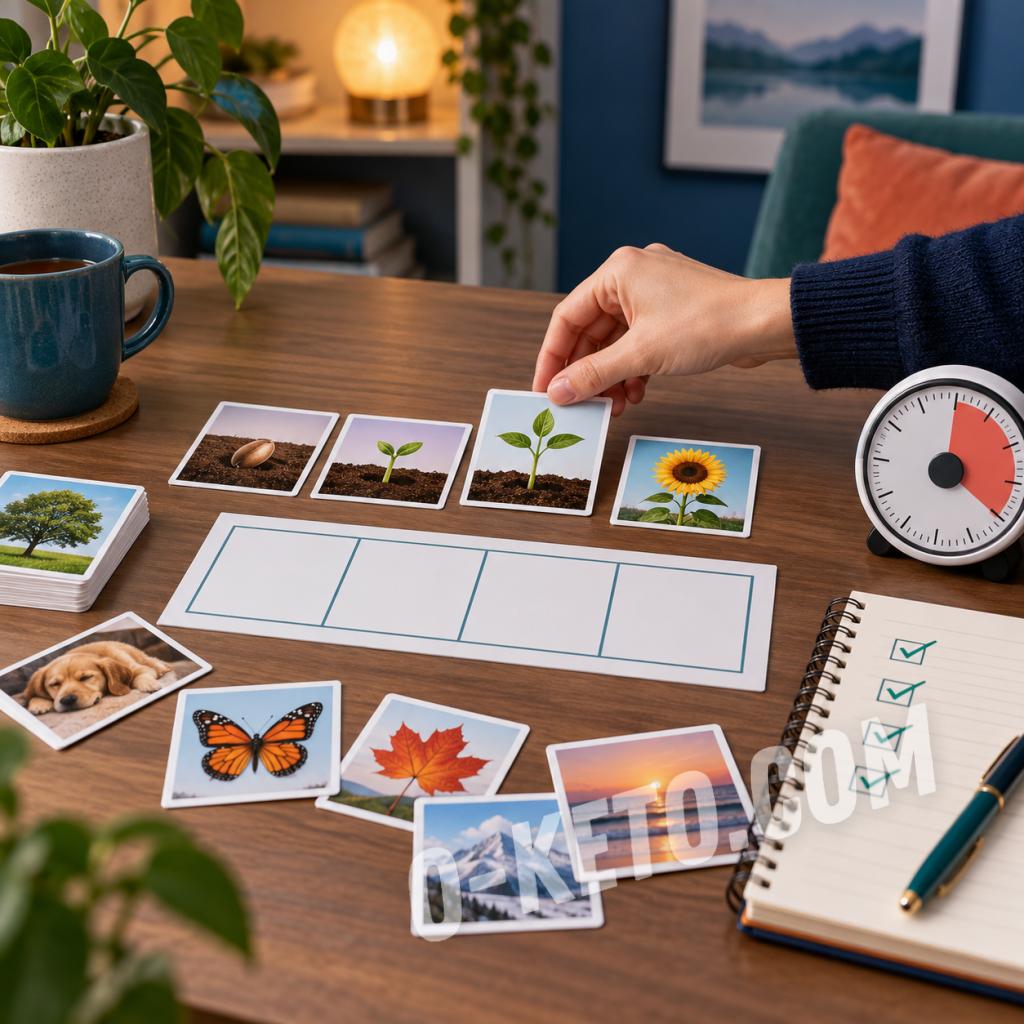
Arrange six to eight pictures or colored cards and study them for one minute. Cover them and rebuild the order on paper. For children, begin with three or four items. You can replace cards with a symbol grid: find a target sign and recall which row contained it.
Prepare a separate field containing numbers 1 to 10 in random positions. Find them in order and record time and errors. Keep the field size and lighting the same for fair comparisons; thirty seconds is not a universal norm.
How to work with text without spaces
Choose a short neutral passage with the words joined together. First read it slowly and mark word boundaries with a pencil. Then try to recover the meaning without chasing a record. This task checks sustained attention and context use, but it does not prove that the brain will automatically adapt to every difficult reading condition. Replace it with ordinary text if your eyes become tired.
How to assemble a fifteen-minute circuit
- 1 minute — preparation and a note about your condition.
- 2 minutes — an auditory word list and recall.
- 2 minutes — countries and writers by category.
- 2 minutes — associations and one or two anagrams.
- 2 minutes — counting by threes forward and backward.
- 2 minutes — mental arithmetic or a number grid.
- 2 minutes — cards, symbol search, or text without spaces.
- 2 minutes — review errors and record the result.
If the full circuit does not fit, alternate tasks across days. The point of an integration circuit is to see how skills combine, not to complete the maximum number of drills at any cost.
How to build a safe weekly routine
After a short workout, decide when and where it will happen. Choose one stable cue: a time after breakfast, a break when you are not driving, the start of lunch, or a quiet evening. The cue should lead to a specific action rather than a general promise to “train memory.” Start with one fifteen-minute session two or three times a week, and add days only when accuracy and well-being remain stable.
Three simple checklists can keep the plan visible:
- Morning: turn off alerts, choose one exercise, set a timer, and note your starting condition.
- Day: complete a short block for auditory memory, search, counting, or reading; record time and errors.
- Evening: recall key words or rules without prompts, note what felt difficult, and prepare materials for the next session.
Spread the load across the first week: use the auditory list and categories on day one; cards and number search on day two; associations and anagrams on day three; counting on day four; and joined text on day five. At the weekend repeat the two weakest tasks instead of forcing the full circuit. A checklist saves decisions, but it should not become a demand to complete every item at any cost.
Track three points: whether the exercise started, how many minutes it took, and what concrete result appeared. Missing one day does not erase a habit. Habit research shows wide individual variation in the time needed for automaticity, so focus on repeating the behavior in a suitable context rather than expecting a result in one or two weeks. Retrieval practice and spaced review are generally more informative than constant rereading, but improvement on one task does not guarantee transfer to every memory task.
Rest belongs in the plan alongside practice. Stand between blocks, look into the distance, and give your eyes a few screen-free minutes. Calm reading, breathing practice, or a quiet walk can help if they actually relax you. There is no need to ban television or make meditation mandatory; choose recovery according to your well-being and sleep quality.
Stop for headache, burning eyes, double vision, marked irritation, or a sharp drop in comprehension. If memory, attention, or word-finding problems appear suddenly, worsen, or disrupt daily life, arrange medical advice. Home practice trains specific skills but cannot identify the cause of a problem.
After the session, note which task felt hardest and repeat it the next day at a calmer pace. This shows whether practice is needed for holding an instruction, auditory recall, search, calculation, or order reconstruction.
Sources
- Using Testing as a Learning Tool.
- Spacing Repetitions Over Long Timescales: A Review and a Reconsolidation Account.
- Memory training interventions for older adults: A meta-analysis.
- Attention and executive functions: a review.
- Working Memory Training Does Not Improve Performance on Measures of Intelligence or Other Measures of “Far Transfer”.
- Time to Form a Habit: A Systematic Review and Meta-Analysis of Health Behaviour Habit Formation and Its Determinants.