When a person suddenly collapses, stops answering, looks confused, or lies still in a way that clearly does not look normal, many bystanders lose precious minutes not because they do not care, but because they freeze. The mind wants to understand exactly what happened: is this fainting, stroke, heart attack, seizure, poisoning, exhaustion, or something else? In the first moments, however, the most important thing is not a perfect label. It is a basic assessment of the situation. You need to know whether the person responds, whether they are breathing normally, and whether there is any immediate danger around you.
First aid begins with a simple sequence, not with rare medical knowledge. You notice that something is wrong. You approach safely. You speak to the person and check responsiveness. You look for normal breathing. You call for help and call emergency services if the situation may be serious. These first steps often matter more than any clever theory because they prevent delay at the exact time when delay becomes dangerous.
Why the first minutes are about basic assessment, not guessing
In a severe medical event, the brain, heart, and lungs are highly time-sensitive. If breathing has stopped or become ineffective, oxygen delivery to tissues falls quickly. If an unconscious person lies flat on their back, they may choke on vomit or secretions. If there is trauma, fire, water, electricity, traffic, or violence nearby, rushing in without a quick safety check can create a second victim.
That is why the first check is not meant to diagnose the exact cause at home. It is meant to answer a few practical questions. Is it safe to approach? Does the person respond? Are they breathing normally? Do you need to call emergency services right now and move to the next step of help? The sooner these questions are answered, the easier it becomes to move from panic to useful action.
How to approach safely
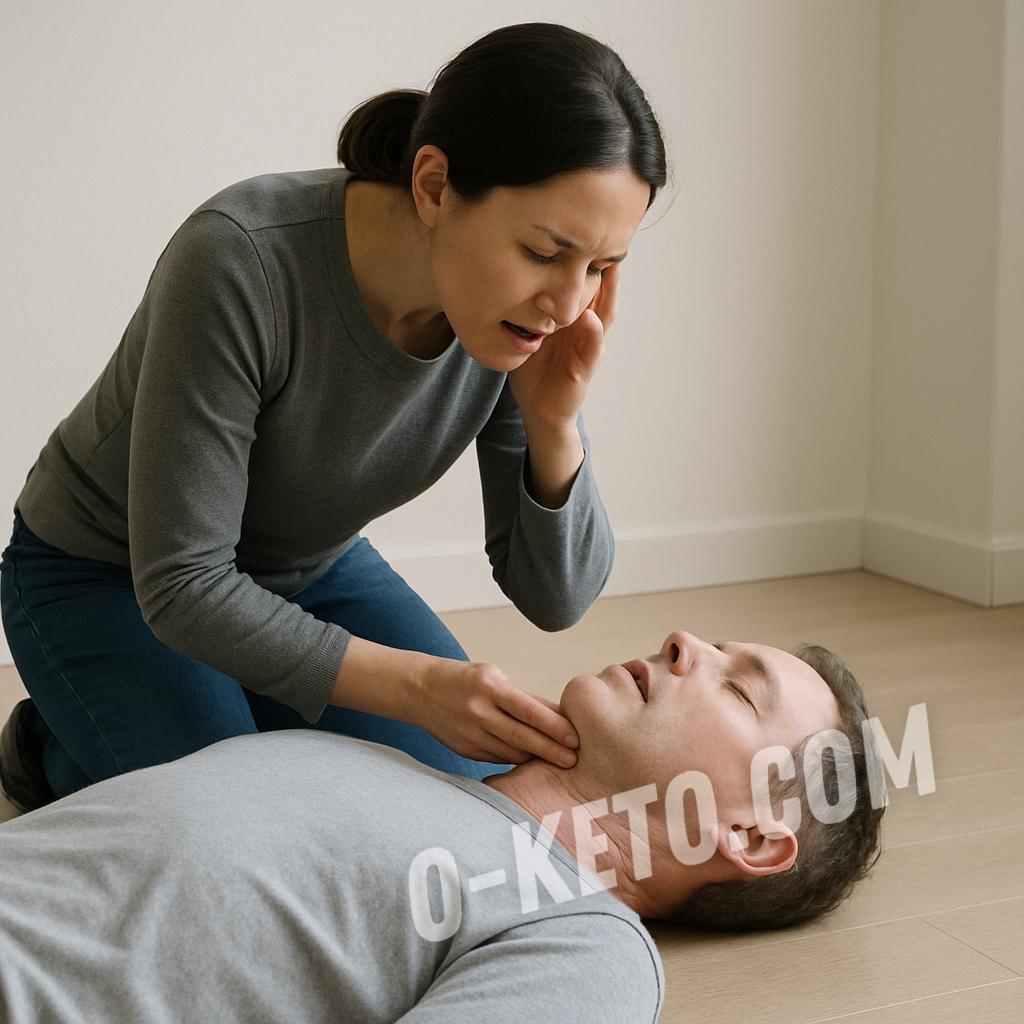
Before touching the person, take one or two seconds to scan the area. Water near an electrical cable, moving traffic, smoke, fire, broken glass, a risk of falling, ongoing violence, or another clear hazard changes the plan immediately. In such conditions, charging in blindly is not heroism. If possible, reduce the danger first, ask others for help, call emergency services, and only then come close enough for an assessment.
If there is no obvious danger, it is usually best to approach from the side of the head or shoulders so the person, if partly conscious, can notice you and not be startled by sudden contact. The approach should be calm and clear. Panic confuses both the helper and the casualty. Even at this stage, it helps to speak to people nearby. One person can call emergency services, another can clear space, and another can wait outside to guide the medical team in.
How to check consciousness
Consciousness is checked first through voice. Speak loudly and simply: “Can you hear me?”, “Are you okay?”, “Open your eyes.” If there is no response, it is reasonable to touch the shoulders gently or lightly shake the shoulder area without yanking the head or neck. The goal is straightforward: is there any meaningful response, eye opening, movement toward you, speech, groaning, or an attempt to follow a simple command?
Consciousness is not all-or-nothing. A person may answer incoherently, seem deeply confused, fail to understand where they are, or drift straight back into heavy drowsiness. That is still abnormal and potentially serious. For first aid, the issue is not whether you can name the syndrome perfectly. The issue is that normal contact is impaired, and that alone can mean the person needs urgent medical help.
How to assess breathing
After checking responsiveness, look for normal breathing. An ordinary bystander does not need advanced measurements or rare breathing classifications. The practical task is to get close enough to see the chest and face and observe whether the chest rises regularly, whether natural breaths are happening, and whether there are long pauses, rare gasps, noisy struggling breaths, or no visible breathing at all.
Normal breathing looks understandable and rhythmic. It may be faster than usual after stress or pain, but it still looks like real breathing. Concerning breathing includes absent breathing, very shallow breathing, rare breaths, gasping, or isolated agonizing attempts to pull in air. People sometimes mistake those gasps for “he is still breathing,” when in fact it is no longer effective normal breathing. In that situation, reassurance is dangerous.
Do you need to search for a pulse
Many people instinctively think of the pulse as the main proof of life because that is how emergencies are often shown in films. In real first aid, however, a prolonged pulse search often wastes time for non-professionals. A pulse can be difficult to feel because of cold skin, weak circulation, poor finger placement, too much pressure, stress, or lack of practice. A bystander can spend half a minute or more trying to be certain, while the real priority should already have been the breathing check and the emergency call.
If you know how to assess a pulse quickly and confidently and it does not delay the rest of the assessment, that skill can be useful. But if you are unsure, everyday first aid should focus first on responsiveness and normal breathing. The practical question is not “Can I perform a perfect pulse examination under stress?” It is “Is this person responding and breathing normally, or not?” That is what drives the urgency of the next step.
When to call for help and call emergency services immediately
Emergency services should be called as soon as it becomes clear that the condition may be serious, not only once things feel hopeless. This includes situations where a person does not respond, loses consciousness, does not breathe normally, suddenly turns blue or gray, has a seizure, has severe bleeding, shows signs of major trauma, choking, stroke, heart attack, poisoning, or any abrupt worsening that clearly looks dangerous.
If other people are nearby, it helps to give them concrete tasks:
- one person calls emergency services and states the address clearly;
- another clears space around the casualty;
- another waits outside or at the road to guide the medical team in;
- if relevant, someone brings a first-aid kit or an automated external defibrillator if one is nearby.
This simple division of tasks reduces chaos. One of the most common crowd mistakes is that everyone assumes somebody else has already called.
What to do if the person is unconscious but breathing
If the person does not respond but you can see normal breathing, the goal changes. At that point, the main priority is to reduce the risk of choking and to keep observing until medical help arrives. If there is no strong reason to suspect a major spinal injury or another condition where movement could obviously worsen harm, the person is usually placed carefully into a side recovery position. This helps protect the airway and makes ongoing breathing easier to watch.
That does not mean the situation is solved. Stay close and keep checking. Are the breaths still regular? Has the skin color changed? Is vomiting starting? Are seizures developing? Has breathing become rare, noisy, or uncertain? A first assessment is not a ritual done once and forgotten. Its value lies in noticing when the situation shifts from one emergency pattern to another.
What to do if breathing is absent or doubtful
If the person is unresponsive and is not breathing normally, or if the breathing looks like rare gasps, the situation should be treated as critical. At that point there is no time to wait for a perfect explanation. Call for help, call emergency services, ask for an AED if one is available, and move to the cardiopulmonary resuscitation algorithm if you are trained to do so.
Even if part of you thinks the person may wake up at any second, absent or doubtful normal breathing is not a situation for passive observation. In emergencies it is safer to make the mistake of acting on a life-threatening pattern than to make the mistake of waiting while oxygen delivery is failing.
Common mistakes during the first check
One common mistake is spending too much time talking around the problem instead of checking the basics. If a person is unresponsive, comments like “maybe he is just sleeping,” “maybe she is tired,” “maybe he is drunk,” or “maybe it will pass” do not replace a breathing check and an emergency call. Another mistake is trying to give water, food, sweets, or tablets before understanding what state the person is in. A third is trying to drag or sit the person up immediately without a reason.
Other dangerous errors include rough shaking of the head, forcing objects into the mouth during a seizure, searching for a pulse for too long instead of assessing breathing, ignoring scene danger, and walking away after one quick glance. In everyday first aid, it is much safer to remember a short sequence: safety, contact, breathing, call for help, then observation or the next emergency step.
Conclusion
You do not need advanced medical language to recognize that someone may need urgent help. If the person does not answer, does not open their eyes, is not breathing normally, breathes only rarely or noisily, or suddenly loses consciousness, the situation already deserves fast action. The first task is to approach safely, check responsiveness and breathing, involve nearby people, and call emergency services.
In everyday first aid, pulse checking should not become a trap that steals time. It is more useful to recognize the absence of normal breathing and avoid arguing with what is already obvious. A calm first check done without hesitation often helps more than chaotic attempts to “do everything at once.” It is exactly this first check that turns fear into useful help.
Sources
- 2024 American Heart Association and American Red Cross Guidelines for First Aid
- 2025 Adult Basic Life Support Guidelines — Resuscitation Council UK
- Part 7: Adult Basic Life Support — American Heart Association CPR & First Aid Guidelines 2025
- First Aid Steps — American Red Cross
- Check, Call, Care: Three Emergency Actions Steps — American Red Cross