
Severe bleeding frightens almost everyone, and that fear often leads to wasted actions. People start looking for water, trying to wash the wound, peeling dressings away to see whether the bleeding has stopped, searching for antiseptics, or arguing about whether a tourniquet is needed. In real first aid, the first minutes should be much simpler than that. The goal is to reduce blood loss quickly, protect clot formation, and call for emergency help early when the situation is serious.
The danger is not only the visible wound. Rapid blood loss reduces oxygen delivery to tissues, weakens circulation to the brain and heart, and can push the injured person toward shock. They may become pale, cold, sweaty, dizzy, confused, and increasingly weak. That is why good first aid in this situation is not about making the wound look neat. It is about buying time and preventing the blood loss from getting worse before medical professionals arrive.
How to recognize dangerous bleeding
Not every cut needs a tourniquet or an emergency response, but some patterns clearly do. Bleeding is especially concerning when it is heavy, sustained, soaking through clothing or dressings quickly, pooling visibly, or continuing despite early attempts to control it. A wound does not have to spray dramatically to be dangerous. Any serious ongoing blood loss that is hard to control deserves urgent attention.
Warning signs also include worsening weakness, dizziness, pale skin, clammy coldness, confusion, fast pulse, and a general sense that the person is fading. A deep wound, major laceration, traumatic amputation, severe limb injury, or bleeding in a child, older adult, or someone taking blood thinners also raises the level of concern even when the floor is not covered in blood.
What to do in the first seconds
Start with safety. If the injury happened near traffic, broken glass, machinery, electricity, or another active hazard, do not become a second casualty. Once the area is reasonably safe, call emergency services or tell someone nearby to do it immediately. In major bleeding, waiting to see whether it “calms down on its own” is a bad strategy.
If gloves are available, use them. If not, do not lose critical time looking for perfect protection. A plastic bag, cloth barrier, or improvised layer is better than delay. The next key step is direct pressure.
Direct pressure is the most important first-aid tool
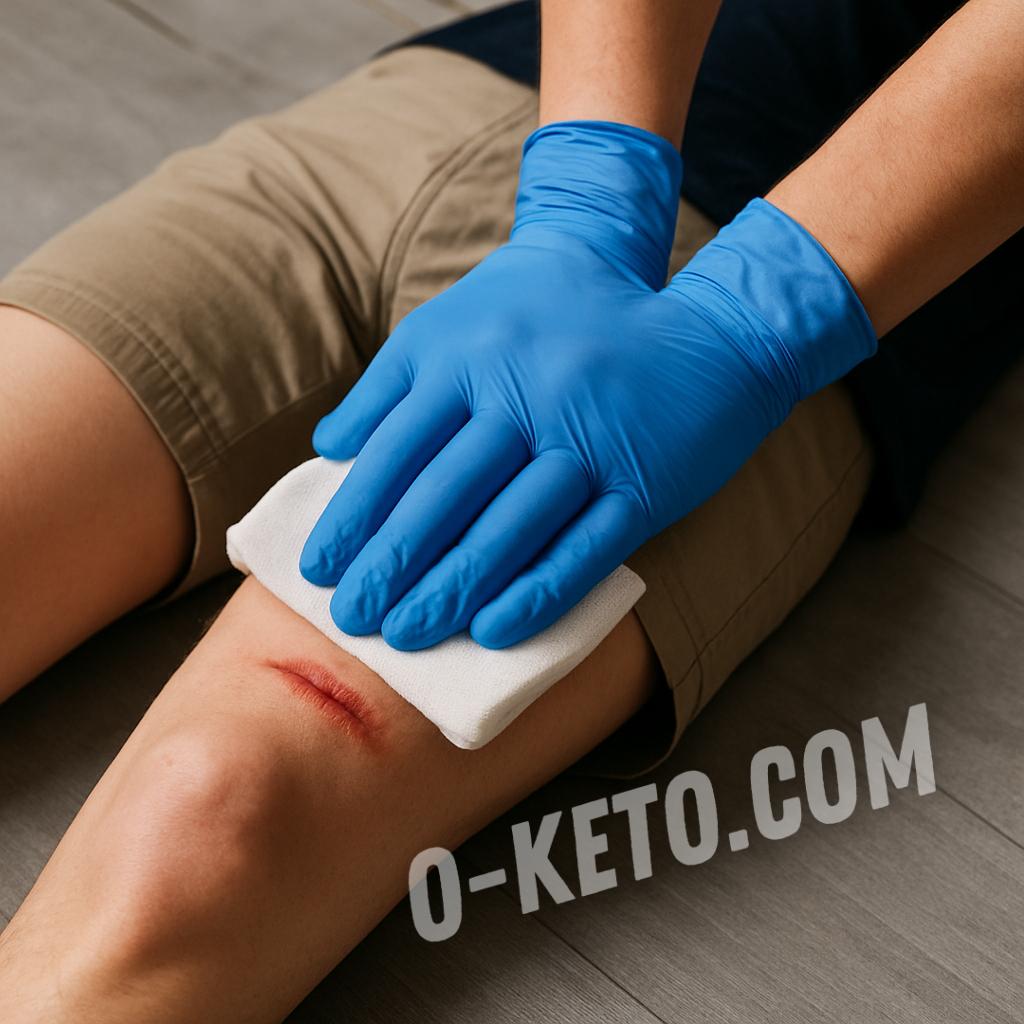
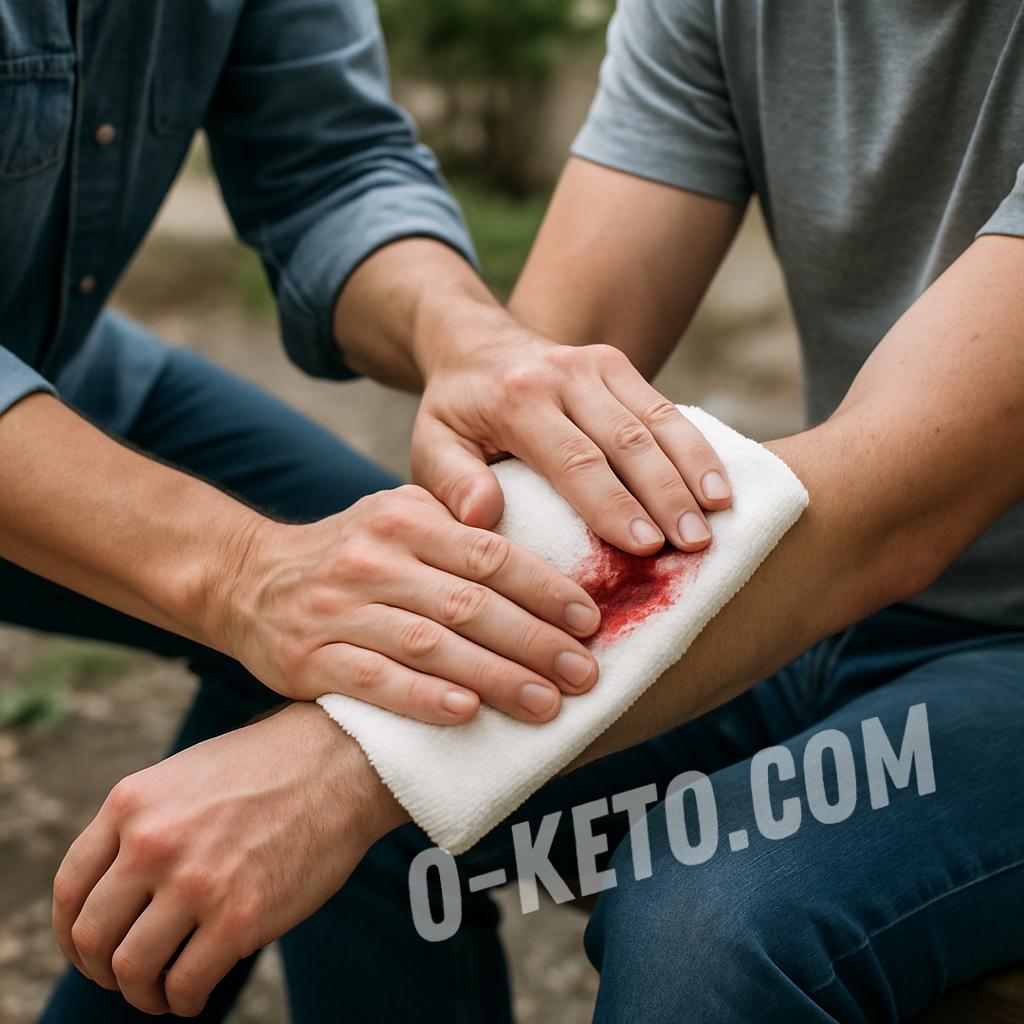
The main and most useful maneuver in external bleeding is to press firmly on the wound. Use sterile gauze, a bandage, a clean cloth, a towel, a shirt, or any thick available fabric. If nothing ideal is nearby, pressure through an available layer is still better than doing nothing. The point is mechanical: reduce the outward flow of blood and give clotting a chance to work.
The pressure needs to be firm and continuous, not symbolic. One common mistake is to press briefly and then lift the dressing again and again to see whether the bleeding has stopped. Every lift can disrupt a forming clot and restart the problem. So once the first layer is in place, keep pressing rather than checking constantly.
If blood soaks through, add more material on top and continue pressing. Do not rip away the original layer just because it looks wet. In serious bleeding, stable pressure matters far more than repeatedly replacing the first blood-soaked cloth.
When a pressure dressing helps
If direct pressure slows the bleeding enough, the next practical step is often a pressure dressing. This is not for appearance. It is meant to hold pressure in place and free your hands while still compressing the wound. In practice, you leave the original pad in place and wrap another layer firmly over it with a bandage or fabric strip.
But a pressure dressing should not give false reassurance. If blood keeps rapidly flooding through it, the bleeding is not controlled and firmer direct pressure is still needed. The dressing works best once pressure has already started helping and you need to maintain that effect.
What to do if something is stuck in the wound
If a knife, glass fragment, metal piece, wooden splinter, or other deep object is embedded in the wound, do not pull it out on scene. The object may be partly blocking the damaged vessel and slowing the blood loss. Removing it before surgical care is available can make the bleeding dramatically worse.
Instead, apply pressure around the object, not onto it. Build padding around the object so the dressing can compress the surrounding area without driving the object deeper. This is also a situation where calling emergency services early matters especially much.
When a tourniquet may be needed
A tourniquet is not the answer to every bleeding wound. It is mainly a tool for life-threatening bleeding from an arm or leg when strong direct pressure is not enough, when the blood loss is so severe that the person may die before help arrives, or when there is a traumatic amputation or near-amputation. It is a limb tool, not something for the torso or neck.
Modern first-aid guidance is much clearer than older myths. If a properly made commercial tourniquet is available and you know how to use it, it can be placed above the wound on the injured limb, tightened until the bleeding stops, and then left in place until medical professionals take over. One of the most dangerous outdated ideas is loosening the tourniquet every so often “to let blood through.” If a tourniquet truly became necessary and was applied correctly, loosening it can restart catastrophic bleeding.
Improvised tourniquets made from belts, scarves, or thin cords are far less reliable and can injure tissue without actually controlling the bleed. So if you do not have proper equipment or skill, strong sustained direct pressure is usually more useful than a badly improvised device that only looks decisive.
Mistakes that make bleeding worse
One common mistake is trying to wash a serious wound right away. In major bleeding, this is not the moment for running water, antiseptic, or peroxide. Hemorrhage control comes first. Another mistake is repeatedly removing the dressing to inspect the wound. That can break the forming clot again and again.
It is also a mistake to spend too much time searching for a “perfect” sterile material when the wound is still bleeding heavily. A clean shirt pressed hard onto the wound is often far more useful than delayed textbook perfection. Ice is another common distraction. Cold is not the main solution for severe bleeding and should not replace pressure.
Another bad decision is making a weak, bleeding, pale person sit up or keep moving around. If blood loss is substantial and the person looks faint or shocked, keeping them down, warm, and relatively still is usually safer. Food, alcohol, and casual drinks are not part of severe bleeding first aid.
What to do while waiting for emergency help
After calling emergency services and starting hemorrhage control, stay with the injured person and keep watching their condition. Watch for worsening weakness, pallor, confusion, or renewed heavy bleeding. If possible, help them lie down, keep them warm with a jacket or blanket, and reassure them. Calm, simple, repeated actions help more than frantic movement and constant talking.
If the injury is on an arm or leg and there is no major concern about movement-related trauma, the limb may sometimes be raised once pressure is already applied, but that does not replace direct pressure. With suspected fracture or severe traumatic pain, do not chase “perfect positioning” at the expense of hemorrhage control.
When medical care is definitely needed
Any severe, ongoing, or difficult-to-control bleeding needs medical evaluation. Emergency help is especially important if bleeding does not stop, the wound is deep, the injury involves glass, bites, dirty objects, face, neck, groin, major joints, hands or feet, if something is embedded, if there has been an amputation, if the person looks shocked, or if they take anticoagulant medication.
Even when the bleeding later slows under pressure, the problem may not be fully solved. Deep damage to vessels, tendons, or nerves can be hidden behind the fact that the floor is no longer getting red. Serious wounds are judged not only by how much blood is visible now, but also by the mechanism of injury and the injured person’s overall condition.
Takeaway
In severe bleeding, the priority is not cleaning the wound but using fast, continuous direct pressure and calling for help early. If there is no embedded object, press firmly with cloth or dressing and do not keep lifting the first layer to look underneath. If an object is stuck in place, do not remove it; press around it instead. A tourniquet belongs mainly to life-threatening limb bleeding that cannot be controlled quickly with direct pressure.
The biggest mistakes are delay, unnecessary washing of a major wound, removing the first soaked dressing, probing into the wound, and loosening a tourniquet before professionals arrive. In real emergencies, the simplest actions done quickly and steadily are often the ones that save the most blood and the most time.
Sources
- 2024 American Heart Association and American Red Cross Guidelines for First Aid
- First Aid Guidelines — Resuscitation Council UK 2025
- First Aid for Severe External Bleeding — American Heart Association and American Red Cross
- First Aid for Life-Threatening Extremity Bleeding That Is Not Controlled by Direct Pressure — American Heart Association and American Red Cross
- Stop the Bleed: Save a Life — American College of Surgeons