Dr. Berg’s body types are a practical pattern model in which body-fat distribution is linked not only to calories, but also to the dominant hormonal or metabolic problem that seems to be pushing the picture the most. The point of the model is not to give someone a decorative label. The point is to use body shape, symptom patterns, food reactions, and day-to-day complaints to guess where the main weak point may be: stress and cortisol, ovarian-estrogen signaling, sluggish thyroid function, or liver and bile overload.
It is important to separate a useful heuristic from a medical diagnosis. This model is not an official diagnostic system and it cannot replace laboratory work, thyroid assessment, liver tests, ultrasound, glucose and insulin evaluation, or menstrual-cycle analysis. Still, many people do notice that their weight tends to collect in a very specific way: mostly in the upper abdomen, mostly in the lower body, more evenly across the whole body, or as a large central belly with bloating and poor tolerance of fatty food. That is what makes the model practical.
What the four types are and why they should not be confused with diagnosis
In Dr. Berg’s framework, four main types are usually described. They differ not only visually, but also in complaints, energy patterns, sleep quality, and food tolerance. The basic scheme is simple:
| type | where weight often gathers | what issue is suspected first |
| adrenal | upper abdomen, waist, back | stress, cortisol excess, poor sleep, constant stimulation |
| ovarian | lower abdomen, hips, thighs, buttocks | stronger estrogen pattern, cycle problems, tendency toward PCOS |
| thyroid | more evenly over the whole body | slow metabolism, sluggish thyroid function, poor hormone conversion |
| liver | large central belly | overloaded liver, weak bile output, poor fat tolerance |
This table is useful as a quick orientation map, but it does not mean one body zone automatically proves one disease. A person may have insulin resistance, chronic stress, bad sleep, low protein intake, poor bile flow, a sluggish thyroid, and ovarian-hormone issues at the same time. That is why it is safer to think of a body type as a dominant pattern rather than a final verdict.
How the four types differ by weight-gain pattern
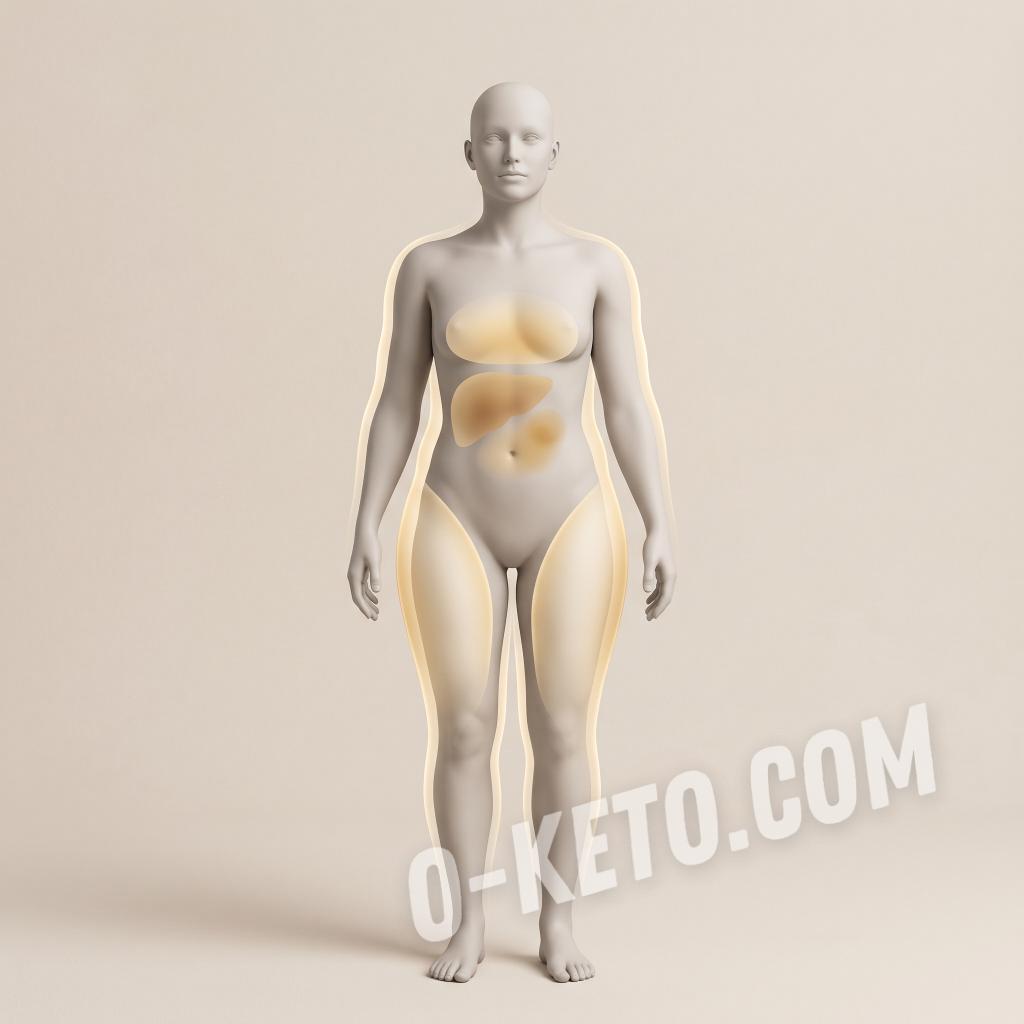
The adrenal type often looks like a person whose main issue gathers around the waist and upper belly. The arms and legs may not be the heaviest part, but the abdomen becomes more prominent on a background of stress, poor sleep, and constant nervous tension. The ovarian type tends to shift weight lower, especially around the lower abdomen, hips, and thighs. The thyroid type often feels more diffuse, as if the person is gaining weight everywhere rather than in one clearly isolated zone. The liver type is more often associated with a large central belly, bloating, belching, right-sided heaviness, and the feeling that fatty meals are both craved and poorly tolerated.
That distribution pattern is what makes the model easy to understand in real life. But the shape alone is not enough. The same waist size can come from very different mechanisms. One person may be dealing mostly with stress and late eating, another with fatty-liver overload and poor bile flow, and another with a broader combination of high insulin, low activity, and poor sleep. So the mirror is only one clue. The symptom context matters just as much.
Adrenal body type
The adrenal type is usually linked to chronic stress, excess cortisol, and a body that spends too much time in a survival mode. These are often people who run on coffee, late nights, erratic meals, and the feeling that they cannot get through the day without stimulation. Weight often moves toward the upper abdomen and waist, while evening cravings for sweets, salty foods, or just more food in general become stronger. Morning energy may feel poor without caffeine, yet real relaxation at night is difficult.
The practical meaning of this type is that simple calorie cutting often works badly. If cortisol is high, sleep is poor, and meals are chaotic, the body becomes less stable in its use of fat as calm fuel and the risk of overeating rises when fatigue accumulates. These people often do better not from a harsher diet, but from rhythm repair: a protein-and-fat breakfast, fewer sweet liquid calories, less late caffeine, a more regular bedtime, and less grazing through the day.
Ovarian body type
The ovarian type is usually linked to stronger estrogen signaling and issues that affect the menstrual cycle, ovulation, fluid retention, and lower-body fat storage. Visually, it can look like relatively more weight in the lower abdomen, hips, thighs, and buttocks. In some women this pattern comes with stronger PMS, a bigger appetite shift in the second half of the cycle, breast tenderness, fluid retention, or signs that fit polycystic ovary syndrome.
This does not mean every woman with fuller hips has a hormone problem. But when the shape pattern is paired with cycle complaints, the model becomes more useful. In that situation, calories are only one part of the picture. Lowering repeated sugar and flour overloads, improving insulin control, supporting the liver because the liver helps process hormone metabolites, eating enough protein, and improving sleep all become important.
Thyroid body type
The thyroid type is usually described as a more even whole-body weight gain on a background of slower metabolism. Typical complaints include feeling cold, low energy, dry skin, weaker hair quality, puffiness, slow mornings, and the sense that the body simply burns fuel more slowly than it should. Weight gain often does not stay in one narrow zone. Instead, the person feels heavier almost everywhere.
The value of this type is that it pushes the discussion beyond one lab number. Proper thyroid function depends not only on the gland itself, but also on hormone conversion, liver status, protein intake, iodine, selenium, zinc, and stress load. In some people, excess estrogen signaling and chronic cortisol may also interfere with thyroid balance.
Liver body type
The liver type is usually linked to an overloaded liver, weak bile production, and poor tolerance of heavy, fried, or very fatty meals. Externally, it often means a larger central belly. In symptoms, it may come with bloating, belching, heaviness under the right ribs, a worse reaction to alcohol, poor tolerance of fatty food, and the strange combination of craving richer food while digesting it badly.
Practically, this type matters because weak bile flow and liver overload can make it hard to digest fats well and therefore harder to absorb fat-soluble nutrients properly. Alcohol, excess sugar, syrups, repeatedly heated oils, ultra-processed foods, and overeating all increase the burden.
Why mixed types are common
In real life, many people do not have one perfectly clean type, and that is exactly what would be expected biologically. Hormonal and metabolic systems affect one another. Chronic stress can suppress thyroid performance. An overloaded liver can worsen the handling of hormone metabolites and interfere with thyroid hormone conversion. Stronger estrogen signaling may become harder to manage if the liver is already burdened. So one person may show a large abdomen, cold intolerance, poor sleep, and cycle problems at the same time.
That is why the model works best not as a hunt for one final label, but as a way to identify the strongest starting point. If the clearest complaints are insomnia, dependence on caffeine, irritability, and upper-belly gain, it makes sense to begin with stress and recovery. If the biggest issues are bloating, right-sided heaviness, and poor fat tolerance, liver and bile work become the first step.
Where Berg suggests starting when the picture is mixed
In the practical part of the model, Berg suggests not getting stuck when a person sees signs of several types at once. His idea is that if the picture is mixed and there is no clear certainty, it often makes sense to begin with the adrenal pattern and then watch the response. The reason is not that the adrenal type is magically universal, but that stress, poor sleep, blood-sugar swings, and stimulation-driven eating are extremely common in real life.
If that pattern does not improve satiety, digestion, weight, or energy, he suggests moving to the next likely pattern, often the liver one. In contrast, thyroid and ovarian patterns are treated as more specific. If a person is already taking thyroid hormone, feels clearly slowed down metabolically, or shows a very strong lower-body estrogen-type pattern, those routes become more reasonable earlier.
How Berg shifts food emphasis for each type
This is where the model becomes more applied. Berg does not use exactly the same food emphasis for everyone. Instead, he shifts the balance of protein, fats, dairy, cruciferous vegetables, and digestion-related caution depending on the dominant pattern:
| type | main food emphasis | what to watch |
| adrenal | more protein and enough fats | satiety, steadier blood sugar, less stimulation and chaos |
| ovarian | similar to adrenal, but with stronger attention to cruciferous vegetables and estrogen-related burden | cycle symptoms, soy exposure, appetite shifts |
| liver | more caution with heavy protein and fats, more bitter and cruciferous vegetables | red-meat tolerance, nuts, bloating, right-sided heaviness, bile support |
| thyroid | more moderate protein and fat, attention to iodine context | coldness, sluggishness, swelling, and response to cruciferous vegetables without enough iodine |
The most useful part of this approach is that it forces a person to look at response rather than at a rigid food label. If digestion worsens, bloating rises, shoulder pain appears, cravings remain strong, or fatigue gets worse, the pattern needs adjustment rather than blind loyalty.
How he frames the adrenal pattern in practice
For the adrenal type, Berg leans toward a more filling protein-and-fat pattern. The logic is that people living in a stress-heavy state often do worse on light or erratic eating because strong hunger and sugar swings push them back toward snacking and quick carbohydrates. He therefore emphasizes eggs, fish, poultry, and other protein foods, together with enough natural fats to maintain satiety if fats are tolerated well.
At the same time, this should not be misunderstood as “protein cures adrenal problems.” The real aim is steadier appetite and less blood-sugar volatility while sleep and stress load are being improved. He also notes that some people with this pattern feel worse on rough cruciferous vegetables because of bloating, so softer vegetables may work better at first.
How he frames the ovarian and liver patterns
For the ovarian type, the structure is partly similar in satiety terms, but the focus shifts toward estrogen handling. That is why cruciferous vegetables become more central, while soy is treated more cautiously. In real life this means the model is trying to reduce lower-body hormonal burden rather than simply cutting calories.
For the liver type, Berg becomes more careful with large servings of red meat, fried food, peanut butter, and excess nuts. The reasoning is that if liver handling and bile flow are already weak, bigger protein and fat loads may create heaviness, bloating, belching, and right-sided discomfort. In that setting, vegetables, digestion, and bile tolerance become more important than forcing a stereotypical high-fat plan.
How to correct the plan instead of following it stubbornly
One of the strongest practical points in this model is that symptoms matter more than rule worship. Berg explicitly treats bloating, belching, digestive heaviness, shoulder pain, rising fatigue, and stubborn carbohydrate cravings as feedback signals. Bloating after fats may point more toward bile trouble than toward a wrong “label.” Strong fatigue may mean protein went too low. Persistent cravings may mean vegetables, minerals, satiety, or meal structure are still off.
This matters because many people copy a plan too literally and then ignore what their own body is telling them. The smarter use of the model is to treat it as a working hypothesis: choose a likely starting point, test it, watch digestion, satiety, sleep, energy, cravings, and weight trend, and then adjust the direction.
How to use the model in practice and with keto
The model is most helpful when it makes the first intervention clearer. There is no need to attack everything at once. A better approach is to identify the dominant pattern and start with the basics that match it: sleep timing, meal frequency, sugar load, enough protein, digestive response to fats, and signs that point toward thyroid slowdown or cycle imbalance.
Keto and lower-carb eating can fit into this model, but only as one tool inside a larger plan. Reducing sugar spikes and repeated insulin stimulation really can help many people with adrenal, ovarian, and liver-type patterns because appetite becomes calmer, snacking drops, and the liver gets less pressure from constant sugar intake. But keto does not automatically fix poor sleep, significant hypothyroidism, weak bile flow, or serious menstrual problems.
When tests and direct medical evaluation matter
If the visible pattern comes with real symptoms, it is worth moving from guessing to checking. In a thyroid-type picture, TSH, free T4, and free T3 are often the first laboratory questions. With marked abdominal weight gain, fasting glucose, fasting insulin, HbA1c, and a lipid profile are often useful. With a liver-type picture, ALT, AST, GGT, bilirubin, and sometimes liver or gallbladder ultrasound may be relevant. With an ovarian-type pattern, cycle history, insulin status, signs of PCOS, and a wider hormone discussion become important.
Main point
Dr. Berg’s body types are useful not because they divide all people into four perfect boxes, but because they help reveal the main direction of the problem. For one person the dominant issue may be chronic stress and cortisol. For another it may be estrogen-pattern imbalance. For another it may be sluggish thyroid function. For another it may be liver overload and weak bile flow. The practical value increases further when the body-shape pattern is combined with real reactions to protein, fats, vegetables, digestion, and meal rhythm. That is where the model becomes a usable map rather than a decorative label.