


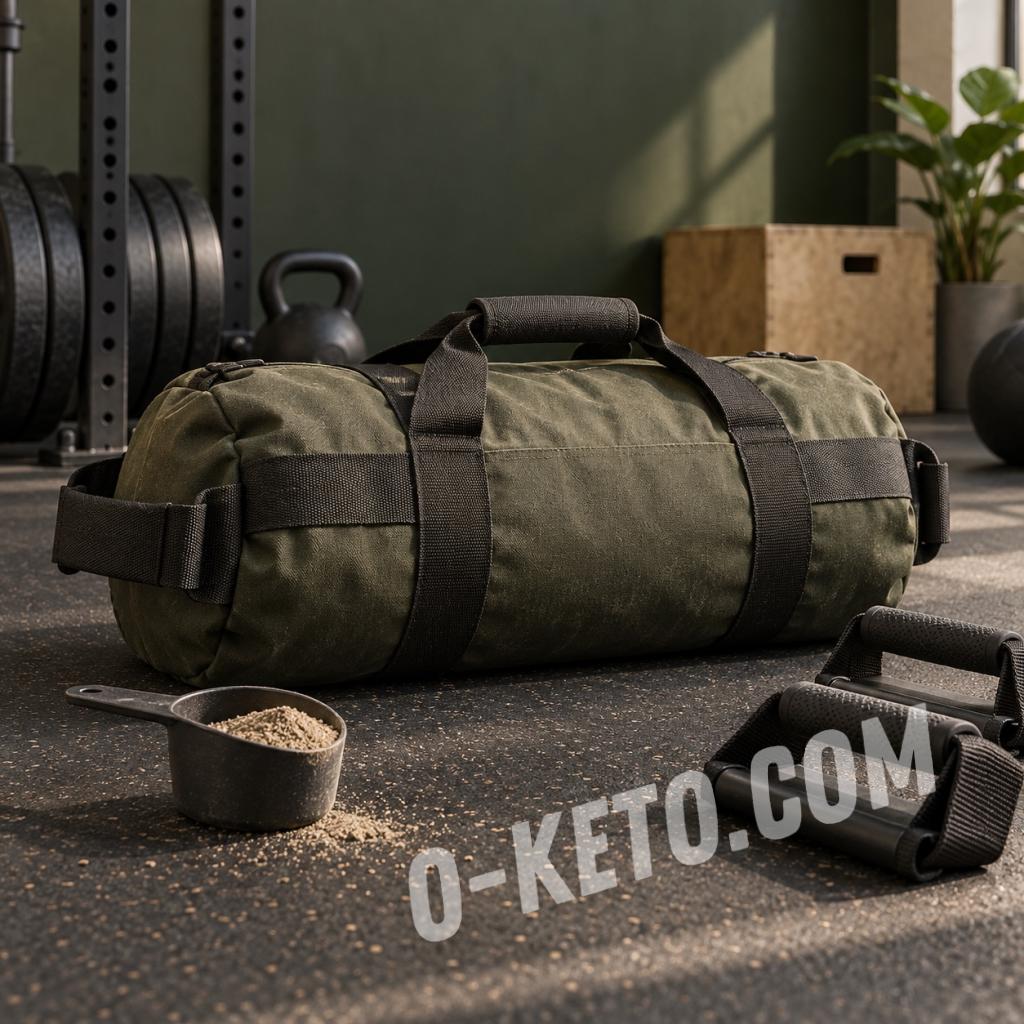

A sandbag provides resistance that changes shape while it is lifted or carried. As the filler shifts, the load feels different at different points of the range, and the grip and trunk must keep adjusting. That makes the sandbag a useful addition to home, outdoor, or gym training, but it does not make it universally better than other equipment. Results still depend on the goal, technique, progressive loading, and recovery.
How to choose and prepare a sandbag
Start with a durable bag with reinforced seams, a closed inner chamber, and handles that do not cut into the hands. The filler should be dry and the closure protected from leaks. Before each session, check the seams, handles, and floor: wet sand changes the mass, and a tear near the feet can cause a sudden fall. Leave clear space and do not lift the bag overhead when people, glass, or fragile equipment are nearby.
Choose the first load by technique rather than by a table from a book or somebody else’s video. Lift the bag from a raised surface, hold it at the chest, and perform a few calm squats. If the trunk tilts, breathing becomes ragged, or the grip fails quickly, use less filler. One light load for learning and a second load for gradual progress are often enough.
Which movements to learn first
Begin with stable bilateral movements: lifting the bag from a raised surface, a front-loaded squat, a bent-over row, a chest press, and short carries. Keep the load close, move smoothly, and finish the repetition before the ribs and pelvis lose their position. Practice every exercise for several sets with a light load before adding complexity.
Shouldering and other explosive variations require more coordination. Learn them only after the hinge, squat, and carry are reliable. Do not catch a moving bag with locked-out arms or let the knees twist with a sudden trunk turn. If the movement breaks down, return to a higher starting surface and a slower lift.
How to train the grip and trunk
An uneven bag shifts its centre of mass, so the hands, forearms, and trunk work asymmetrically. Use a front carry, a shoulder carry, and short farmer-style walks. Take controlled steps, look forward, and do not compensate with an exaggerated lower-back arch. With a one-sided carry, shorten the distance and keep the pelvis level.
Add rotation and lateral work after straight-line carries are controlled. Turn through the feet and hips rather than twisting only the lower back; keep the range comfortable. The bag’s shifting load can make a task harder, but exercises on a Swiss ball or another unstable surface are not required and often reduce the force that can be produced.
How to progress
Change one variable at a time. First add a repetition or a few seconds of carrying, then add a small amount of weight. Other options are a longer range, a pause at the bottom, a slower lowering phase, or a slightly longer carry. Record load, sets, repetitions, distance, and perceived difficulty. Keeping about one to three repetitions in reserve helps end the set before technique fails.

A full-body sandbag session
After a warm-up, perform a raised-surface lift, a front-loaded squat, a bent-over row, a chest press, and a front carry. Begin with two sets of each movement and rest one to three minutes, adding time when breathing or grip control has not returned. A third set is unnecessary if technique has already slowed. Finish with an easy walk and a short note about readiness.
Train two or three times per week, with at least a day between hard sessions. On another day, use easy walking or mobility work. A circuit with short rests increases work density, but it should not replace strength-focused sets when strength is the priority. For power, use only mastered movements and end the set when speed clearly drops.
How to combine a sandbag with other equipment
Barbells and dumbbells make load and bar path easier to track, while a sandbag adds grip and carrying variation. Put the most important lift first. The sandbag can be a secondary movement or a separate general-conditioning day. Avoid increasing the barbell load, sandbag volume, and cardio at the same time.
Safety and recovery
Stop for sharp pain, dizziness, chest pain, unusual breathlessness, or sudden weakness. After an injury, surgery, pregnancy, a long break, or with uncontrolled blood pressure, coordinate the plan with a clinician. Pay attention to sleep, food, and hydration. A special filler, the label “functional,” or a promise of greater calorie burn cannot compensate for poor technique or an overly rapid increase in load.
Conclusion
A sandbag is a useful free-load option for squats, lifts, carries, presses, and controlled rotation. Start with sound equipment and a light load, learn stable movements, then change one variable at a time and keep records. An uneven load challenges grip and trunk control, but it does not automatically make the sandbag better than a barbell or training on an unstable surface.
Sources
- Resistance Training Prescription for Muscle Function, Hypertrophy, and Physical Performance in Healthy Adults: An Overview of Reviews — American College of Sports Medicine
- Resistance training prescription for muscle strength and hypertrophy in healthy adults: a systematic review and Bayesian network meta-analysis — British Journal of Sports Medicine
- The influence of resistance exercise training prescription variables on skeletal muscle mass, strength, and physical function in healthy adults: An umbrella review
- WHO Guidelines on Physical Activity and Sedentary Behaviour — World Health Organization


