


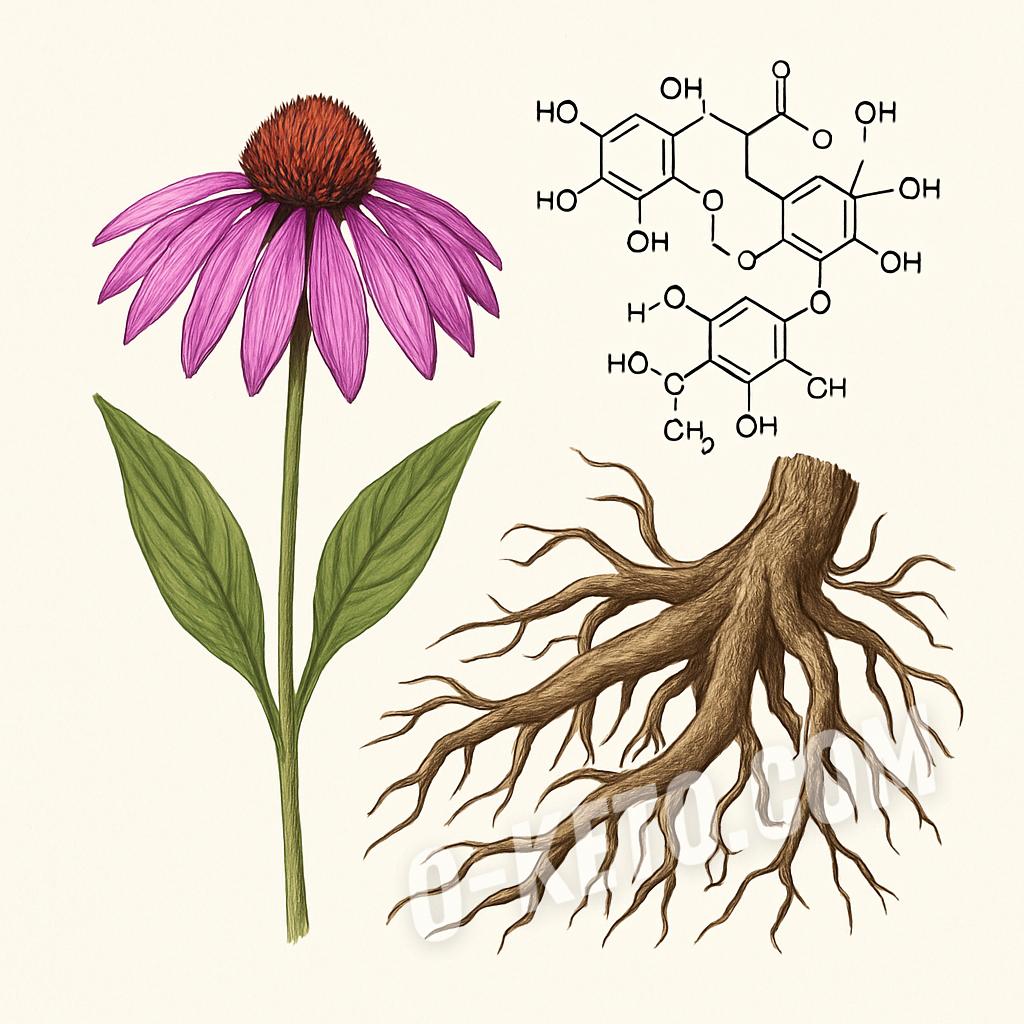

Echinacoside is a phenylethanoid glycoside best known from the roots of some echinacea species, especially Echinacea angustifolia and Echinacea pallida. In echinacea extracts it is useful as one of the active-profile markers because it helps show whether the raw material truly represents a meaningful root extract rather than only carrying a familiar plant name.
Why it matters
The active profile of echinacea cannot be reduced to one molecule: alkamides, polysaccharides, and phenolic acids matter too. Even so, echinacoside remains one of the most recognizable quality markers for root-focused extracts. That makes it useful here not to oversimplify echinacea, but to compare products more precisely when species and plant part really matter.
Where it occurs
The practical source on this site is echinacea. Echinacoside content depends strongly on the species, the plant part used, and the extraction method: roots of some species are much richer than aerial parts or weaker materials. This is one reason why two products labeled “echinacea” can differ substantially in meaning and potency.
Practical benchmarks
There is no official daily requirement for echinacoside. This page uses a practical milligram benchmark so root extracts can be compared and readers can see when a product contains a meaningful active fraction. With echinacea, the number is only part of the picture; species, plant part, and extract type still matter.
What to consider
Echinacea is often used in shorter courses rather than as an endless daily supplement. The echinacoside marker is therefore most useful as a sign of raw-material quality and extract identity, not as a replacement for understanding the whole plant profile and the logic of a given course.