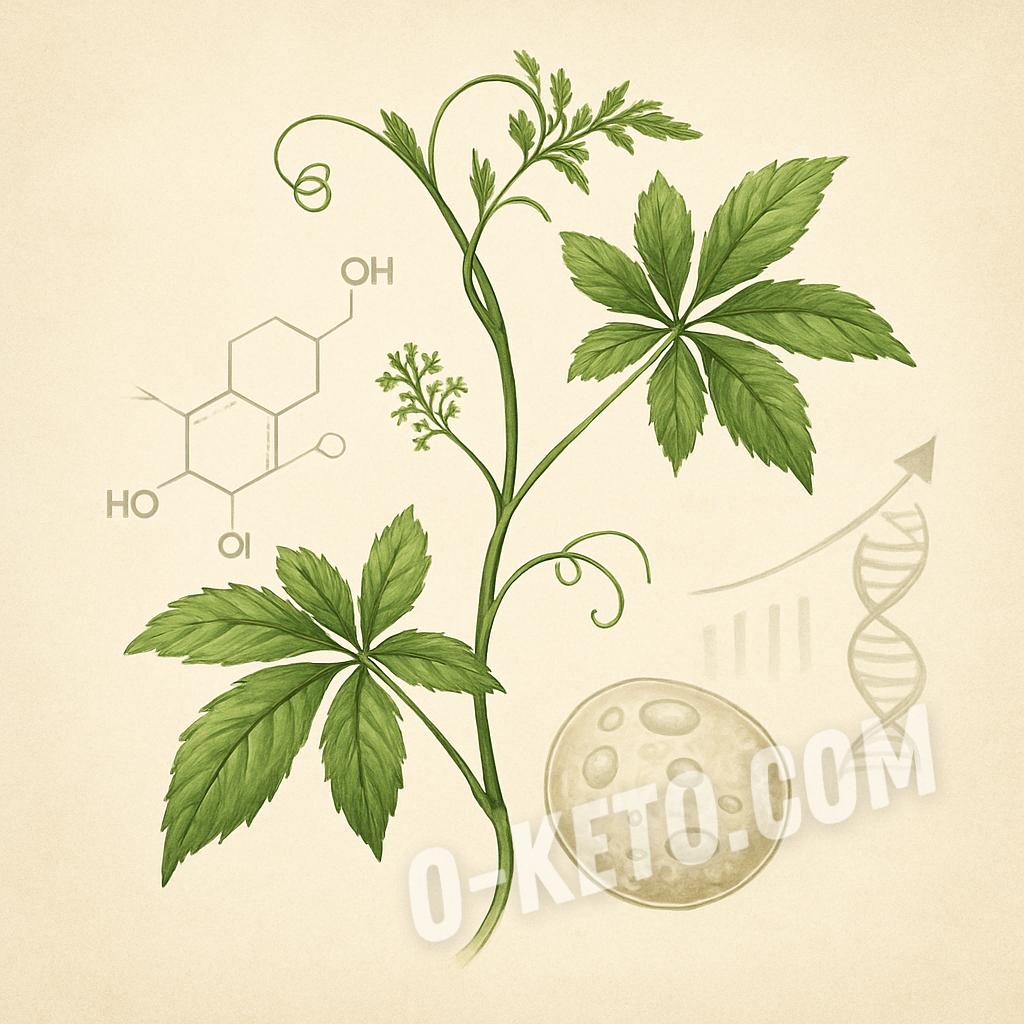
Gypenosides are a group of triterpene saponins characteristic of Gynostemma pentaphyllum, better known as jiaogulan. They are usually treated as the plant’s main active fraction when its metabolic, anti-stress, and vascular effects are discussed. For this page, the practical point is simple: loose leaf jiaogulan, tea, and a standardized extract are not equally dense sources of gypenosides.
Why they matter
When jiaogulan products are compared for quality, gypenosides become the marker that helps separate plain herbal material from a more concentrated extract. Many formulas rely on total saponins or gypenoside-rich fractions as the core standardization layer. Without that information, the plant name alone says very little about the actual strength of the product.
Where they occur
On this site the main practical source is jiaogulan. Gypenoside levels can vary substantially with plant material and extraction method, so in practice a clear active-saponin standardization is far more useful than a vague concentration ratio.
Practical benchmarks
There is no official daily requirement for gypenosides. This page uses a practical milligram benchmark so products can be compared by active density rather than by marketing language alone. For longer use, tolerability and a predictable extract profile usually matter more than pushing the highest possible saponin number.
What to consider
Jiaogulan is often grouped with adaptogenic herbs, but real-world stimulation, tolerance, and subjective response can vary a lot between people. The gypenoside value here is therefore best treated as a standardization marker, not as a promise of an identical effect for everyone.
PubMed studies(10)
✓Adjunctive gypenosides for acute optic neuritis: A prematurely terminated randomized, double-blind, placebo-controlled pilot trial in a cohort with frequent AQP4-IgG positivity.2026 06 27 · Multiple sclerosis and related disorders
✓Gypenosides Induce Preadipocyte Browning via FXR/Rubicon Pathway-Mediated Inhibition of Autophagy.2026 08 28 · Chinese journal of integrative medicine
✓[Exploring mechanism of gypenosides in inhibiting anoikis resistance in breast cancer via TGF-β1/Foxp3/RORγt signaling axis].2026 Jun · Zhongguo Zhong yao za zhi = Zhongguo zhongyao zazhi = China journal of Chinese materia medica
✓[Development of DUS test guidelines for new varieties of Gynostemma].2026 Apr · Zhongguo Zhong yao za zhi = Zhongguo zhongyao zazhi = China journal of Chinese materia medica
✓Gypenoside XVII Ameliorates Osteoarthritis and Suppresses Chondrocyte Apoptosis and Extracellular Matrix Degradation via STING-Dependent Inhibition of ER Stress.2026 04 27 · Phytotherapy research : PTR
✓Gypenosides inhibit melanoma proliferation, migration and enhance the anti-tumor immunity of CD8 T cells via ETV5/PD-L1 signaling.2026 04 22 · Journal of translational medicine
✓Gypenosides ameliorate depression by modulating microglial state transition via the NLRP3/Caspase-1/ASC signaling pathway.2026 04 15 · Phytomedicine : international journal of phytotherapy and phytopharmacology
✓Gypenosides as a potential bacteriostatic agent against Escherichia coli: dual mechanistic insights from host target network analysis and in vitro validation.2026 03 28 · Naunyn-Schmiedeberg's archives of pharmacology
✓Integrating metabolomics and molecular dynamics simulation to elucidate the anti-atherosclerotic mechanisms of Gynostemma pentaphyllum.2026 03 12 · Archives of biochemistry and biophysics
✓Biocompatible Food Matrix for Digestibility and Bioavailability of β-Carotene, Resveratrol, and Gypenosides.2026 01 12 · Journal of the American Nutrition Association
Published: 09.07.2026
Any remaining questions? Ask chatGPT.:
If you have any questions about the nutrient "Gypenosides", you can ask them to AI. Please note, a low-cost OpenAI model is used. It may answer questions about disease treatment with errors!
Ask a question
List of videos from YouTube about nutrients "Gypenosides":