


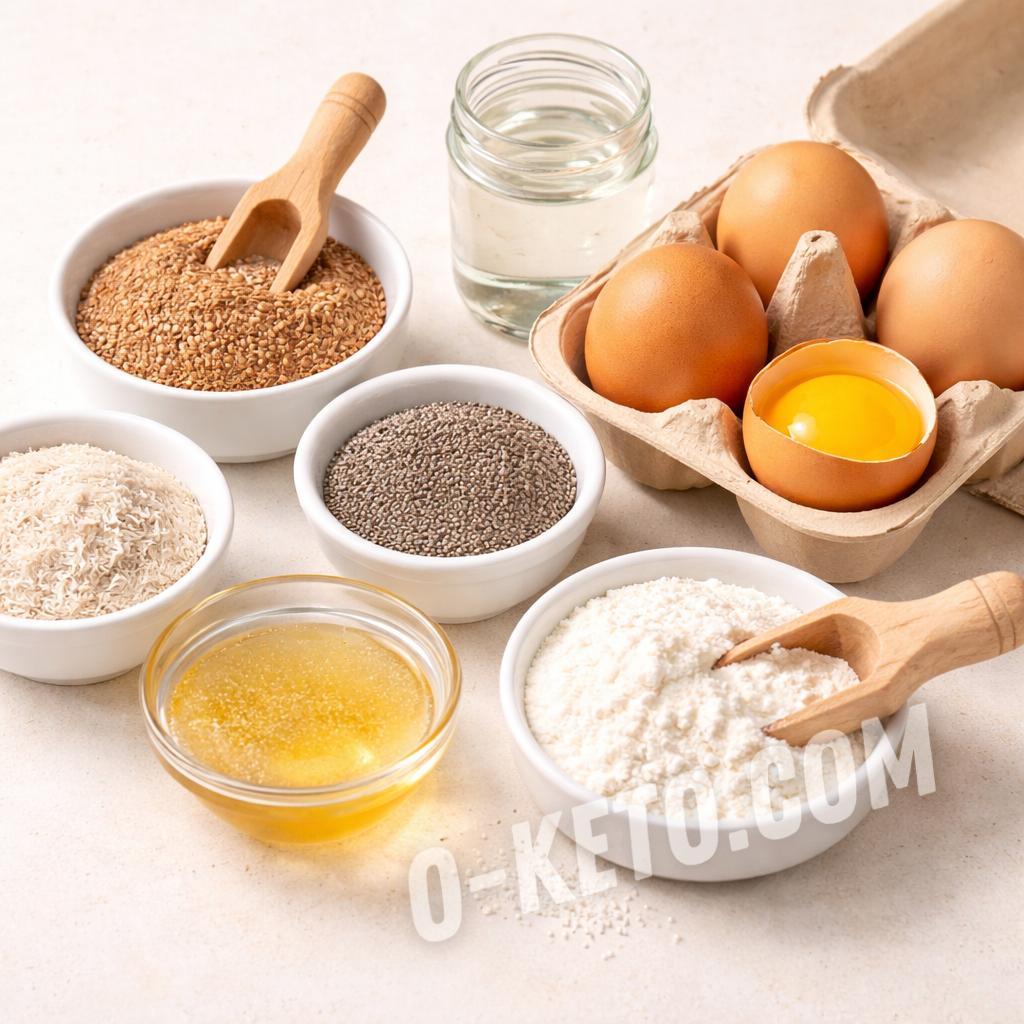

Working with eggs in recipes requires precision, especially in keto and low-carb baking. Eggs serve several functions: they bind ingredients, create structure, retain moisture, and contribute to texture formation. Therefore, it is important to understand not only their weight but also their behavior in different conditions, as well as to use substitutes correctly.
Weight of Eggs and Their Components
The weight is given without the shell. On average, the egg white makes up about 58–60% of the egg’s mass, and the yolk about 30–32%.
Why Accurate Weight Matters:
- different categories of eggs provide different volumes of liquid;
- baking is sensitive to excess or lack of moisture;
- in keto recipes, balance is especially critical due to the absence of gluten;
- the egg white and yolk perform different functions in the recipe.
Functions of Egg White and Yolk
Egg White:
- creates structure when heated;
- retains moisture;
- participates in foam formation;
- makes texture lighter.
Yolk:
- contains fats and emulsifiers;
- makes texture soft and creamy;
- enhances flavor and color;
- stabilizes structure.
Main Egg Substitutes
Substitution may be necessary in cases of intolerance, vegan recipes, or to change texture. However, it is important to understand what function the egg performs in a specific recipe.
Dry Egg White (Albumin):
- used to replace egg white;
- has a high concentration;
- suitable for meringues and sponge cakes.
Reconstitution ratio:
- 1 g of albumin + 7 g of water;
- soaking time 20–30 minutes;
- water temperature around 20–22°C.
Flaxseed or Chia “Egg”:
- 1 tbsp seeds + 2–3 tbsp water;
- suitable for dense baking;
- provides a heavier texture.
- binds moisture;
- used in keto baking;
- it is important not to exceed the dosage.
- provides structure;
- suitable for desserts and creams;
- does not create airiness.
Limitations of Substitution:
- substitutes rarely fully replicate the properties of eggs;
- texture and density change;
- whipped structures are harder to reproduce without egg white;
- the fats in yolk are difficult to replace without losing flavor.
Conclusion
Accurate work with eggs is the foundation of stable results in baking. Understanding their weight, structure, and functions allows not only to correctly scale recipes but also to wisely use substitutes without compromising the quality of the dish.
Practical Recommendations:
- in complex recipes, it is better not to replace eggs completely;
- use combinations of substitutes;
- control the consistency of the dough, not just the grams;
- always test the recipe before scaling.


