


E1201 (polyvinylpyrrolidone)
Polyvinylpyrrolidone is a synthetic polymer used as a binder, stabilizer, or technological carrier, especially in tablet forms of sweeteners, supplements, and special foods. In low-carb nutrition, E1201 matters as a marker of product form and excipients, not as a carbohydrate source.
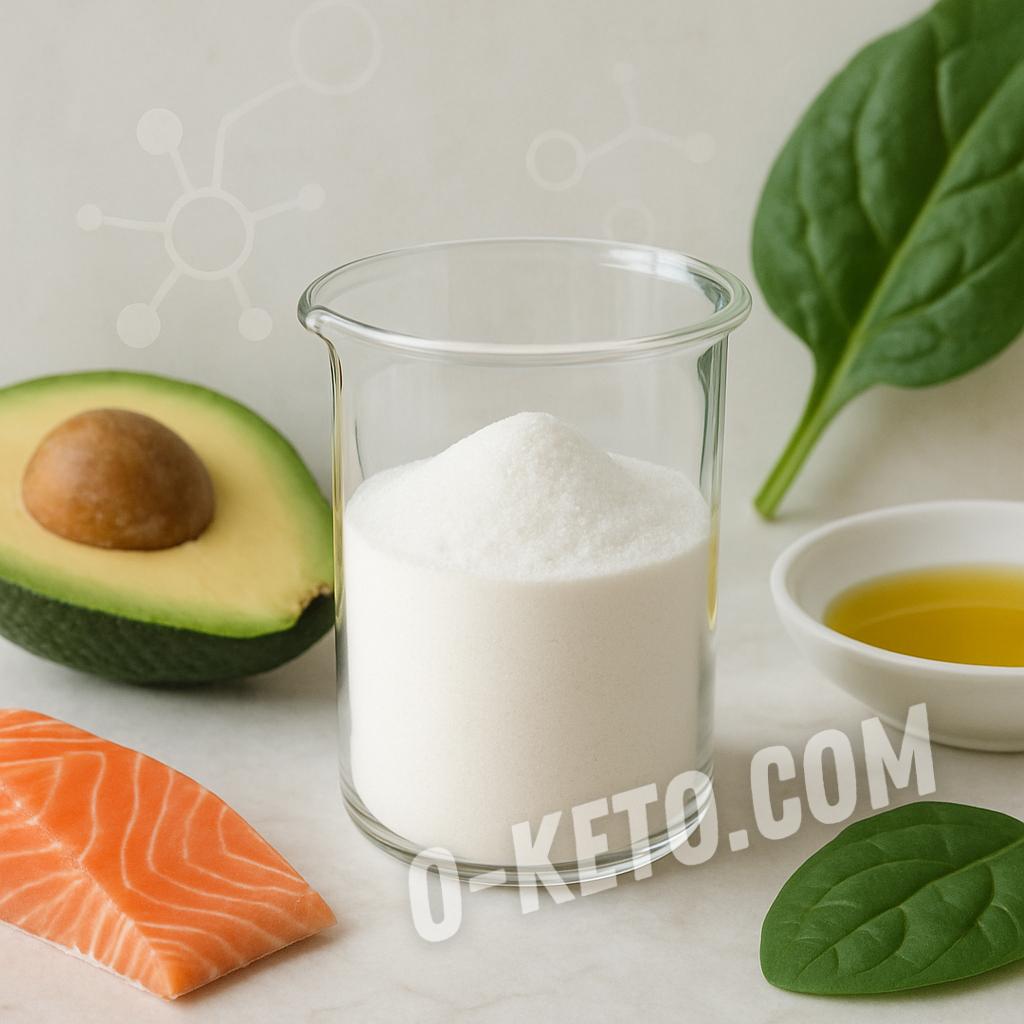
E1201 is polyvinylpyrrolidone, or PVP, a synthetic water-soluble polymer. In food and adjacent technologies it is not used as a nutrient, but as an auxiliary substance: a binder, stabilizer, carrier, or component of a tablet form. It helps hold tablet structure, distribute active ingredients, and make the product technologically convenient. For that reason, E1201 is more often connected with tabletop sweetener tablets, solid food supplements, and certain foods for special medical purposes than with ordinary food on a plate.
What the substance is
Polyvinylpyrrolidone is made from vinylpyrrolidone units linked into a long chain. In the finished additive, the relevant material is the polymer, not the free monomer. This distinction matters because a polymer and its small starting substances do not have the same properties. PVP interacts well with water, can form films, and can bind components inside a tablet or granule. Unlike sugar, starch, or fiber, it is not a normal energy source and is not used by the body as a meaningful nutrient. Its role is technological: to build the form of the product and keep it stable.
Where E1201 is found
The clearest examples are tablet sweeteners and solid dietary supplements. In these products, a very small amount of active substance needs to be distributed in a convenient form. The tablet should not crumble in the package, but it should dissolve or disintegrate properly when used. E1201 can help with that task. In the European Union, its use has also been considered for foods for special medical purposes in tablet and coated tablet forms. For the ordinary consumer, this means E1201 is usually found in products where the pharmaceutical logic of dosage form is more important than the culinary value of food.
Relevance for keto and LCHF
E1201 itself is not sugar, starch, or a sweetener. It should not be treated as a source of net carbohydrates in a low-carb diet. Its presence may still tell you that the product is not a whole food, but a processed tablet, supplement, or special formula. For keto, that matters because excipients are rarely the only issue. A tablet sweetener may also contain lactose, dextrose, maltodextrin, fillers, or flavorings. A supplement may contain carriers, coatings, and colors. E1201 is therefore best read as a reason to inspect the whole ingredient list, not as a standalone threat to ketosis.
Safety and limits of interpretation
Regulatory evaluations consider E1201 as a food additive under authorized conditions of use, including purity, residual substances, and estimated intake. That does not mean every product containing PVP is automatically useful. Safety of an additive and quality of a food choice are different questions. A person may tolerate polyvinylpyrrolidone without difficulty but still receive unnecessary sweet stimulation from tablet sweeteners or unnecessary excipients from many supplements. Extra caution is reasonable when someone takes many supplements at once, each with its own carriers, binders, and coatings. The issue is usually not one E1201 molecule, but the total processed load of the diet and supplement routine.
Difference from E1202
E1201 is easy to confuse with E1202 because both substances belong to the polyvinylpyrrolidone family. But E1201 is soluble PVP, while E1202 is cross-linked insoluble PVPP, which more often acts as a sorbent and clarifying agent. Put simply, E1201 helps form and stabilize a tablet or mixture, while E1202 can bind unwanted compounds and be removed during processing. For the reader, this distinction is practical. One code is more closely related to supplement form, while the other is more closely related to beverage processing and removal of phenolic substances. A similar name does not make them the same additive.
Practical conclusion
If E1201 appears in a tablet sweetener or dietary supplement, there is no need to panic, but the product should not be mistaken for a natural food. For low-carb eating, the main questions are what else is in the ingredient list, how often the product is used, and whether it maintains a constant desire for sweetness. If someone uses one sweetener tablet occasionally, the importance of PVP is minimal. If the diet is built around many tablets, powders, bars, and capsules, it is better to look more broadly: food quality, tolerance of additives, filler composition, and the real need for each dosage form. E1201 is a technical detail, but such details sometimes reveal how processed a product really is.
If you have any questions about the term "E1201 (polyvinylpyrrolidone)", you can ask them to AI. Please note, a low-cost OpenAI model is used. It may answer questions about disease treatment with errors!


 1 / 4
1 / 4
 1 / 4
1 / 4