


Calories after cooking often differ from the number in a food table because the food has changed in weight, water content, and sometimes fat content. Meat may lose water and render fat, vegetables may soften and lose water, while oil, sauce, or coating can add energy. On keto, it is therefore important to count the actual form of the food: raw or cooked, edible portion or bone-in, and with or without added fat.
Why values per 100 g change after cooking
Most databases report nutrients per 100 g, but 100 g of raw meat and 100 g of the same meat after roasting are not the same amount of the original food. Water evaporates during heating, proteins contract, and fat may render or remain in the portion. If the weight falls mainly because of water loss, the cooked food may look more calorie-dense per 100 g even though the total calories in the whole piece have changed little.
The opposite happens when grains, legumes, and some vegetables absorb water. The energy in the dry ingredient does not disappear; it is distributed through a larger cooked weight. This is why 100 g of cooked food usually contains fewer calories than 100 g of the dry ingredient. For strict keto, the same distinction matters when assessing starchy vegetables and mixed dishes.
Practical rule: never combine a raw-food calorie value with the cooked weight unless you have recalculated the complete recipe. Match the database form to the form you weigh.
Meat and poultry
There are two reliable approaches. Weigh the raw edible portion, record its nutrients from a raw-food entry, cook it, and divide the total recipe into portions. If the whole piece is eaten, its total calories remain the raw food calories plus the fat that was actually consumed, even if the cooked weight is lower.
Alternatively, weigh the cooked meat and use a matching cooked-food entry. This is convenient, but the match must be close: breast, thigh, minced meat, skin-on and skinless meat have different compositions. Bones and other inedible parts should not be counted as edible weight. If visible fat renders onto the tray and is discarded, the portion may contain less energy than a version in which the fat remains.
Count cooking oil, butter, ghee, or animal fat separately. If some oil remains in the pan, do not automatically count all of it as eaten, but do not treat it as zero either. Weighing the container before and after cooking gives a practical estimate of how much fat entered the dish.
Practical rule: for meat and poultry, counting the raw edible piece, the consumed cooking fat, and the final number of portions is usually the most reproducible method.
Fish and seafood
Fish also loses water during roasting and frying, but the result depends on fat content, thickness, and cooking method. Fatty fish may lose some of its own fat, while lean fish may show a larger change in the proportion of protein and water. Skin, marinade, oil, and canned brine or oil must be assessed separately.
When fish or seafood is boiled, some soluble compounds move into the cooking liquid. If the liquid remains in the dish, it should not be treated as nutritionally empty. If it is discarded, the exact loss is difficult to predict with a universal percentage. For home tracking, calculating the whole recipe is more reliable than guessing a fixed loss.
Practical rule: weigh fish before cooking and calculate the whole recipe, or weigh it after cooking and use a database entry for the same cooked form, while counting oil and dressing separately.
Vegetables
For vegetables, weight changes are usually driven by water rather than newly formed calories. Boiling may move soluble compounds into the water, while roasting and frying remove moisture. Oil, cheese, cream, and sauce can change the energy of a vegetable dish more than the vegetable itself.
For broccoli, cauliflower, zucchini, cucumber, leafy greens, and other non-starchy vegetables, the key keto questions are the carbohydrate content of the portion and the amount of added fat. For potatoes, sweet potatoes, beets, carrots, and other more starchy roots, portion size and carbohydrate load remain important regardless of whether they are boiled, roasted, or fried.
Practical rule: count the cooked edible portion, include the fat and sauce, and do not treat cooking as a way to remove the carbohydrate load of a starchy vegetable.
Oil, sauce, and marinade
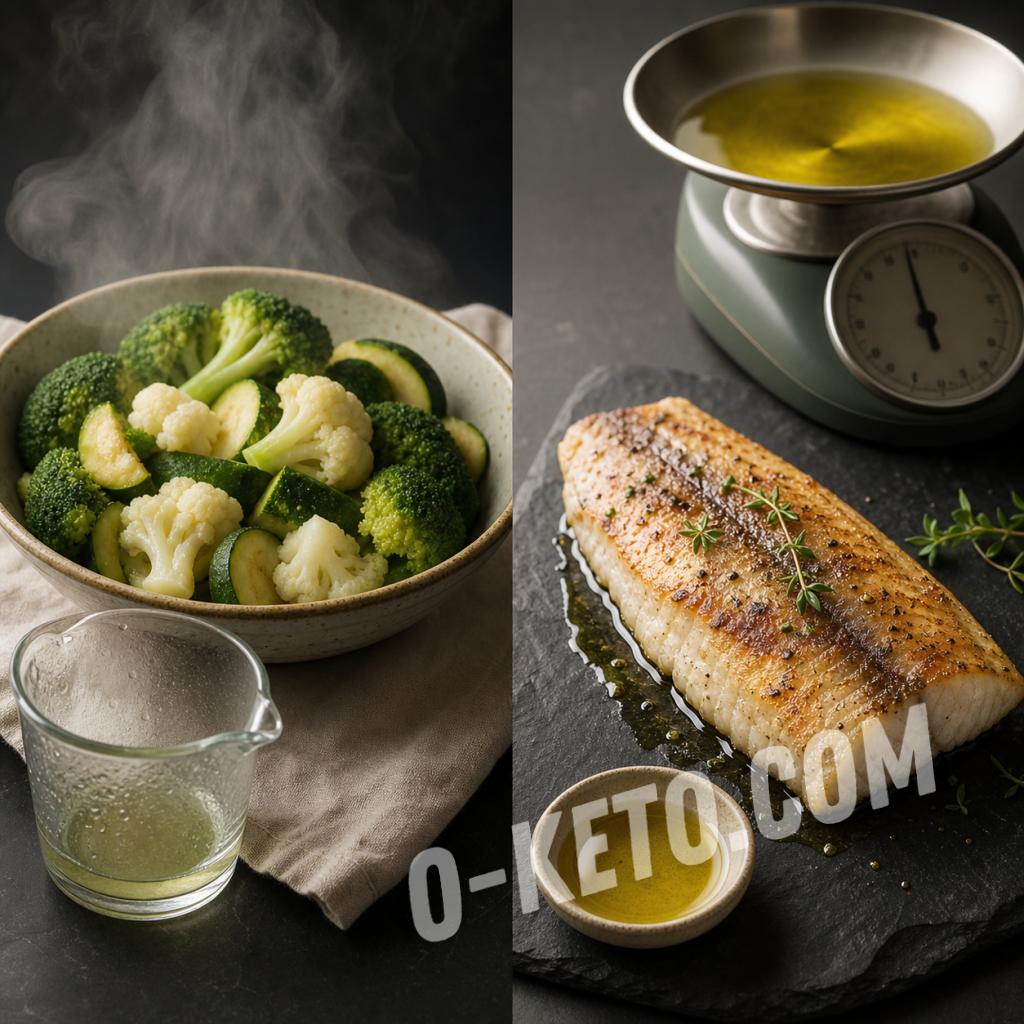
The most common mistake is counting only the main ingredient. Oil, cream, cheese, nut coating, sweet marinade, and thick sauce can change both calories and carbohydrates. Not all liquid necessarily reaches the plate, so it is better to weigh the dish or the container before and after cooking when accuracy matters.
For a mixed recipe, weigh every ingredient before cooking and record the total calories, protein, fat, and carbohydrates. Then weigh the finished dish. The nutrients in a portion equal the total recipe nutrients multiplied by the portion weight and divided by the total finished weight. This automatically accounts for water evaporation or absorption.
Practical rule: calculate the complete recipe instead of applying approximate loss percentages to every ingredient.
A repeatable keto calculation method
First identify whether the database entry is raw, boiled, fried, or roasted. Remove bones and other inedible parts, weigh the ingredients, and enter oil, sauce, and carbohydrate-containing additions separately. After cooking, weigh the complete dish and divide it into portions by weight. If the recipe changes, recalculate it.
Conclusion: accurate keto tracking begins with a consistent weighing system. Raw food should be matched to raw data, cooked food to cooked data, and consumed fat and sauce must be included. This is more reliable than searching for one universal percentage of cooking loss for all meat, fish, and vegetables.
Sources
USDA FoodData Central Foundation Foods Documentation
The Influence of Cooking and Fat Trimming on the Actual Nutrient Intake from Meat
Domestic Cooking of Muscle Foods: Impact on Composition of Nutrients and Contaminants
Cooking at Home to Retain Nutritional Quality and Minimise Nutrient Losses: A Focus on Vegetables, Potatoes and Pulses
Effect of Different Cooking Methods on the Content of Vitamins and True Retention in Selected Vegetables


