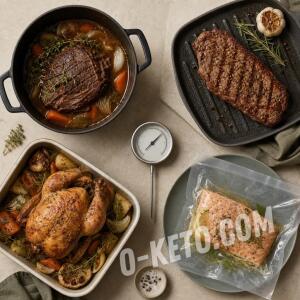
Many people first buy a home vacuum sealer because they are interested in sous vide, but in everyday cooking it often becomes useful for much more ordinary reasons. It helps portion meat and fish, organize weekly prep, reduce drying and air exposure, store sauces and cooked vegetables, and keep the refrigerator or freezer from turning into an unstructured pile of half-open containers. For keto or low-carb cooking this matters even more, because meals often rely on proteins, fats, cooked vegetables, broths, and prepared components that benefit from better packaging.
At the same time, a vacuum sealer is not a magical device that fixes all food storage problems. It does not replace cold storage, it does not make food last forever, and it does not rescue poor raw ingredients. What it does well is remove excess air, improve packaging, reduce surface drying, and make weekly kitchen organization easier. That is where its real value lives.
When bags are the better choice
For most routine home tasks, ribbed vacuum bags or rolls are the most practical option. They work well for meat, fish, cheese, cooked vegetables, sauces with low free liquid, and many meal-prep portions. They also save space, especially in the freezer, where flat compact packs are easier to stack and sort than a crowd of bulky containers.
Bags are especially useful when you want true portion control. One meal, two fillets, one cooked serving, one freezer pack of marinated protein — these are the kinds of tasks where a vacuum sealer quickly starts earning its place on the counter. In that sense, it is often less about “special cooking” and more about preventing waste and friction during the week.
When containers make more sense
Containers are helpful when the product is fragile, easily crushed, or likely to lose its shape under stronger suction. Tender greens, some berries, delicate prepared foods, and items you will reopen several times can be easier to handle in a rigid container. Containers are also convenient for short-term marinating or for situations where you care more about gentle handling than about squeezing out every last bit of air.
That does not mean containers are always better. They take more space and are usually less efficient in the freezer. But for the right products, especially delicate ones, they are often the calmer choice.
How to work with liquids and very wet foods
Liquids and moisture-heavy dishes are where many people learn that vacuum sealing is not a one-button skill. If you try to fully vacuum soups, sauces, braises, or very wet marinades while they are loose and fluid, liquid can travel toward the seal and ruin it. That is why these products usually need a different approach: cooling first, sometimes partial freezing, and often using a gentler seal-only or reduced-vacuum mode if the machine allows it.
For juicy salads and very wet ingredients, a perfect deep vacuum is not always the goal. Sometimes the smarter choice is simply a clean sealed pack with less stress on the food. This is especially true when there is a lot of surface moisture or delicate texture. In real kitchens, a reliable seam is often more useful than an aggressive vacuum that damages the contents.
Why cooling and blotting matter
Warm food should not go straight into vacuum bags. Heat creates steam and condensation, which interferes with the seal and worsens storage quality. Cooked food should be cooled first, and wet ingredients such as meat, fish, vegetables, or greens are often worth blotting with paper towels before packing.
This small step matters more than many people expect. Excess moisture is one of the most common reasons for weak seams, internal water buildup, and disappointing storage results. It is also important for freezing: a dry outer surface helps packs stay separate and easier to handle later.
Do you need an expensive machine
In most home kitchens, no. A sensible household model with stable suction, a reliable seal, and some tolerance for moist foods is usually enough. The point is not to buy the most impressive machine on paper, but to choose one that seals consistently and suits the way you actually cook.
For many users, a wider or double seam matters more in practice than abstract power numbers. Especially when you work with marinades or moisture-heavy ingredients, seam quality often decides whether the storage plan works calmly or becomes annoying.
How it helps with weekly prep
The easiest way to use a vacuum sealer well is not to package random leftovers one by one, but to build a simple weekly system. Portion proteins, package cooked vegetables separately, keep sauces in usable amounts, and label packs with the date and contents. This turns the vacuum sealer into part of a calm kitchen routine rather than a gadget used once in a while.
It also makes everyday meals easier. Pulling one labeled portion from the fridge or freezer is simpler than reopening a large box, disturbing the whole batch, and trying to seal it again. In that sense, vacuum sealing supports consistency more than novelty.
Can bags be reused
Sometimes, yes, but only with judgment. If a bag held a dry or relatively clean product and the material is still intact, it may be washed, dried, and reused for similar tasks. But bags that held raw meat, fish, greasy sauces, or anything messy are usually not worth reusing. Reuse only makes sense when cleanliness and seal quality are still easy to maintain.
In the end, a home vacuum sealer is valuable because it helps organize real food more intelligently. Bags are best for most portions and freezer prep, containers are helpful for delicate products, liquids require a different strategy, and cooling plus moisture control often matter more than extreme vacuum strength. Used that way, the machine becomes a reliable everyday tool instead of a niche appliance for occasional experiments.
How long to store prep and how not to ruin it
A vacuum sealer does not make food immortal, so it helps to think in terms of process rather than gadget. First cool the food completely, then package it, label the date, and only after that move it to the refrigerator or freezer. Warm food inside a sealed bag creates condensation, and that extra moisture weakens the seal, shortens texture stability, and makes storage less predictable.
For the freezer, portioning in advance is one of the biggest advantages. Keep meat in one set of bags, fish in another, cooked vegetables in another, and broths or sauces separately. Flat bags freeze faster and stack better than thick irregular bundles. If a prep item is meant for one dinner, it is usually smarter to package one serving at a time instead of freezing a large amount and thawing more than you need.
In the refrigerator, vacuum sealing is most useful as a way to keep order and slow oxidation, not as permission to store everything for weeks. Ready meals still work best when eaten within sensible timeframes, and delicate foods such as fresh fish, ground meat, or liver should not be turned into long experiments just because the air was removed. In the freezer, the benefit is clearer: less freezer burn, fewer mixed odors, and a lower chance that the product dries out around the edges.
Before freezing, it helps to organize prep by weekly logic: protein base in one bag, vegetable base in another, quick finishing accents on their own. Then a weekday meal becomes assembly instead of recooking. If a bag contains a lot of liquid, such as broth, braised meat, or sauce, cool it fully and sometimes chill it until slightly thickened before sealing. That makes the seam cleaner and the result much more reliable.
A practical rule of thumb is simple: keep short-term prep for the next few days in vacuum bags in the refrigerator, and move anything that will not be eaten soon to the freezer in portioned packs. Labels with date and contents matter more than memory. Once there are many bags, good marking is what keeps prep from turning into a forgotten archive.