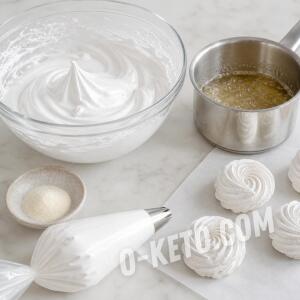


There is no single perfect thickener that solves every keto dessert problem equally well. Pectin is often better for fruit and berry layers, gelatin gives a cleaner cold set and a more defined slice, xanthan and guar control viscosity and moisture retention, inulin adds body and dry matter, and small technical starch doses in some formulas are only narrow structural support rather than the basis of a low-carb texture. The first mistake appears when all of these ingredients are thrown into one vague category called “thickener” and expected to behave the same way.
In practice, not only the ingredient choice matters, but also the working format. Gelatin shows this especially well. Many people think of it only as a dry powder that has to be bloomed separately every time. But when a dessert is built from several delicate components and depends on micro-doses, a prepared gelatin mass often becomes the more stable and practical option. It does not turn gelatin into a new substance, but it changes the reliability of the kitchen workflow quite a lot.
Why texture tools that seem similar still behave differently
A dessert may need a firm chilled slice, a soft creamy body, a slightly thicker flow, a fruit gel, or simply more fullness in the mouthfeel. Formally, all of this belongs to “structure,” but the ingredients achieve it through different mechanisms. Gelatin forms a protein network that becomes especially meaningful after chilling. Pectin works more through gel behavior in fruit and water phases. Xanthan and guar often do not create a classical firm gel at all, but rather change the viscosity and water retention pattern. Inulin is different again: it is less of a direct “setter” and more of a structural filler that adds body and fullness.
Because of that, two desserts can both look stable and still feel completely different in the mouth. A gelatin-based layer may give a clean cut and stronger definition, while a pectin-based one feels softer and fruitier. Xanthan can create thickness without a real sliceable set, and inulin can make a formula feel fuller without holding a vertical shape on its own.
Why gelatin needs a special home-kitchen strategy
Gelatin is especially sensitive to home mistakes because keto desserts often use it in very small amounts. Sometimes only 2 to 4 grams of dry gelatin are needed for a cream, filling, or fruit insert. At that point ordinary scales become the weak link. Tiny dry doses are easy to misread, and once that happens, texture stops being predictable. One time the layer comes out too soft, the next time almost rubbery.
That is why it can be more practical to stop treating gelatin only as a dry powder and instead keep it as a prepared gelatin mass. In that format, the gelatin has already been mixed with water, fully swollen, and can later be weighed in a larger, easier amount. It does not change what gelatin is, but it reduces the number of avoidable errors and makes multi-component dessert work much calmer.
What gelatin mass is and when it really helps
Gelatin mass is simply pre-hydrated gelatin held in a known ratio with water. A practical kitchen reference is often 1:6, meaning 10 grams of gelatin with 60 grams of water. Later, the needed portion can be taken from that total for a cream, mousse, cheesecake filling, or fruit layer. The point is not just saving a few minutes. The real point is repeatability. Instead of fighting a scale over 2 grams of dry powder, you weigh a larger prepared mass and get a more consistent result.
This is especially useful in lighter creams and fillings where gelatin is not supposed to create a hard jelly, but only tighten the structure slightly without adding more fat. It also helps when several dessert parts are made in one kitchen session. In that setting, a prepared gelatin mass reduces clutter and repeated tiny hydration steps.
Small details that matter: hydration order and heat
For gelatin mass to be genuinely useful, the basic method still matters. It is usually safer to place the water into the container first, then sprinkle the gelatin over the top and stir right away. That order helps reduce clumping and gives the granules a more even chance to hydrate. After that, the mixture needs enough time to swell fully. Before it goes into the dessert, it should not be dropped in as cold lumps. It needs to be reheated until fully dissolved, usually to the point where visible steam rises but there is no hard boil.
This matters not only for convenience but also for texture quality. Undissolved granules in a cream or mousse almost always show up as a flaw. In keto desserts, where the textural balance is often delicate, those flaws become especially obvious.
How this differs from pectin, xanthan, and guar
This is where the tools clearly separate from one another. Gelatin can be kept as a ready working mass because its role transfers well into a pre-hydrated format. Pectin, xanthan, and guar usually do not work that way. They are more often introduced as dry ingredients at a specific stage of the recipe, sometimes mixed with sweetener or other dry components first, and then managed through temperature, dispersion, hydration, and acidity.
Pectin is especially sensitive to the surrounding medium and heat profile. Xanthan and guar can form clumps very easily if dispersed badly at the start. Inulin is again different, because it often behaves more as body support than as a direct gelling tool. So gelatin mass is not a universal model for all stabilizers. It is a practical handling technique mainly for gelatin.
Agar and locust bean gum: different jobs
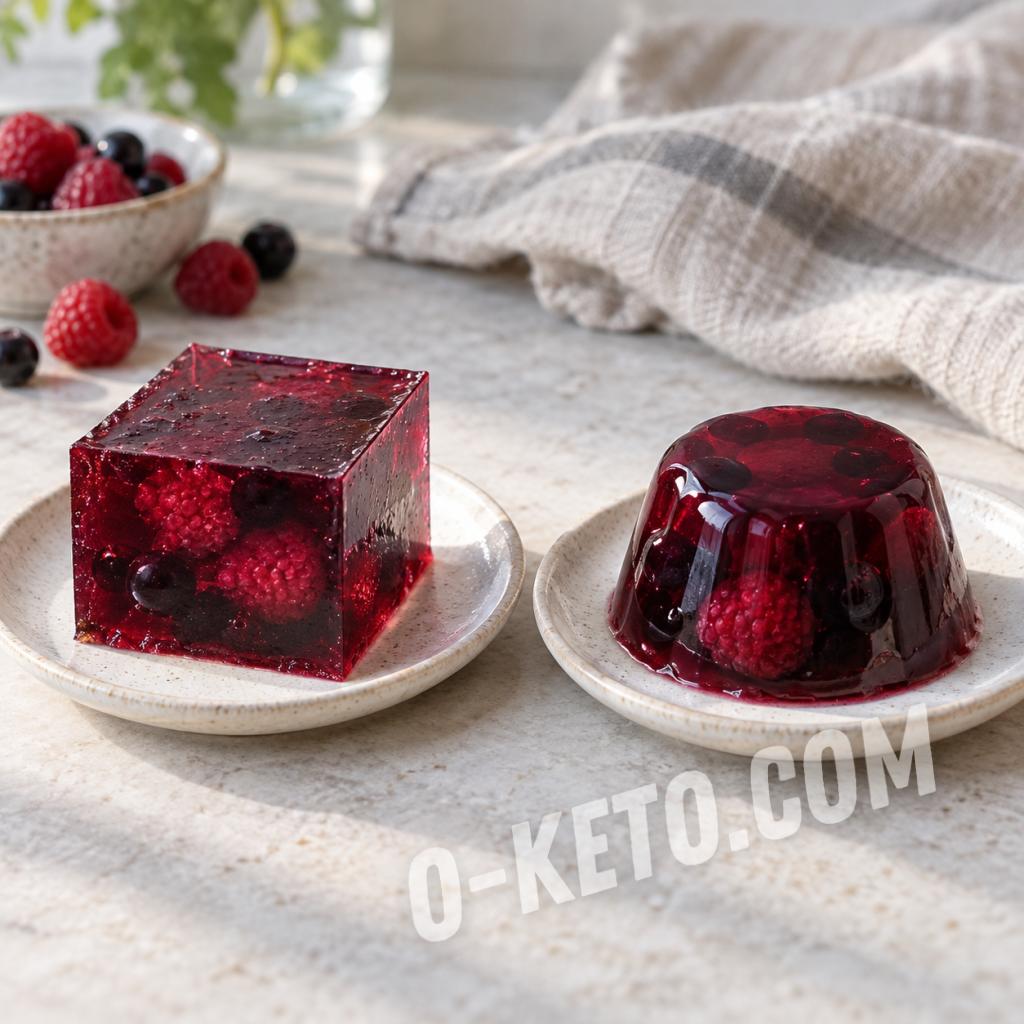
Agar forms a more heat-resistant but generally more brittle gel than gelatin. It can suit a layer that must hold its shape at warmer temperatures, but it will not deliver gelatin’s soft, elastic bite. Agar must be fully dissolved with heat and measured from a formula designed for agar; replacing gelatin gram for gram changes both the set and the mouthfeel.
Locust bean gum (LBG) serves a different role as a thickener and stabilizer, including in frozen desserts. In tested ice-cream systems, stabilizer blends containing LBG can help limit ice-crystal growth during storage, but the result depends on the base and the combination of hydrocolloids. For a home recipe, LBG is a distinct ingredient—not a direct substitute for gelatin or guar—so use a formula written for it.
Where this approach is most useful
The biggest practical benefit appears in mousses, lighter ricotta or cream-cheese creams, lower-calorie fillings, fruit layers, no-bake cheesecakes, and desserts that need shape without a large amount of butter or heavy cream. In these jobs, gelatin acts like a fine adjustment, and gelatin mass helps hit that adjustment more accurately.
If the recipe is a firmer jelly, a large production batch, or any preparation where the dry dose is already easy to weigh directly, one-time blooming can still be perfectly reasonable. So there is no need for dogma here. What matters is choosing the working method that creates fewer errors for the actual texture goal.
Conclusion
In keto desserts, it is not enough to know the name of a stabilizer. It is just as important to understand how that tool behaves and how it is best handled in a real kitchen. Gelatin, pectin, xanthan, guar, and inulin are not interchangeable in mechanism, and gelatin is particularly sensitive to tiny dosing errors. That is why gelatin mass is a useful technique wherever repeatability, clean texture, and less dependence on uncertain micro-weighing matter. It does not make gelatin the answer to every dessert, but it does make it a much more controllable tool in home low-carb pastry work.