

A sugar-free and gluten-free sponge cake seems like a simple task only until the first unsuccessful attempt. In practice, such sponge cakes often collapse, become heavy, crumble, turn out moist inside, or quickly stale. The reason is usually not just a “bad oven,” but that the person tries to mechanically remove sugar and wheat flour without restructuring the entire batter system.
In a classic sponge cake, sugar and gluten contribute much more than just sweetness and familiar structure. Sugar retains moisture, affects viscosity, helps the foam be more stable, and slows down the rapid coagulation of proteins when heated. Gluten, along with starch, forms a network that holds air and helps the batter rise. When both of these elements disappear, the sponge cake has to be built from scratch: through the protein system, precise selection of flour, sweeteners, fats, and baking mode.
Error 1. Replacing ingredients only by name, not by function
One of the most common mistakes is to think like this: sugar is removed, so any sweetener will do; wheat flour is removed, so any gluten-free flour will suffice. But technologically, the replacement should not be based on the name of the ingredient or its sweetness, but on its role in the specific system. It is essential to first understand what the component actually does: does it retain moisture, create volume, stabilize foam, affect viscosity, or help the structure hold air.
When this understanding is lacking, a typical chain of problems begins. The sponge cake rises at first, then suddenly collapses, or it does not achieve proper volume at all. Sometimes it looks beautiful on the outside but turns out to be sticky and wet on the inside. In other cases, it crumbles even when sliced. The correction does not start with a magical addition but with an honest analysis: what exactly in the recipe is now responsible for moisture, structure, and volume stabilization.
Error 2. Not Considering the Differences Between Types of Flour
Gluten-free flour is not just one category, but a whole set of completely different products in terms of behavior. They can be conditionally divided into more starchy, more protein-rich, and more fatty types. This is where many mistakes happen. Starchy flour gives a lighter texture but easily dries out the product and requires time for hydration. If dough made with such flour is sent straight to the oven, the starch may not have enough time to properly bind the moisture, resulting in a dry and crumbly sponge cake.
Protein-rich types of flour should also not be considered a universal solution. When they are used in excess, the system becomes heavier, the rise worsens, and the crumb becomes denser. Therefore, it is more convenient to use them as a booster for the protein part of the recipe rather than as an absolute base. Fatty types of flour behave differently: for example, almond flour and similar options provide softness and rich flavor but do not hold air as well as a system with starch and gluten would.
A separate trap is coconut flour. It seems convenient because it formally also suits gluten-free and low-carb baking, but in terms of behavior, it is not “just another white flour.” Coconut flour actively absorbs water, thickens quickly, and easily makes the sponge cake heavy if used by volume or substituted one-to-one for almond flour. This is why it is usually kept as part of a mixture in sponge cakes rather than as the sole base. Mixing coconut flour with almond flour provides a softer balance: almond retains flavor and fat content, while coconut helps gather moisture without pulling the entire system into a dry and crumbly crumb.
Sesame and sunflower flours also do not work as a free substitute for almond flour. Sesame flour usually feels drier, has a more pronounced flavor, and in excess can easily make the crumb heavier and coarser. Sunflower flour often behaves even denser, quickly leading baked goods to dryness and can provide a darker, slightly “grainy” flavor profile. If used as a complete substitute for almond flour without adjusting the liquid and egg, the sponge cake often loses both rise and softness.
In practice, it is useful to remember a simple scale of moisture absorption. Almond flour is usually the softest in absorption among these popular options, while coconut flour is the most aggressive. Sesame and sunflower flours are often somewhere in between but noticeably have a stronger impact on the density and structure of the crumb than almond flour. Therefore, the same weight of different types of flour does not mean the same result: not only the flavor changes, but also how much water, egg, and time for stabilization the dough needs.
This is why one of the most useful practical tips is not to rely on just one flour but to create a balance. Sometimes the sponge cake needs more time for the dry components to swell, sometimes a little more egg, and sometimes a combination of two different types of flour instead of one. The more a flour absorbs water or the higher its fat content, the more carefully one needs to monitor the moisture and structure. If the mixture thickens sharply before it even goes into the oven after changing the flour, that is already a hint that the recipe lacks moisture or resting time, and not just “another five minutes of baking.”
Error 3. Sweetener is chosen only for sweetness
The sweetener in the biscuit is not just an answer to the question “what to use to make it sweet.” The mistake begins when a person thinks that it is enough to take any sweetener and measure the grams to taste. In reality, sugar in classic baking affects texture, moisture, volume, protein behavior, and the overall crumb feel. Therefore, sugar substitutes should be evaluated not only for sweetness but also for what they physically do to the dough.
Erythritol, for example, can give a rougher texture and partially recrystallize after cooling. Sometimes because of this, the biscuit initially seems normal, but then becomes denser and drier. Allulose behaves more like sugar, but in excess, it can create too moist a center and cause faster browning during baking. Intense sweeteners do not create volume at all and do not help the structure because they work in microdoses. Therefore, the best approach is not to expect one sweetener to solve all problems but to understand the role it actually plays in a specific dough.
Ready-made sweet mixtures with inulin pose a separate risk. In drinks or cold desserts, it can be an acceptable filler, but in sensitive biscuit dough, it sometimes disrupts the expected result. The mixture starts to hold moisture differently, behaves differently when heated, and the crumb can become stickier or denser than expected. Therefore, in recipes where the undesirability of inulin is specifically mentioned, it is not a matter of taste preference but a technological warning.
In chocolate baking, this mistake is compounded by an overestimation of sweetness itself. If the base is built on cocoa or dark chocolate flavor, the main result is given not only by the sweetener but also by the quality of the cocoa powder. Weak, dusty, or flat cocoa cannot be saved even by precise measurements of erythritol or allulose because in such a recipe, cocoa provides the main depth of flavor. Hence the frequent disappointment: a person expects a cupcake or light dessert but receives a dense chocolate base with a strong cocoa flavor.
Because of this, sweetness in low-carb chocolate baking is often more sensibly regulated not only by the dough but also by the glaze, cream, or other top finishes. A dense base can remain more adult and less sweet, while the glaze or filling brings the flavor to the desired balance. This approach is especially useful where the structure is closer not to an airy biscuit but to a richer, moister, and denser chocolate dessert.
Error 4. Underestimating eggs, temperature, and whipping
In sugar-free and gluten-free sponge cakes, eggs become even more important than in regular baking. The air that is successfully retained in the eggs is often the main chance to achieve a light structure. Because of this, insufficient or careless whipping can be costly. If the egg whites do not reach the desired form, and the yolk or egg mixture remains too heavy, the framework will be weak even before it goes into the oven.
The temperature of the ingredients is equally important. Cold eggs, especially in recipes with fats, can hinder the even distribution of the mixture and reduce the stability of the system. As a result, the fat begins to behave heavier, the foam holds air worse, and the volume turns out weaker. It is also useful to remember that sometimes a sponge cake truly benefits from a stronger protein system: for example, when part of the structure has to be gathered precisely from the eggs, rather than from gluten.
Particularly often, the problem arises from underestimating the role of proteins as a leavening agent. In low-carb baking, it is often the proteins that replace part of the lifting power that sugar and the flour network provide in a regular sponge cake. If too many yolks are used or whole eggs are simply taken where the recipe calls for a lighter protein framework, the fat from the yolk begins to weigh down the mixture and interfere with the volume. Therefore, in some recipes, either separately whipped egg whites work better, or even an enhanced protein system with the addition of dry egg white, when a more stable crumb is needed without the feeling of an omelet.
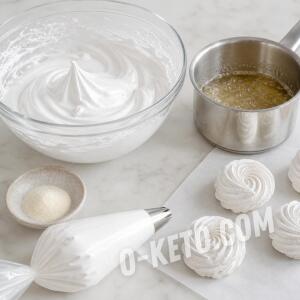
There is also one more detail that seems insignificant but constantly breaks the result: the contact of egg whites with fat and water. Even small traces of fat on the whisk or bowl, overly wet utensils, or haste during the whipping stage can prevent the egg whites from reaching the necessary volume. As a result, a person later blames the flour or the oven, even though the main loss of height occurred right at the start.
Error 5. Overloading the batter with fiber, psyllium, and gums
When a sponge cake doesn’t hold its shape, many want to save it by adding a large amount of psyllium, xanthan, guar gum, or other moisture-retaining components. However, an excess of such additives often turns it into a bread-like, sticky, or overly chewy mass. This is especially noticeable in chocolate and nut variations, where the structure is already complex.
Hydrocolloids and dietary fibers work only in very careful dosages. Sometimes they are sufficient in literally micro amounts, and sometimes it’s better to do without them altogether. If the sponge cake turns out too rubbery, sticky, or unexpectedly heavy for digestion, it’s a reason not to add even more “improvers,” but rather to reduce their quantity and reassess the balance of flour, eggs, and moisture.
Psyllium itself can also vary. Whole husk and fine powder are not equal in water absorption. The powder usually works more aggressively: it thickens faster, pulls moisture more strongly, and in the same weight can easily make the batter raw inside, sticky, and dense after baking. Therefore, if one variant in the recipe is replaced with another without recalculating, the result almost always leans towards a heavy, moist, and poorly rising sponge cake.
Xanthan should not be perceived as a universal “structure repair.” In small doses, it can help create a more even crumb and retain moisture, especially if the batter has little starch and a lot of nut flour. But it has an important limitation: not every gum behaves the same way. Replacing xanthan with any other gum on the principle of “it’s also a thickener” often changes viscosity, swelling speed, and air bubble stability. In one batter, the mixture will become too sticky, while in another it will not be able to hold its shape. This is why the warning “xanthan cannot be replaced with another gum” in sensitive sponge cake recipes is often quite justified.
This issue is particularly capricious when working with coconut flour. Coconut itself aggressively pulls water, and xanthan further binds the system and increases viscosity. In the correct dosage, this can help create a crumb. In excess, the batter quickly turns into a too-thick paste that does not rise well in the oven and results in a dense, almost raw center. If after adding xanthan the mixture resembles a sticky paste even before baking, this is not a sign of reliability, but a signal that the balance has already shifted too far.
Error 6. Using the wrong pan and greasing it “just in case”
For gluten-free sponge cake, the baking pan has a greater impact than it seems. Silicone heats up more gently and slowly, which means the structure sets more slowly, and the center may remain unstable for longer. Metal pans usually hold the rise more reliably because they conduct heat faster and more evenly. Teflon options can behave differently depending on the thickness and quality of the coating.
Another common mistake is greasing the sides of the pan with oil out of habit. For airy sponges, this often hinders the process because the batter has a harder time gripping during the rise. A similar issue occurs with overly slippery non-stick parchment on the sides of the pan. Sometimes, it is more beneficial for the sponge to rise on a dry surface than to slide down it.
Error 7. Incorrectly working with oven temperature
Too cold an oven, too rapid heating, and uneven temperature inside are some of the most common reasons why a sponge cake turns out skewed, cracks, has a wet center, or collapses after baking. Low-carb sponge cakes have particularly little margin for error: if the surface sets too quickly while the middle is still expanding actively, a bump can easily form on top, and inside, there is an undercooked moist crumb.
But too low a temperature doesn’t help either. In that case, the structure sets slowly, the air escapes faster than the proteins can hold their shape, and volume is lost. Therefore, it is especially useful to preheat the oven in advance and, if possible, use a separate thermometer rather than relying solely on the number on the panel. The same recipe in different ovens may require different adjustments.
A separate problem with chocolate baking is the incorrect expectation of the degree of doneness. A dense brownie, moist chocolate layer, or rich nut-cocoa base does not have to behave like a dry classic sponge cake, but that doesn’t mean the center can remain raw. If a skewer comes out wet rather than just with soft crumbs, the product is not fully baked yet. If the top is already darkening too quickly while the center is still undercooked, it is more beneficial to cover the pan with foil and let the center finish baking than to increase the heat and dry out the edges.
What to do if the sponge cake didn’t turn out again
The most useful strategy is not to change everything at once, but to analyze the failure by symptoms. If the sponge cake is dry and crumbles, look at hydration, the type of flour, and the amount of egg and fat. If it is moist and sinks, check for excess moisture, the performance of the sweetener, oven temperature, and the moment of structure setting. If it is dense and does not rise, examine the whipping, flour balance, and whether the system is overloaded with heavy protein or fibrous components.
In practice, it is convenient to analyze even more precisely. A sponge cake that is too moist, sticky, and has a “rubbery” center is often related not only to underbaking but also to an excess of coconut flour, powdered psyllium, or xanthan gum. If the sponge cake looks dry but is heavy to lift, it is worth checking if too much protein strength has been lost due to replacing egg whites with whole eggs or due to weak whipping. And if the top sets quickly while the center remains undercooked, it is almost always worth revisiting not only the time but also the heating profile in the oven itself.
It is also important to remember about the leavening agent. The same dose of leavening agent works differently depending on the moisture of the batter, the amount of fat, acidity, the strength of the protein foam, and how heavy the flour mixture is. In a denser batter, it is harder for gas to expand the structure, while in an overly moist or fatty framework, bubbles are more easily lost before setting. Therefore, the problem is not always that there is “too little” or “too much” leavening agent per se: sometimes the recipe simply cannot realize even a normal dose due to an overloaded system.
If we reduce the diagnosis to three common scenarios, the logic becomes simpler. If it does not rise – most often it is weak whipping, too heavy flour, or moisture-overloaded batter. If it sticks together, seems sticky, or clumps when cut – usually, the culprits are an excess of moisture-retaining components, underbaking, or cutting too early before the crumb stabilizes. If it dries out – this is usually an excess of coconut, sesame, or sunflower flour, too harsh an oven setting, an excess of leavening agent with low moisture, or simply trying to keep the sponge cake in the oven longer than necessary.
A low-carb sponge cake almost always requires greater technological discipline than a regular one. But the good news is that most problems are solved not by exotic ingredients, but by a more precise understanding of the process. When it is clear what each component does and at what stage a failure occurs, the recipe becomes much easier to adjust to your flour, your eggs, your mold, and your oven.
Main Conclusion
A sugar-free and gluten-free sponge cake doesn’t have to be a failure, but it almost never forgives mechanical substitutions. The better you understand who in the recipe is responsible for moisture, volume, binding, and softness, the easier it is to achieve an airy and stable result. In such baking, it’s not the one who adds more trendy ingredients that wins, but the one who assembles the system more accurately.