




Chocolate decor looks complicated mostly because several delicate processes happen at the same time. There is tempering, painted cocoa-butter work, sheet handling, waiting for crystallization, and finally assembling fragile details into something that still looks elegant rather than clumsy. A simple chocolate bar can hide a lot of technical errors, but a leaf, petal, or thin decorative shard reveals them almost immediately.
That is actually useful for a home baker. Most good chocolate decoration does not depend on rare tools nearly as much as it depends on understanding a few practical rules. The layer has to stay thin. The chocolate has to stay in the correct temperature range. The color has to belong in a fat system rather than a water system. And the work has to include pauses, because chocolate needs time to become the object you want it to be.
What you actually need for chocolate decor
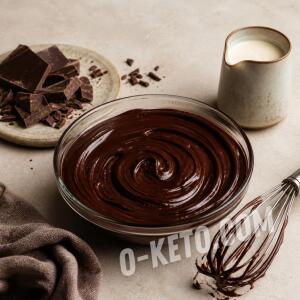
The core setup is simpler than it looks: tempered chocolate or couverture, cocoa butter, thin film or acetate, a thermometer, dry brushes, and fat-soluble colors when color is needed. Decorative shimmer such as luster dust can be useful, but it is not the foundation. If the underlying chocolate work is unstable, no sparkle will save it.
Thin sheets matter because they let you create controlled surfaces for leaves, petals, strips, painted patterns, and transfer-like effects. Slightly firmer acetate is useful when you need shape support. The goal is not to build a luxury toolbox. It is to make sure every tool has a clear role: where the color goes, where the chocolate sets, how the piece is released, and how it cools without moisture getting involved.
Why cocoa butter matters in decorative work
Cocoa butter is not just part of chocolate. In decoration it also becomes a technical medium for color and surface effects. It allows color to move through a fat-compatible system and helps decorative layers adhere and set more predictably than random oily mixtures would.
When cocoa butter is combined with white chocolate for decorative coloring or spraying, the result is often a more controllable mass that spreads evenly and behaves better as a visible surface layer. Home bakers do not need to begin with large complex setups, but it helps to understand the logic: cocoa butter is one of the main reasons decorative chocolate can look refined instead of messy.
Why the colors must be fat-soluble
Chocolate and cocoa butter do not tolerate water well. That is why decorative chocolate work relies on fat-soluble colors rather than ordinary water-based or gel colors that work fine in batter or cream. Water can seize chocolate, make it grainy, or push the whole mixture into a clumpy unstable state.
Fat-soluble colors are designed to disperse through the cocoa-butter phase. That matters most when the color is painted, dotted, brushed, or layered onto film before chocolate is added. If the wrong color system is used, the final result may look muddy, unstable, or simply refuse to set cleanly.
How acetate sheets work and why the layer must stay thin
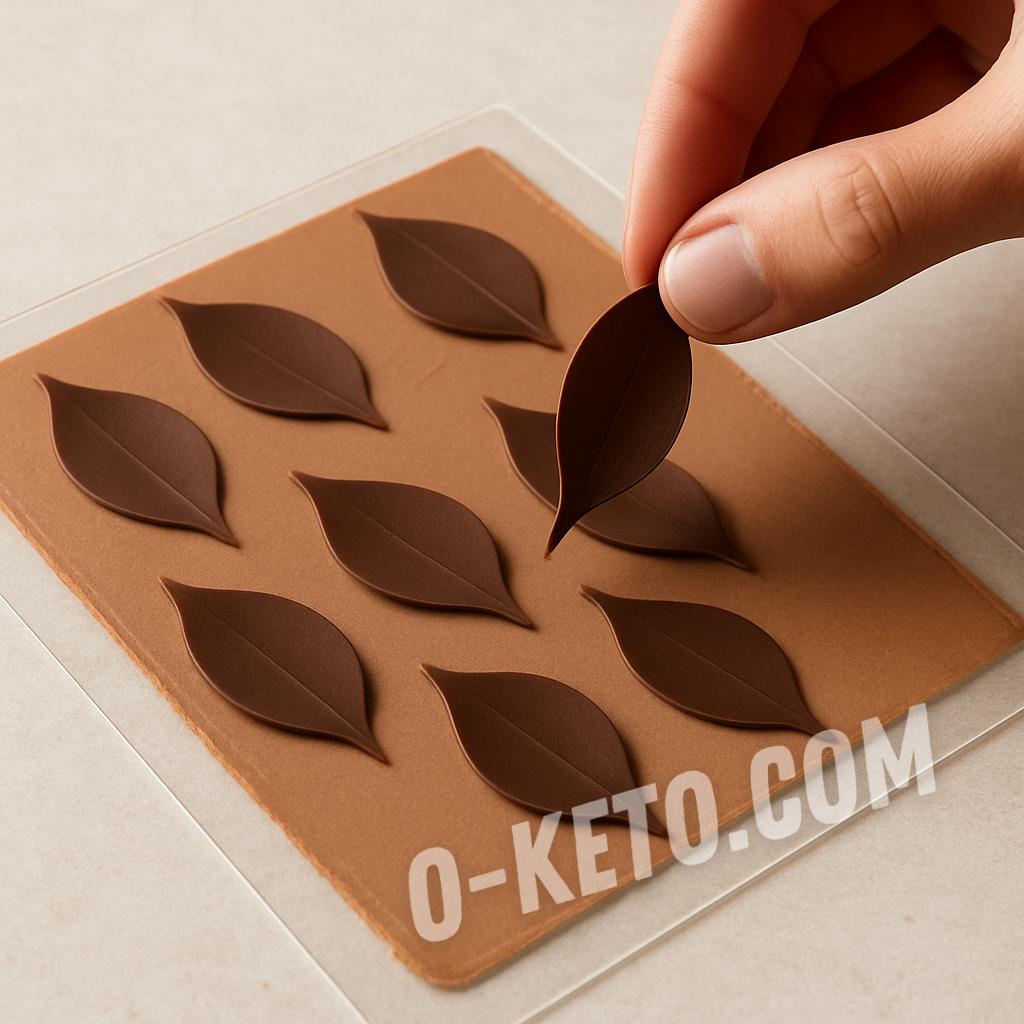
Film or acetate gives chocolate decoration a clean smooth working surface. Color or pattern can be painted onto it first, then tempered chocolate is spread over it, and after crystallization the baker lifts away a leaf, petal, plaque, or textured shard. Thinness is crucial here. If the chocolate or colored cocoa-butter layer is too thick, the piece becomes heavy, blunt, and often more fragile.
Thinness matters for the color layer as well. A shallow brushed film creates refinement and transparency where needed. A thick puddle creates drag, smearing, and a muddy heavy look. In good chocolate decor, the effect usually comes from precision rather than from large quantities of material.
How layered color should be applied
Layered color works best when each layer has enough time to begin stabilizing before the next one goes on. This does not always require long waiting, but it does require restraint. If the lower layer is still too mobile, the next color will drag it, blend it, or tear the border apart.
This is especially visible in leaves and petals, where one color may be followed by a lighter highlight, then a shimmer accent, then a deeper background or fixing tone. When the sequence is rushed, the result stops looking intentional. Patience matters more than drama.
Why it is easy to overdo shimmer and luster dust
Luster dust and similar powders can highlight decorative work beautifully, but they are also easy to misuse. Too much shimmer can interfere with clean visual structure, leave a dusty surface, or weaken the clarity of the underlying design. What should have been an accent becomes a distracting mask.
It helps to treat shimmer as a final whisper rather than a full paint layer. If the form, color, and thickness are already good, a small amount of reflective powder can add life. If the structure is poor, the shimmer only makes the problems more expensive and more obvious.
Why crystallization pauses are mandatory
Chocolate decor almost never happens as one uninterrupted action. Even when the movements are fast, the process usually includes short pauses while a layer begins to crystallize. That is true for painted sheets, thin chocolate layers, and shaped elements that will later be curved, lifted, or assembled into flowers.
Without those pauses, several things go wrong at once. Color smears into places where it should not go. Chocolate sticks to tools. Thin details collapse instead of holding shape. And the baker starts handling pieces before they have become structurally ready. In decoration, crystallization is not downtime. It is part of the construction itself.
Room temperature and working surface
Chocolate decor is extremely sensitive to the room. If the kitchen is too warm, pieces soften, set too slowly, and become vulnerable to the heat of the hands. If the room is too cold, the chocolate thickens too early and becomes difficult to spread or shape cleanly.
Something around 21 °C is often comfortable because the room is no longer fighting the chocolate in either direction. Marble or granite can help further by providing a stable cool surface that absorbs heat more evenly than a warm countertop. In decorative work, those small environmental differences often matter just as much as the recipe itself.
Common mistakes at home
The first major mistake is rushing. People often try to solve instability by moving faster, but that usually makes the smearing worse. The second is using a layer that is too thick. The third is choosing the wrong kind of color. The fourth is working in a hot kitchen or next to unnecessary heat. The fifth is touching the piece too early just to see whether it has set.
Another common mistake is trying to build complex flowers and multi-part structures before mastering simple leaves, strips, or clean plaques. Chocolate decor improves through repetition of a few clear movements under controlled conditions, not through jumping immediately to the most ambitious design.
How to make the result cleaner and more stable
Small organized batches usually work better than a large chaotic setup. It is easier to melt only what is needed for one block of work than to fight a big bowl that keeps drifting warmer and colder while the next step is being planned. It also helps to lay out sheets, brushes, spatulas, and trays before the chocolate is ready, so nothing has to be searched for with sticky hands.
In home chocolate work, order on the table is often more valuable than one more fancy pigment or tool. Chocolate responds well to preparation. The less chaos there is around the process, the cleaner the lines and the fewer damaged petals you will have to throw away.
Conclusion
Chocolate decoration is not built on one secret ingredient. It depends on a system of small correct choices: suitable chocolate, cocoa butter, fat-soluble colors, thin layers, dry tools, a sensible room temperature, and enough time for crystallization between steps. When those conditions are in place, even home-made leaves, petals, and painted-sheet details start to look controlled and elegant.
Most failures do not happen because someone lacks artistic talent. They happen because the room is too warm, the layer is too thick, the color is wrong, the shimmer is excessive, or the work is rushed. Fixing those ordinary problems makes chocolate decor far more repeatable.