Holes in cheese do not always mean the same thing. Sometimes they are a beautiful and expected pattern created by the correct work of specific cultures in a well-built body. At other times they are a defect: random voids, early gas, sponge-like looseness, cracks between curd particles, or porosity that appears in the wrong place and at the wrong stage. That is why it is much more useful to ask what kind of holes they are, when they appeared, and what was happening with acidity, moisture, and microflora at that moment.
In practice many home cheesemakers confuse several different phenomena at once. Mechanical openings are taken for bacterial eye formation. Early gas is mistaken for “successful holes.” Overly wet paste full of tiny cavities is seen as cheese that “ripened correctly,” even though it was simply assembled badly. Once those things are confused, the same visible sign leads to the wrong diagnosis and the wrong correction. To fix the process properly, you first need to separate the nature of the openings themselves.
Mechanical eyes and bacterial holes are not the same thing
The most important practical distinction is between mechanical openings and gas-produced eyes. Mechanical voids appear when the curd particles do not knit together properly and small gaps remain between them inside the body. This may happen because of weak stirring, poor self-pressing, irregular curd moisture, or sloppy slab collection before molding. Such openings often look random, elongated, torn, or arranged along lines where curd particles joined badly.
Gas eyes arise through a different logic. They are formed not by the physical assembly alone, but by bacteria producing gas inside a relatively cohesive cheese body. When the process is correct, these eyes tend to look rounder and more intentional. The trap begins here: not every gas-produced opening is a beautiful and desirable pattern. Sometimes it is the expected work of the right culture, and sometimes it is early unwanted gas formation.
Which cultures actually help create a pattern
When eye formation is discussed, people often remember only propionic bacteria, but that is too narrow. In different cheeses, other cultures may also matter for both eye development and aroma. Leuconostoc and diacetylactis, for example, matter not only because they can participate in gas formation. They also shape the aromatic profile, adding a creamier, butterier, softer, or more distinctly “cheesy” background. That means the question of eyes can never be reduced to the presence or absence of holes alone. It also matters what kind of flavor accompanies that pattern.
For the same reason, the goal “make eyes” does not imply one identical microbiological solution. One cheese may be built around a softer aromatic style, another around a more nutty and sweet profile, and a third around a completely different warm-phase ripening logic. If you substitute cultures only by label and expect the same outcome, you may end up with the wrong flavor, the wrong pattern, or both at once.
Why propionic cultures should not be swapped casually
Propionic bacteria do play a major role in some eye-forming cheeses, but even here the mistake begins when all propionic strains are treated as interchangeable. In practice, they differ in working speed, tendency to produce eyes, temperature requirements, and behavior during the warm stage. One strain may proceed steadily and slowly, another more actively, a third may show larger eyes only in a very well-controlled environment.
For a home cheesemaker the lesson is simple: do not replace one propionic culture with another carelessly just because the package points toward the same general cheese style. The cheese may behave differently in flavor, pace of ripening, and the eyes themselves. Sometimes the issue is not that a culture is “bad,” but that the chosen strain needs a different warm phase, a different body condition, or simply works more slowly than the one you are used to.
How excessive moisture ruins proper eye formation
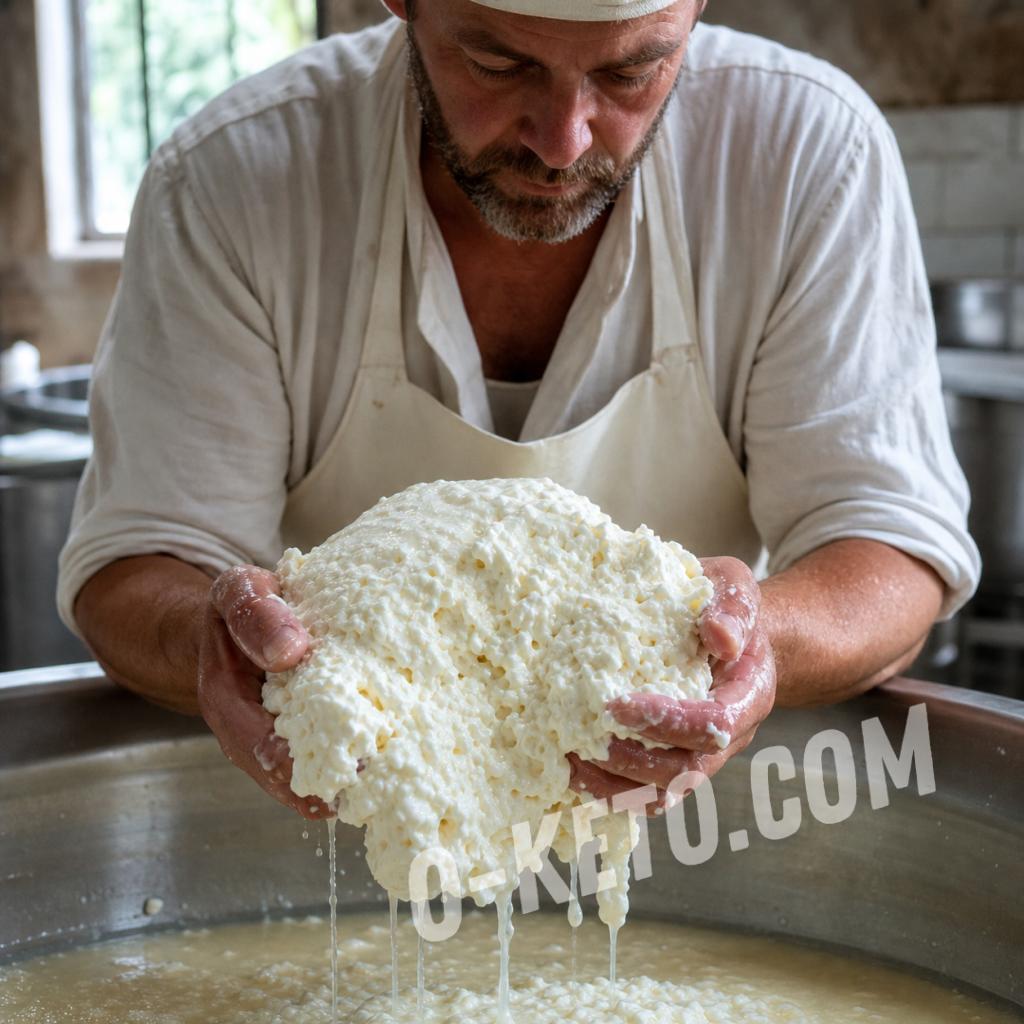
One of the most common reasons for strange holes is overly wet cheese paste. When the mass was underworked, failed to release enough whey, or simply remained too watery for the intended style, gas does not create a clean, controlled pattern. Instead, the cheese becomes sponge-like, filled with many small irregular openings, and the body feels loose and incompletely gathered.
This matters especially to beginners who celebrate any porosity as a sign of a “living cheese.” If moisture is too high, holes by themselves are not a virtue. They often signal that the body never reached the required density, that the curd was stirred too little, or that molding happened while the mass was still too wet. In such a cheese, the openings are not a noble pattern but a consequence of weak structure.
Why underworking and poor curd knitting also create voids
Even without active gas production, cheese can end up with many mechanical openings if the curd never knit properly. Insufficient stirring, uneven curd particle size, molding too early, or weak self-pressing leave micro-gaps between the particles. Later those become mechanical eyes that are easy to mistake for bacterial patterning.
These voids usually look less regular, often stretch along layers, and tend to follow the seams where separate clumps of curd came together. This is why a beautiful eye pattern depends not only on culture choice but also on the very physical mechanics of curd handling. Good microbiology cannot fully rescue a body that was assembled carelessly.
How acidity can damage the pattern through underdevelopment or excess
Acidity influences eye formation in both directions. If the paste has not developed enough acidity, it may remain too coarse, too resistant, and less capable of holding gas in the right distribution. If acidity has gone too far, the body becomes more brittle, drier, and crumbly, and even with gas present the result will not be a beautiful pattern. The gas simply cannot work inside the matrix the way it should in a properly maturing cheese.
Over-acidified paste is especially deceptive. From the outside it may seem that something active happened in the cheese, while internally the structure no longer supports normal eye development. Instead of a controlled pattern, you may see chaotic voids, brittleness, crumbliness, or a generally disharmonious texture. That is why the hole problem is almost never only about bacteria. It is also about hitting the right acidity window.
Why early holes are not always good news
If holes appear too early, especially already in the curd or immediately after molding, that is usually not a sign of a “successful Swiss-style cheese.” It usually points to gas production that began too early. At that point you should think not about beautiful eye formation, but about milk background, bacterial load, summer logistics, overly gentle pasteurization, or unwanted flora. Proper eyes follow their own technological schedule and should not appear chaotically at an early stage simply because gas has already started working in the body.
Early holes are dangerous partly because cheesemakers may confuse the desired with the undesirable. Without separating the normal action of the intended culture from an early defect gas problem, it becomes easy to adjust the wrong variable: changing the starter instead of fixing milk cooling, blaming the rennet instead of reviewing moisture, or searching for the perfect strain when the real issue began before cheesemaking even started.
How to judge holes in cheese correctly
The most useful approach is to evaluate not only the presence of openings but the whole context around them. When did they appear? What shape do they have? Was the body wet or already well-knit? Did acidity develop evenly or move too far? Were the cultures truly suited to this style of pattern, and was the body prepared correctly for their work? Only together do these questions produce a reliable answer.
If the openings are round, expected for the style, supported by the right flavor, and present inside a dense, well-knit body, that is one story. If they are chaotic, early, sponge-like, and accompanied by a loose, wet, or crumbly structure, that is a completely different story. In the first case, you are looking at a technologically justified pattern. In the second, you are looking at a defect that must be analyzed through moisture, curd knitting, acidity, and microflora.
Main practical conclusion
Holes in cheese do not come from one cause. They appear where mechanics, microbiology, and precision in curd handling intersect. A beautiful pattern requires not only the right culture, but also well-knit grain, appropriate moisture, correct acidity, and a ripening regime that actually supports that style. If one of these layers fails, eyes can turn from an advantage into a defect very quickly.
The sooner you stop treating all holes as equal, the easier it becomes to understand what exactly needs correction in a specific batch. Sometimes the answer is a different strain. Sometimes it is lower moisture. Sometimes it is more accurate acidity control. And sometimes the issue is not the culture at all, but the fact that the cheese was assembled poorly from the start. That distinction is what makes cheesemaking much more precise.