
With pasta filata cheeses, the most sensitive moment does not begin at salting or shaping. It begins in that short interval when the curd is tested for stretch. This is where it becomes obvious whether the batch has entered the working acidity window. If acidity is still too low, the curd may look dense and promising, yet when heated it tears into fibers and refuses to gather into a smooth elastic ribbon. If acidity has already gone too far, the mass may first seem soft and compliant, then quickly lose body, spread apart, cloud the water, and stop holding a clean structure.
That is why the problem almost never boils down to saying that the cheese simply does not stretch. The real question is deeper: where exactly the acidity stands, how fast it has been developing, how well the curd drained, and whether the cheese maker is trying to stretch it too early or too late. For mozzarella, suluguni, caciocavallo, and similar cheeses, this decides nearly everything. It determines whether the mass will gather into a glossy plastic ball or turn into torn pieces or an exhausted flowing paste.
Why the acidity window is so critical for pasta filata
Stretching in pasta filata does not come from hot water alone. It appears when the protein network has been prepared enough by acidity but has not yet been weakened by too much of it. While pH is still too high, calcium bridges remain too rigid, and the mass cannot move into the proper plastic phase. As acidity approaches the working zone, the structure becomes able to stretch into smooth layers and fibers. If acidification continues beyond that point, the network begins to lose stability and the beautiful stretch gives way to a tired, sticky, or collapsing mass.
In practice, many cheese makers think of a zone around pH 5.1–5.3 as commonly workable for stretching, but that number is not a magical universal target for every vat. Milk composition, starter activity, curd moisture, drainage speed, and curd handling all shift the behavior. That is why a pH meter is useful but does not replace an actual stretch test. It narrows the window, while the final decision still comes from how a warmed test piece behaves in water.
What under-acidification looks like
When acidity is still insufficient, the curd often looks deceptively encouraging. It may appear neat, compact, and even resilient. The mistake is to interpret that firmness as readiness for filatura. Once heated, this curd does not stretch cleanly. It tears into short fibrous strips. The surface looks rough, folds do not smooth out, and the inside resists as if the curd is being forced apart rather than drawn into shape by its own plasticity.
At this stage, many cheese makers respond by increasing the water temperature or kneading longer, hoping the mass will finish developing during stretching. Usually that only worsens the result. An overheated but still under-acidified curd does not become good pasta filata. Instead it loses additional moisture and becomes even more ragged. The visible signs are harsh ribbons, coarse tearing, poor seam smoothing, and a lack of the characteristic glossy finish.
What over-acidification looks like
Too much acidity creates the opposite but equally frustrating picture. At first, the mass may seem very compliant, which is exactly why this stage can be misleading. It softens quickly in hot water and flows easily under the hands, but instead of controlled stretch it starts to lose form. Layers become too thin, sections spread apart, the surface may look overworked or overly wet, and the water clouds quickly from protein loss and fine particles escaping from the mass.
At this point the cheese has already passed its best moment. Over-acidified pasta filata often stretches not like an elastic ribbon but like a tired sheet that first yields and then sinks. It becomes difficult to make a springy ball or a firm braid because the structure no longer holds a proper frame. After cooling, the cheese may taste too sharp and may feel either too dry or oddly loose inside because the desired fibrous structure never formed in a balanced way.
How under- and over-acidification look on the table
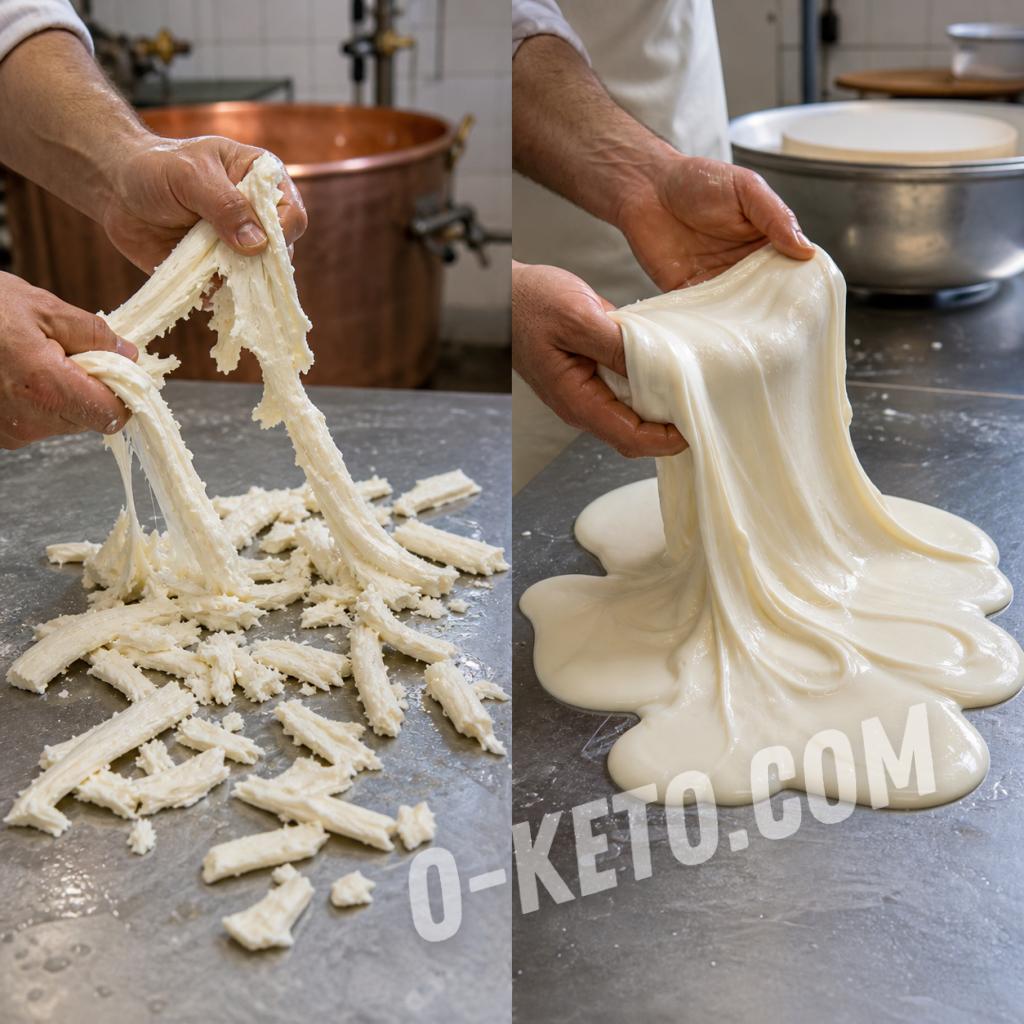
The easiest way to distinguish these states is not by a single sign but by a combination of behavior markers. Under-acidified curd shows resistance, coarse tearing, and refusal to gather into a smooth glossy sheet. Over-acidified curd shows the opposite problem: too little resistance, fast loss of form, rapid thinning, and a sense that the mass cannot be held in a defined volume.
| situation | what the stretch test shows | what it usually means |
| too little acid | the mass tears, fibers stay short, surface is rough | the network is still too rigid for proper stretch |
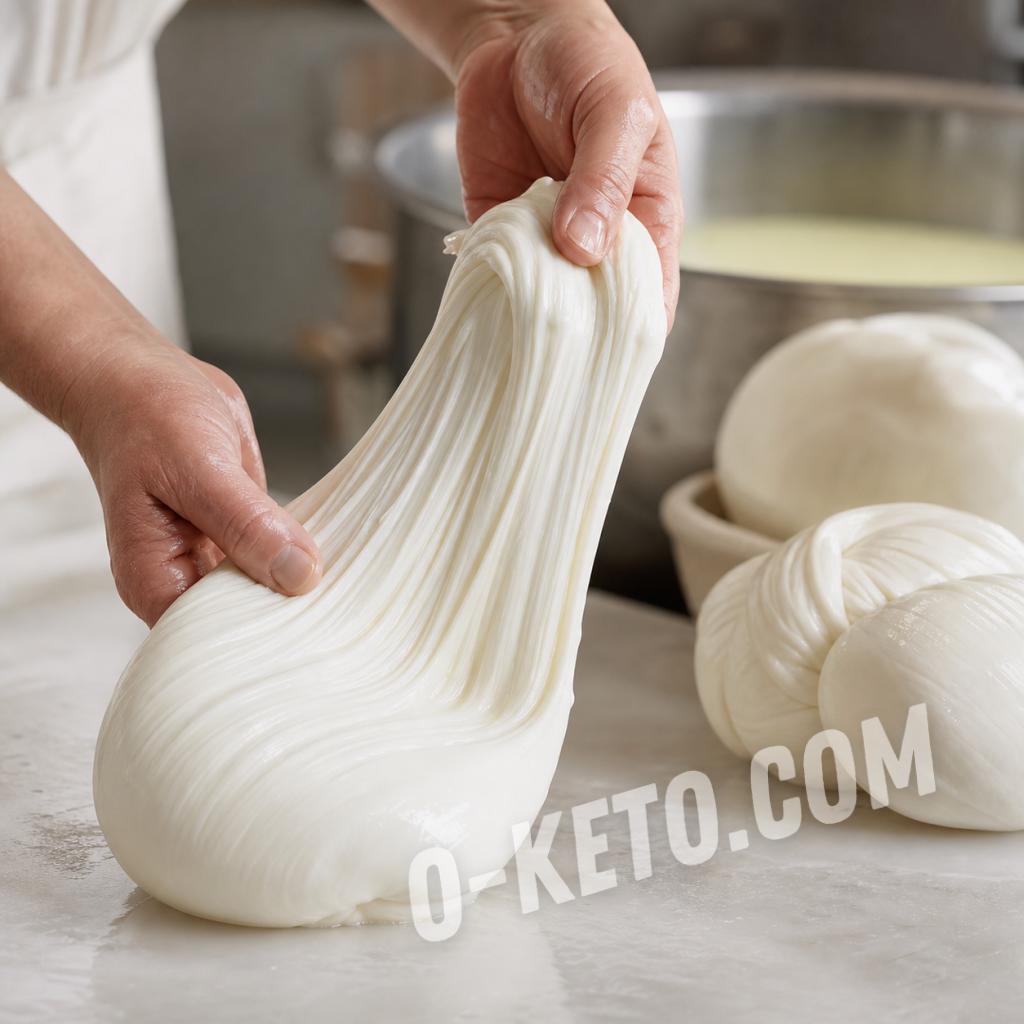
| enough acid | the mass stretches into a smooth glossy ribbon and folds cleanly | the workable filatura window has been reached |
| too much acid | the mass softens too fast, spreads, and clouds the water | the best stretching point has already passed and the network is weakening |
That is why it helps to make short repeated tests over time instead of waiting for one dramatic perfect signal. In pasta filata, the workable window can be quite narrow. It is easy to miss it, especially in a warm kitchen, with a fast starter, or when the drained curd is left standing longer than expected without close checks.
Why pH alone does not save the batch
It is entirely possible to see a beautiful number on the meter and still get poor stretch. One batch at a similar pH may behave better than another because milk mineral balance, curd moisture, starter speed, or drainage pattern was different. A number helps, but pasta filata remains a technology of curd behavior, not of one isolated measurement.
There is also another trap: the reading is taken at the wrong stage. If the test is done too late, after substantial moisture loss, the number may look suitable while the real stretching window has already shifted. That is why experienced cheese makers compare several markers at once: pH, curd resilience, drainage pattern, acidification speed, and the behavior of a small warmed test piece in hot water.
What is easy to confuse with an acidity problem
Failed filatura does not always mean only under- or over-acidification. A similar picture may come from a curd that is too wet, poor curd cutting, weak pre-drain handling, water that is too cool or too hot for stretching, or milk that already gave a weak coagulum before this stage. The difference is that in a true acidity problem the behavior changes over time in a fairly logical way: earlier the mass tears, then it becomes ideal, and later it starts to collapse.
If the mass behaves badly at all stages without that clear progression, the cheese maker should suspect not only acidity but also the underlying make itself. For example, a fundamentally weak coagulum can create chaos during every stretch attempt because the protein network was built poorly from the start. In that situation it makes no sense to treat everything by waiting a little longer for more acid. The first question should be whether the original curd was sound in the first place.
How to correct the batch in practice
If the test shows under-acidification, the most useful move is not to overheat the curd or force it mechanically. It is better to allow a little more time for acid development and repeat a short stretch test later. If the test already shows clear over-acidification, returning the mass to the perfect window is usually not realistic. In that case, the better choice is to stop abusing the curd with endless stretching and form it as gently as possible, accepting that the final texture will be less ideal.
For future makes, the lesson is even more valuable than the fate of the current batch. If under-acidification happens consistently, starter activity, temperature, holding time, and drainage speed need review. If over-acidification happens repeatedly, the workable window is being missed too easily: the starter may be too fast, testing begins too late, or the drained curd is being left without control after it was already close to ready. In pasta filata, the winner is not the person who pulls harder, but the one who catches the moment more precisely.
Practical conclusion
Pasta filata stops feeling mysterious when the cheese maker reads the behavior of the mass instead of reacting emotionally to one failed pull. Under-acidification gives resistance and rough tearing. Over-acidification gives slackness, collapse, and loss of frame. The workable point sits between those extremes and usually does not last long, so the best tool is not only a pH meter but a series of timely short stretch tests. Once that window becomes visible, mozzarella, suluguni, and other stretched-curd cheeses become much more predictable.