When milk fails to form a proper curd, the problem is almost never just one “bad rennet.” In home cheesemaking a weak curd usually appears when several layers stop working together at once: the milk itself is not suitable for cheese, pasteurization changed it too much, available calcium dropped, acidity developed in the wrong direction, the starter worked sluggishly, or the rennet was added under poor conditions. That is why the same workflow that behaved beautifully last week can suddenly give you a trembling mass and cloudy whey today.
It is far more useful to treat this as a diagnostic problem than as a question of what else to throw into the pot. The real question is which stage broke the coagulation. That approach helps you do more than rescue one failed batch. It shows why one milk source forms a confident curd while another barely gathers into a proper cheese mass.
What milk should be like for cheesemaking
Good cheesemaking milk must be more than simply fresh. Its protein system and mineral balance need to remain intact enough for both rennet and starter culture to do their work. Milk after gentle treatment can still perform well, while milk that was heated too harshly or stored too long often behaves much worse.
In practice that means “milk for drinking” and “milk for cheese” are not always the same thing. A product can be perfectly acceptable for daily consumption and still be a poor choice for building a dense, clean curd. This is especially common with milk that carries signs of ultra-pasteurization or strong industrial stabilization.
How pasteurization interferes with a proper curd
Pasteurization is useful for safety and predictability, but it changes milk. After heating, some calcium becomes less available for rennet coagulation, and the proteins may behave differently from those in more intact milk. The harsher the regime, the higher the chance that milk will respond poorly to rennet.
Gentle home pasteurization or relatively delicate industrial treatment can still be compatible with good cheesemaking, especially if the next steps are corrected properly. Ultra-pasteurized milk, however, is often changed too strongly. In that case the curd may set badly, slowly, or with a structure that simply does not match what a cheesemaker expects.
Why fat level and normalization also affect curd strength
When people discuss weak curd, they usually jump straight to calcium or rennet. Yet for semi-hard cheeses the normalization of milk matters almost as much. If fat rises too high, especially clearly above roughly 4%, the curd can become loose, flabby, and less willing to release whey. It may look softer and less organized from the very beginning.
The issue is not only the absolute amount of fat, but the protein-to-fat balance. Fat globules physically interfere with the formation of a tight paracasein network and make it harder for that network to assemble cleanly into stable curd. The result can be a woolly or underbuilt body even when calcium and rennet themselves are workable. This matters especially in semi-hard cheeses, because they depend on good whey drainage and a more disciplined protein structure. Excess fat pushes the system toward softness and instability.
That is why it helps to look beyond the simple question of whether milk is “rich” or “not rich.” The broader issue is cheesemaking suitability. If milk is very creamy but relatively low in protein, you may struggle to obtain a clean, elastic curd even with careful technique. In home practice this is one reason why one farm milk makes wonderful cheese while another tastes pleasant but still gives a weak grain. Sometimes it is wiser to normalize the milk slightly before making cheese than to fight a loose curd later with emergency additions.
Why calcium matters so much
After pasteurization and storage, milk often lacks enough available calcium to build a confident protein network. In that case, even with a normal rennet dose, coagulation becomes sluggish and the curd turns weak, brittle, or unable to show a clean break. That is exactly why cheesemakers use calcium chloride.
Calcium does not magically make every milk ideal, but it often restores part of its cheesemaking strength. This is especially useful when the milk seems fresh on paper, the rennet is active, and the curd still behaves lazily. If the batch improves noticeably after calcium chloride is added, that is usually a strong sign that the problem really lived in the mineral layer and not only in the rennet.
How acidity affects coagulation
In cheesemaking, acidity should never be treated as background noise that will somehow arrange itself. Starter cultures gradually change milk pH, and that directly affects how rennet works and how the curd behaves afterward. If acidity rises too slowly, coagulation can be weak and unstable. If it rises too quickly, the mass may set in its own way but still develop the wrong texture and release whey too abruptly.
That is why weak curd is not always only a lack-of-acid problem. It can also mean that acidity is developing at the wrong pace for the cheese you are making. In one batch this shows up as delayed flocculation. In another it appears as a loose curd that does not tolerate cutting well. In both cases it may look as if rennet alone is guilty, while the deeper cause lies elsewhere.
What happens when rennet is weak or added poorly
Rennet may have a respectable name and still be weakened by storage, temperature fluctuations, or simply too much time after opening. It is also easy to add it under the wrong conditions: milk that is too cold, milk at the wrong acidity, or a system already struggling with calcium. Then even the correct dose fails to deliver the expected result.
Another common mistake is to try to solve everything with more rennet. That may speed up setting, but it does not fix the real cause. Worse, the curd can become too coarse or contribute bitterness later on. If coagulation collapsed because of the milk itself or because the process was broken, rennet is not obliged to save the batch by itself.
Signs that the milk is poorly suited for cheesemaking
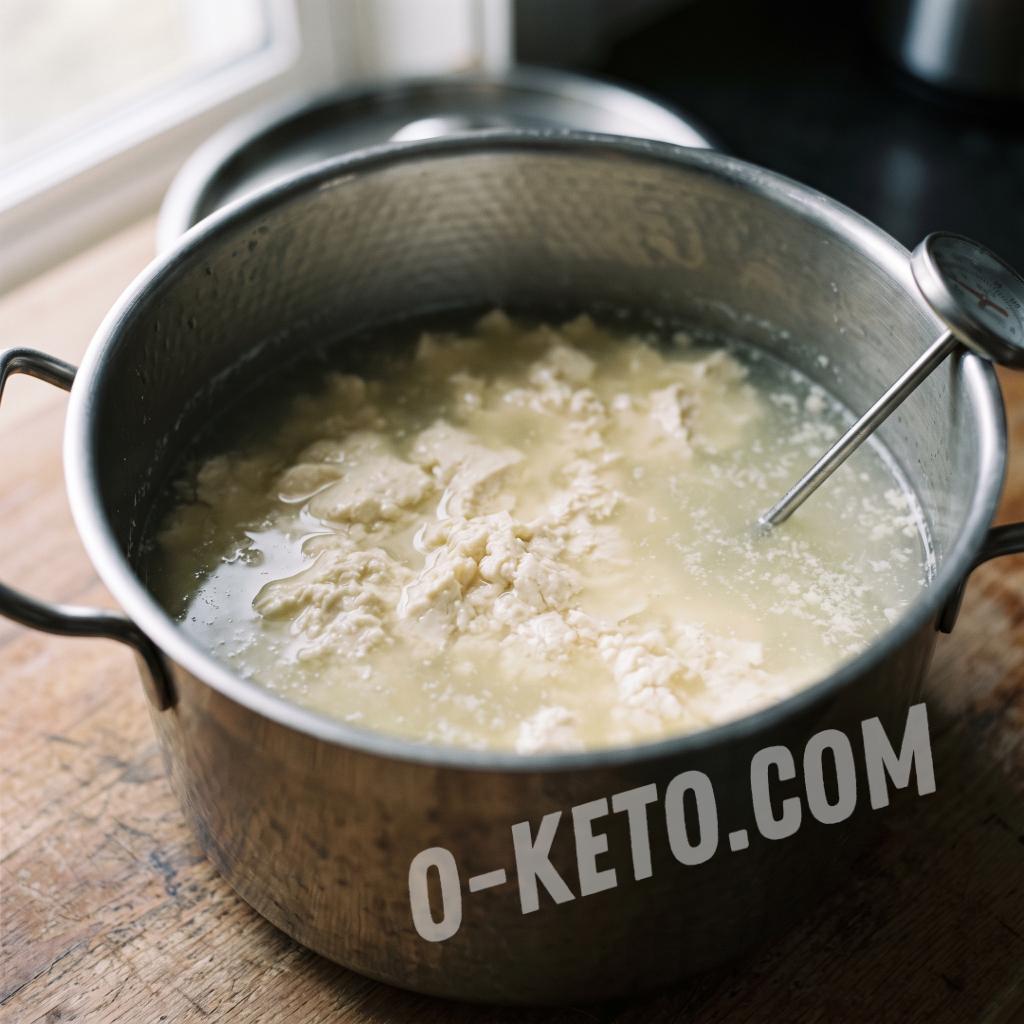
Several symptoms repeat themselves often. Flocculation arrives much later than usual. A clean break looks weak and uneven. After cutting, the curd grain falls apart quickly and loses fine particles into the whey. The whey itself looks cloudier than normal. Cheese yield drops, while the mass remains too wet or structurally uncertain.
If that pattern repeats consistently with one particular milk type rather than in one random pot, the milk or its treatment is usually the first suspect. This is especially typical with milk after harsher industrial processing, where the product may still be nutritionally usable yet already much less suited to cheese. The same can happen with very rich, poorly normalized milk, especially when you are making semi-hard cheese and need a more organized structure.
Why fresh milk and stored milk behave differently
Even without ultra-pasteurization, milk changes over time. Refrigerated storage, transport, agitation, temperature fluctuations, and the overall age of the batch all affect how it will form curd. The same milk on the day of purchase and several days later can show different flocculation speed and different grain stability.
That is why the question of which milk suits cheesemaking includes more than just a brand or a farm. It also includes the freshness of the specific batch. If coagulation was confident yesterday and the same milk feels much weaker today, the problem may not be the recipe at all. The cheesemaking strength of the milk may simply have faded.
How to check the problem step by step
The best strategy is to diagnose the failure in sequence. First, check the milk type and how it was treated. Then evaluate the temperatures for starter and rennet addition. After that, ask whether calcium chloride was needed and whether the rennet itself remained strong. Then analyze the pace of acid development and the flocculation point. If the milk is noticeably richer than usual or the batch feels unusually soft, the normalization question should be part of that check from the start, not an afterthought.
When you change only one factor at a time, the picture becomes clearer much faster. Keep the same milk but add calcium. Or keep the same milk but lower fat slightly before cheesemaking. Or leave the milk unchanged and watch timing and temperature more carefully. That is how real conclusions appear instead of guesses.
Main practical conclusion
A proper curd is not born from one lucky ingredient but from coordinated work across the whole system. You need suitable milk, not-too-harsh processing, enough available calcium, sensible fat normalization, appropriate live starter cultures, the right temperatures, and working rennet. If even one of these layers fails, the cheesemaker sees it as lazy coagulation, cloudy whey, and weak grain.
The sooner you begin diagnosing the structure instead of chasing guesses, the easier it becomes to find milk that genuinely suits cheesemaking and to stop treating every batch with random fixes. That is the real transition from accidental cheese making to a predictable home process.