

Homemade keto ice cream often becomes hard not simply because sugar is absent, but because the mixture contains too much free water and freezes slowly. Sugar normally sweetens and also lowers the freezing point. When it is removed, fat, sweetener, cooling, maturation, and stirring must be planned together.
What makes the texture soft
Softness comes from several factors. Cream fat surrounds part of the ice crystals and gives a smooth mouthfeel. Dissolved allulose lowers the freezing point, although too much can create a cooling sensation and later crystallization. Egg yolk, cream cheese, or yogurt add solids and emulsifiers, while a small amount of ice-cream stabilizer holds water in a fine structure.
Fat alone is not enough: cream and sweetener can still freeze into a solid block. A balanced base is needed. For a first attempt, use rich cream, a modest dairy or cheese component, a measured amount of allulose, and stabilizer when the recipe calls for it. More free water means that stirring becomes more important.
Building a sugar-free base
Combine the liquid ingredients in a saucepan and mix dry ingredients before adding them. Never drop stabilizer into cold liquid as a lump; it will distribute unevenly and form clots. Heat a dairy base gradually, commonly to 80–85 °C when it contains egg yolks or milk proteins, then cool it quickly. For an egg-free mixture, follow the heating instructions for the chosen stabilizer.
Weigh allulose rather than adding it by eye. It affects structure as well as sweetness. Too little produces an icy dessert; too much gives a strong cooling taste and may encourage crystals. With chocolate, cocoa, coffee, or sour berries, check sweetness only after every component has been mixed.
Which bases work for home freezing
For a quick version, warm part of the cream with allulose, cool it completely, and fold it gently into whipped cream. This base contains little free water and works well in a wide container; with sufficiently rich cream it can be frozen without constant stirring, although the first 6–8 hours still require attention to its texture.
For a denser texture, make a custard base from milk, cream, and egg yolks. Heat it until it thickens without boiling, cool it quickly, and only then fold it into whipped cream. A milk base with butter and milk powder requires accurate weighing, gentle heat, and gradual tempering of the yolks to prevent curdling.
A sour-cream base gives a more pronounced cultured-dairy flavor: warm the cream with allulose, dissolve the sweetener, add sour cream off the heat, and cool the mixture. In every version, a wide container and short stirring sessions early in freezing help produce smaller ice crystals.
Why the base needs refrigerator maturation
After heating, cool the base quickly to refrigerator temperature, cover it in contact, and chill it for at least 4–8 hours. Fat stabilizes, dry ingredients hydrate, and the stabilizer binds part of the free water. A matured mixture freezes more evenly and reaches a creamy consistency sooner.
Do not put a warm base straight into the freezer. It raises the temperature around the container and freezes slowly, which usually means larger crystals. An ice bath first lowers the temperature from hot to room temperature; the mixture can then go into the refrigerator safely.
Making ice cream without a machine
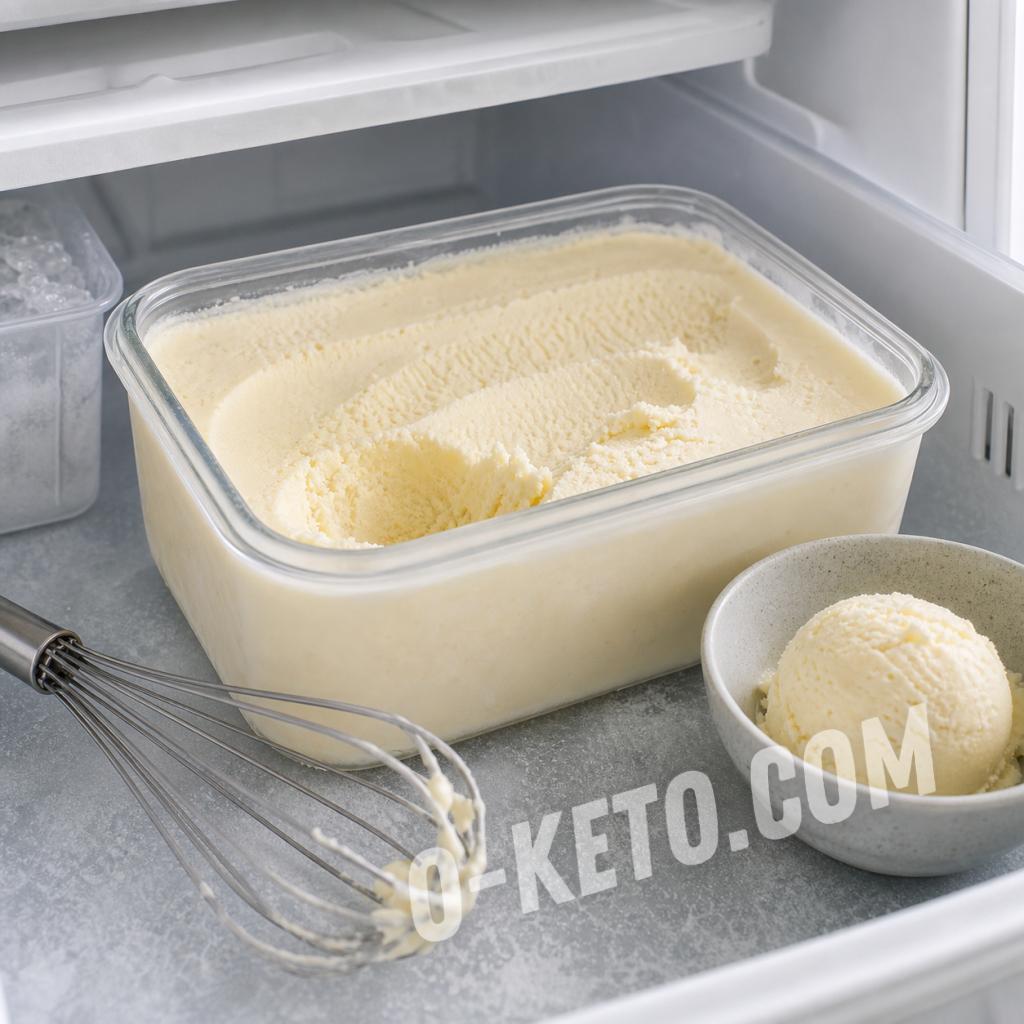
Use a wide, shallow container with a lid. A thin layer freezes faster and is easier to stir. Pour in the fully chilled base, cover it, and place it in a freezer at about −18 °C. After 30–40 minutes, remove it and stir thoroughly with a whisk or immersion blender, scraping the frozen edges into the softer center.
Repeat every 30–40 minutes three or four times. Early stirring breaks the first crystals while the mixture is still mobile. Each blending session should last no longer than one minute: the goal is to reduce ice crystals and distribute fat, not to warm the base. After the last session, leave the ice cream to stabilize for 4–8 hours.
An alternative hand-churning schedule uses a longer maturation and different intervals. Let the stabilized base mature in the refrigerator for 10–12 hours, then place it in the freezer for about 1–1.5 hours until very cold and beginning to set. Blend it briefly with an immersion blender and repeat short cycles roughly once an hour; some mixtures may need up to six or seven cycles. This schedule replaces, rather than adds to, the 30–40-minute stirring method above: choose one approach and follow the texture, preventing the mixture from melting completely or warming during blending.
A homogenizer follows a different sequence: it does not freeze the base but rapidly breaks down a portion that has already frozen solid. Freeze the prepared base in a suitable container, choose a program for the formula and intended texture, and check the result before repeating the cycle. Some mixtures may need a second pass, but there is no universal setting; the result depends on the formula and on whether the ice cream will be served immediately or used in molds.
Temperature, container, and serving
Store the finished ice cream in a tightly closed container, nearly filled to the lid. Empty air space encourages frost and dries the surface. Before serving, let the container stand for 5–10 minutes at room temperature. Do not thaw the entire batch and refreeze it after complete melting.
If the dessert is too hard, check the process first: a very cold freezer, a deep container, rare stirring, and long storage all increase firmness. If it melts too quickly, make sure the base was cold before freezing and the container was not warm.
Common mistakes
Do not replace sugar with an intensive sweetener at the same gram weight; stevia and similar extracts do not provide the same structure. Do not increase allulose without limit. Weigh stabilizer. Do not cool the base slowly on the counter or leave long gaps between the first stirring sessions.
The reliable home sequence is simple: a rich base, measured sweetener, rapid cooling, refrigerator maturation, and several short stirring sessions. It cannot duplicate a commercial freezer, but it greatly reduces crystal size and gives a softer texture in an ordinary container.