

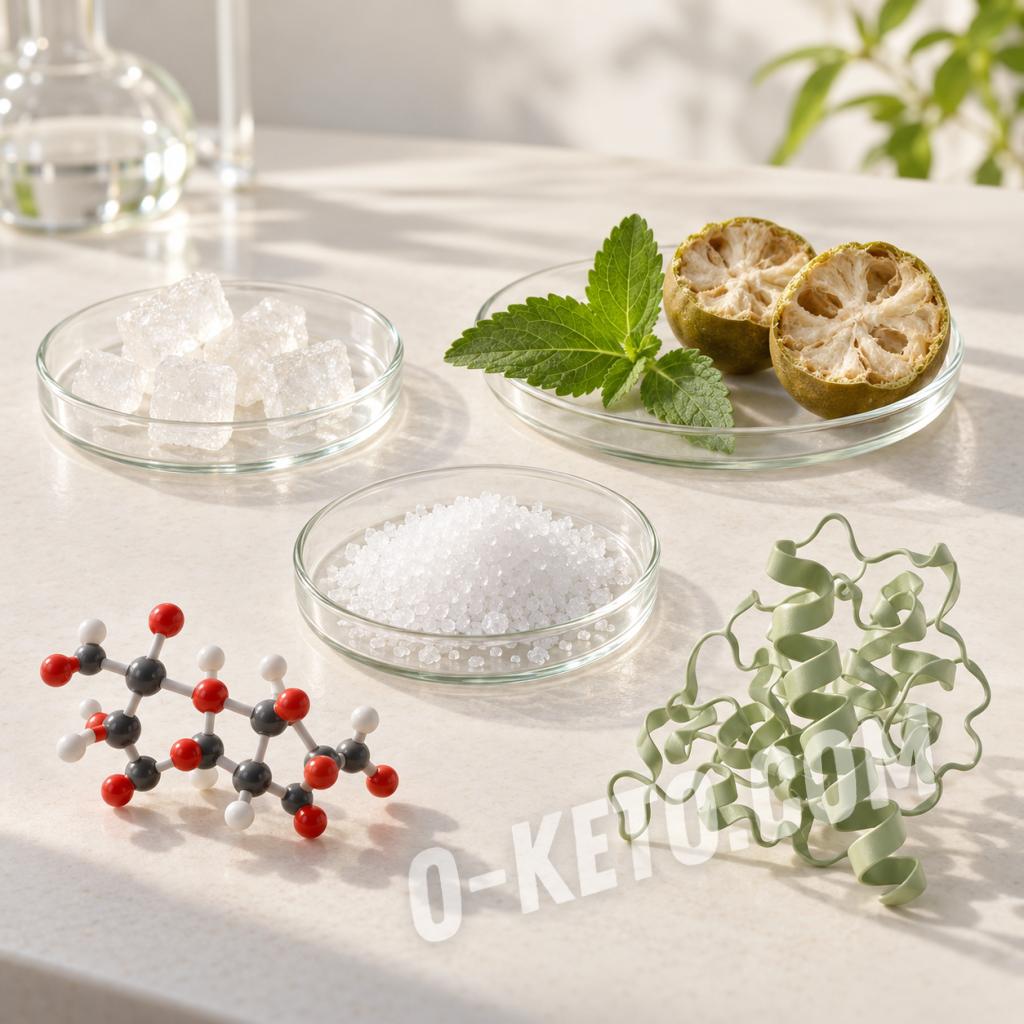

A label may list sugar, erythritol, and stevia side by side even though they belong to different chemical groups. The word “sweetener” describes their shared function—adding a sweet taste—but it does not explain molecular structure. Chemical classification helps distinguish a sugar from a polyol or a high-intensity sweetener used in a very small amount.
This classification answers one question: “What kind of molecule is it?” By itself, it does not tell you the calories or available carbohydrates in a product, how sweet it will taste in a particular recipe, how a person will respond to a serving, or whether the substance is authorized in a given country. Those properties must be checked separately.
Which chemical groups do sweeteners belong to?
The main groups are distinguished by molecular structure, not by whether a substance comes from a plant, is synthesized, or is produced with microorganisms. The table shows familiar examples and approximate sweetness comparisons where comparable figures are available.
| Chemical group | What links the substances | Examples | Approximate sweetness relative to sucrose |
| Sugars | Monosaccharides, disaccharides, and related carbohydrates | Glucose, fructose, sucrose, lactose, trehalose, allulose, tagatose | No single value applies to the whole group |
| Polyols | Polyhydric alcohols structurally related to sugars | Erythritol, xylitol, sorbitol, maltitol, lactitol, isomalt | Depends on the specific substance and product form |
| Glycosides | A non-sugar part of the molecule is linked to one or more sugar units | Steviol glycosides, mogrosides | Steviol glycosides: about 200–400 times; monk-fruit extracts: about 100–250 times |
| Amino-acid-based compounds | Small molecules with peptide bonds or modified peptide structures | Aspartame, neotame, advantame | Aspartame: about 200 times; neotame: 7,000–13,000 times; advantame: about 20,000 times |
| Sweet proteins | Sweet taste comes from large protein molecules | Thaumatin, brazzein, monellin, mabinlin | Thaumatin: about 2,000–3,000 times; values vary by substance and conditions |
| Other individual compounds | They do not form one common chemical family | Saccharin, acesulfame potassium, cyclamate, sucralose | For example, saccharin: about 200–700 times; sucralose: about 600 times |
The ratios in the last column are approximate sensory comparisons with sucrose, not universal recipe conversions. Perceived sweetness depends on concentration, temperature, acidity, and the food matrix; blends and retail products may include carriers. The table helps distinguish chemical classes, but it does not replace the product directions or a small taste adjustment.
Sugars: more than table sucrose
In everyday use, “sugar” usually means sucrose, or table sugar. Chemically, there are many sugars. Glucose and fructose are monosaccharides: each molecule has one sugar unit. Sucrose, lactose, and trehalose are disaccharides made of two linked sugar units. Sucrose, for example, consists of glucose and fructose, while lactose consists of glucose and galactose.
Allulose, also called D-psicose, and tagatose are examples of rare sugars. Their structures are close to those of other monosaccharides, but a small difference in the arrangement of atoms makes each a distinct compound. “Rare” describes how commonly a sugar occurs in nature or food sources; it does not guarantee a particular calorie content, glucose response, or suitability for every diet.
This is why classification axes should not be mixed. Allulose remains a sugar by chemical structure even though its metabolism and labeling are treated separately in some jurisdictions. Conversely, a sweet taste does not turn aspartame or steviol glycosides into sugar.
Polyols: sugar alcohols without ethanol
Polyols are called sugar alcohols because of their molecular structure: they contain several hydroxyl groups characteristic of polyhydric alcohols. The chemical name does not mean that they contain ethanol or belong to alcoholic beverages. The FDA describes sugar alcohols as carbohydrates with chemical characteristics of both sugars and alcohols.
Polyols include erythritol, xylitol, sorbitol, mannitol, maltitol, lactitol, and isomalt. In the EU food-additive system, examples include E420 for sorbitols, E965 for maltitols, E967 for xylitol, and E968 for erythritol. A shared class can contain substances with different carbon-chain lengths and properties, so “polyol” does not mean identical sweetness or identical behavior in a recipe.
Polyols can contribute not only sweetness but also bulk, moisture, and texture. Replacing sucrose with an intense sweetener that is hundreds of times sweeter is therefore not a gram-for-gram swap: volume and some technological functions of sugar disappear. Even within the polyol group, solubility, crystallization, and the cooling sensation in the mouth differ. Baking and creams depend on the specific ingredient, its form, and the recipe—not just its chemical class.
Glycosides: stevia and monk fruit
A glycoside is a molecule in which sugar units are linked to another, non-sugar part called an aglycone. The word does not mean “sweet substance”: glycosides are widespread in plants, and many do not taste sweet.
The sweetness of stevia leaves comes from steviol glycosides; the non-sugar base of these molecules is steviol. In monk fruit, also called luo han guo, sweetness is associated with mogrosides, which are built around a different non-sugar base. Both groups are glycosides, but their molecules, individual compounds, and taste profiles are not identical. Commercial products may contain purified glycosides, a mixture of compounds, or carriers that make dosing easier.
Origin and chemical nature answer different questions. A steviol glycoside may be extracted from leaves or made through another production process, but that does not change its chemical class. Likewise, the presence of a plant extract on a label does not prove that the product contains only one sweet compound.
Amino-acid sweeteners and sweet proteins
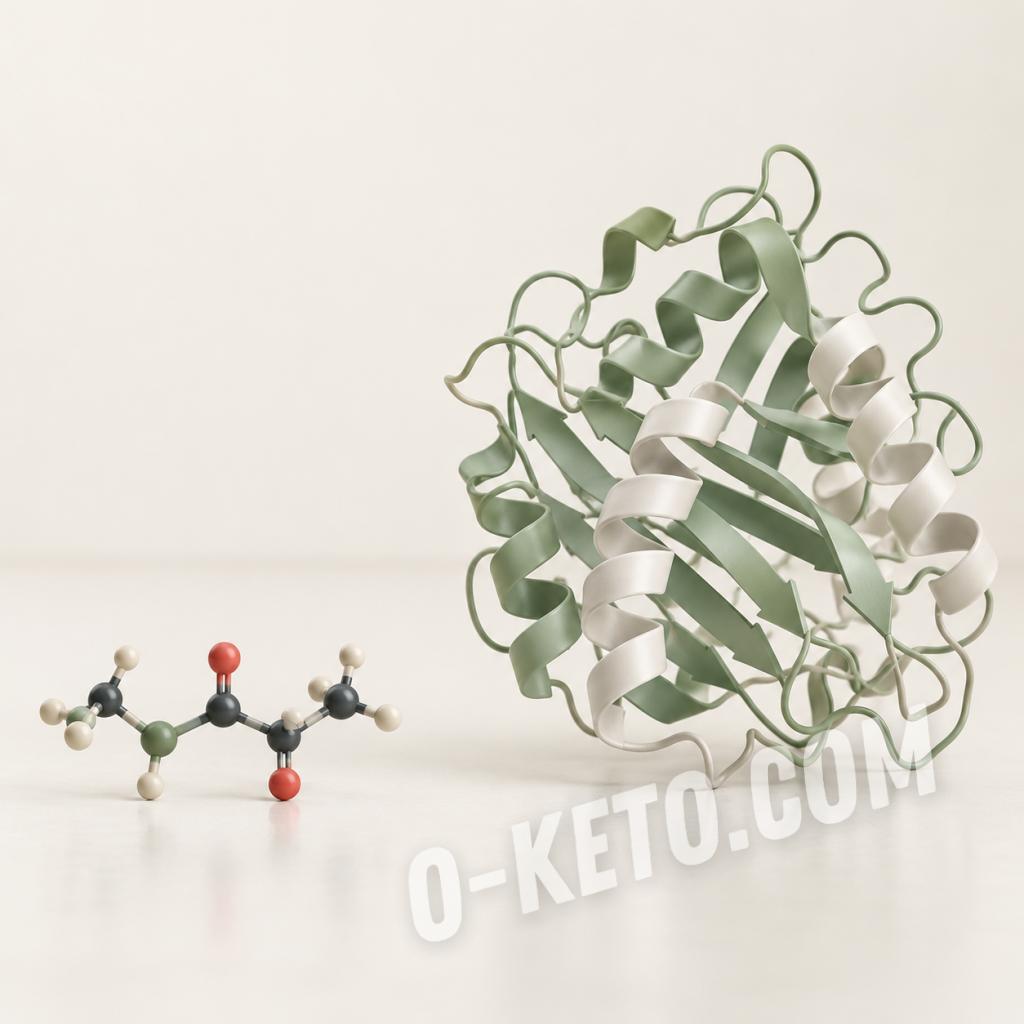
Aspartame is neither a sugar nor a protein: it is a small dipeptide-type molecule made from residues of aspartic acid and phenylalanine, with a methyl ester in its structure. Neotame and advantame are chemically modified compounds related to the aspartame structure. Their sweetness is far greater than that of sucrose, so only a small amount of the pure compound is needed in a formulation. Retail sachets or blends may also contain carriers that provide bulk.
Sweet proteins are different: they are long amino-acid chains folded into three-dimensional structures. Familiar examples include thaumatin, brazzein, monellin, and mabinlin. Their sweet taste depends on the specific protein structure and its interaction with sweet-taste receptors. The name “sweet protein” describes a molecular type; it does not mean that all of these substances are equally available or authorized for every use in every country. For example, thaumatin is listed as an EU sweetener under E957; the status of other substances must be checked separately.
The comparison shows why sweetness alone cannot predict chemical type: aspartame, its modified derivatives, and a large protein can all taste intensely sweet while remaining chemically different. Even related molecules are not guaranteed to have the same heat stability, flavor, or uses during heating.
Saccharin, sucralose, and other individual molecules
Saccharin, acesulfame potassium, cyclamates, and sucralose are often grouped in overviews by their purpose or high sweetness intensity. Chemically, they are different substances rather than members of one common family. Sucralose is structurally related to sucrose, but it is a modified chlorinated derivative; that does not make it ordinary sugar.
Regulatory identifiers also differ from chemical classification. For example, in the EU system E951 identifies aspartame, E957 thaumatin, E960 steviol glycosides, E961 neotame, and E420 sorbitols. These codes identify food additives in the relevant jurisdiction; by themselves, they do not tell you whether a molecule is a sugar, polyol, glycoside, or protein. Authorization and labeling rules depend on the country and the specific product.
Which sweeteners in this list usually fit keto?
Chemical class tells you what an ingredient is, but it does not determine whether a serving fits keto. The practical questions are how many digestible carbohydrates are in the amount you use and how that fits your daily limit; there is no universal official list of “keto-approved” sweeteners. This table is a practical guide, not a judgment about safety or legal authorization as a food additive.
| Sweetener and examples | Keto fit | Why this rating applies and how to count it |
| Common sugars: sucrose, glucose, fructose, lactose, trehalose | Usually a poor fit in ordinary sweetening amounts | Count their carbohydrates in the ingredients and serving; “natural” does not change that calculation. |
| Allulose | Usually fits keto in a moderate serving if it is pure and has no carbohydrate carriers | In a small human study, about 70% of the dose was excreted unchanged in urine; the FDA uses 0.4 kcal/g for allulose. In the U.S., it remains in Total Carbohydrate but may be excluded from Total Sugars and Added Sugars. Absorption into the blood does not mean conversion to glucose. |
| Tagatose | Conditional: it is metabolized differently from ordinary sugar, but it is not carbohydrate-free | In a small study of 6 people with an ileostomy who consumed 15 g/day, apparent small-bowel absorption was 81% (range 69–88%). This is not the share converted to glucose and is not a universal value. For a strict limit, count the amount on the label and the serving you actually eat. |
| Erythritol | Often one of the more convenient polyols for keto when it is pure erythritol | Check for dextrose, maltodextrin, or other carriers in a blend. Large amounts may have a laxative effect. |
| Xylitol, sorbitol, mannitol, isomalt, lactitol | May fit in a small serving; each polyol has different properties | These polyols differ in absorption, energy contribution, and effect on blood glucose; some of the unabsorbed portion is fermented. There is no single absorption percentage for the group. For a strict limit, do not subtract them automatically; count the amount in the actual serving. |
| Maltitol | Limited: a small serving may fit, but count the full label amount for a strict limit | Sugar alcohols are slowly and incompletely absorbed and usually have a smaller effect on blood glucose than sugar, but their contribution is not zero. Do not automatically subtract all or half of the amount, or apply the erythritol rule to maltitol. |
| High-intensity sweeteners: steviol glycosides, mogrosides, aspartame, neotame, advantame, saccharin, acesulfame potassium, cyclamate, sucralose | Usually easier to fit in a small dose when used without a carbohydrate-based carrier | Check the full ingredient list for powders, tablets, and syrups: carriers may include sugars, starch-based fillers, or polyols. |
| Sweet proteins: thaumatin, brazzein, monellin, mabinlin | Concentrated forms are used in small amounts and may be convenient for limiting carbohydrates | Check the ingredients and serving of the finished product; availability and permitted uses of specific proteins vary by country. |
For allulose, distinguish the Total Carbohydrate line on the label from the amount the body turns into energy or glucose. A U.S. label for pure allulose can therefore show about 100 g of Total Carbohydrate per 100 g of product, although that is not equivalent to 100 g of glucose. Intestinal absorption, later metabolism, and a change in blood glucose are different measures. Choose one consistent keto-counting method: if you limit total carbohydrate, use the full label amount; if you count net carbohydrates, treat allulose separately according to that method. Do not apply the same deduction to tagatose or maltitol.
How to use the classification when choosing a product
Start with the ingredients in the specific product. The name on the front of the package may refer to one high-intensity sweetener, while most of the blend’s mass comes from erythritol, maltitol, dextrose, maltodextrin, or other carriers. In that case, identify the chemical group of each ingredient separately and use the product label to check carbohydrates and serving size.
For keto and low-carbohydrate eating, one marketing claim should not be mistaken for another. “Made with stevia” indicates the presence of steviol glycosides, but does not necessarily say what provides the blend’s bulk. “Sugar alcohol” points to a polyol but does not tell you which one. “Sugar-free” also does not state the product’s total calories, carbohydrate content, or behavior in a particular recipe.
If the sweetener is for baking, check not only relative sweetness but also the role sugar plays in the original recipe. Sugar can contribute volume, moisture, browning, or foam stability. Pure stevia, aspartame, or another high-intensity sweetener adds sweetness in a small dose but does not automatically replace those functions. A drink may need only a small amount of concentrate, while a sponge cake or cream may require an ingredient with suitable bulk and technological properties.
In short, the main chemical types are sugars, polyols, glycosides, amino-acid-based compounds, and sweet proteins; saccharin, acesulfame potassium, cyclamate, and sucralose remain individual molecules with different structures. This map helps identify what you are using, but dosing, carbohydrate assessment, food function, and permitted use must be checked for the specific substance, formulation, and label.
Sources
- European Food Safety Authority (EFSA). Sweeteners.
- U.S. Food and Drug Administration (FDA). Aspartame and Other Sweeteners in Food.
- Food and Drug Administration — Sugar Alcohols: Interactive Nutrition Facts Label.
- Food and Drug Administration — Sugars That Are Metabolized Differently Than Traditional Sugars.
- EFSA Panel on Food Additives and Flavourings. Re-evaluation of neotame (E 961) as a food additive. EFSA Journal, 2025.
- Masuda T, Kitabatake N. Developments in biotechnological production of sweet proteins. Journal of Bioscience and Bioengineering, 2006.
- Tan VWK et al. Temporal sweetness and side tastes profiles of 16 sweeteners using temporal check-all-that-apply. Food Research International, 2019.
- Starkey DE et al. The Challenge of Measuring Sweet Taste in Food Ingredients and Products for Regulatory Compliance: A Scientific Opinion. Journal of AOAC International, 2022.
- EFSA. Re-evaluation of erythritol (E 968) as a food additive: plain-language summary.
- FDA. The Declaration of Allulose and Calories from Allulose on Nutrition and Supplement Facts Labels: Guidance for Industry, 2020.
- Iida T et al. Failure of D-psicose absorbed in the small intestine to metabolize into energy and its low large intestinal fermentability in humans. Metabolism, 2010.
- Normén L et al. Small-bowel absorption of D-tagatose and related effects on carbohydrate digestibility: an ileostomy study. American Journal of Clinical Nutrition, 2001.