


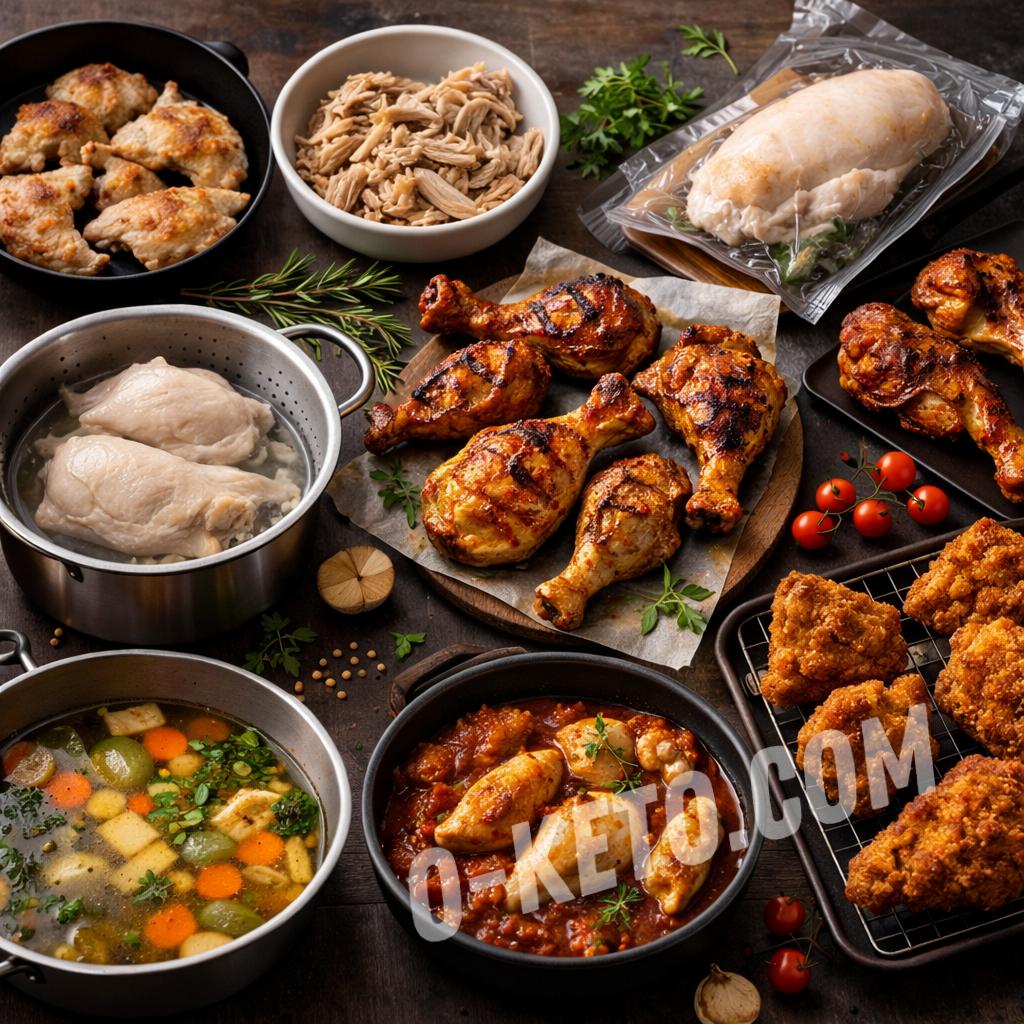

Chicken is one of the most versatile products: from one carcass, you can get a quick dinner, meal prep for the week, and a base for soups and sauces.
To ensure the meat is juicy, the key is not so much the “secret recipe,” but the proper preparation and the choice of cooking method for the specific part.
Preparing Chicken Before Cooking
Butchering. If you buy a whole carcass, it is often more convenient to cut it into parts: this makes it easier to control doneness and juiciness:
- separate the legs by inserting a knife between the lower part of the breast and the leg and cutting along the cartilage;
- similarly, separate the wings;
- remove the breast fillet with a thin sharp knife along the breastbone or detach the breast from the backbone and cut it into 2-4 pieces;
- if desired, separate the drumsticks and thighs, and cut the wings into segments; chop the carcass for broth.
Spatchcocking. This method is needed for even cooking of a whole chicken on a grill or in the oven, as well as for the “tabaka” variant:
- cut the breast, turn the chicken breast-side down, and press it down to flatten it;
- or remove the backbone with two cuts on either side, then press the carcass into a flat shape.
If the breast remains whole, it usually turns out juicier after cooking. To prevent the chicken from deforming, weigh it down or secure it in a grill.
Bone Removal. Bones are removed completely or partially to prepare stuffed rolls, fry more evenly, and serve conveniently. This is especially useful when it is important for the thickness of the meat to be uniform.
Marinating. Marinade helps to evenly salt the meat, add flavor, and, with the presence of acid or enzymes, slightly change the texture:
- dry marinade: a mixture of salt and ground spices that is rubbed onto the meat in advance;
- liquid marinade: a liquid base plus aromatic additives.
For chicken, flavor is usually more important than tenderizing.
Brining. Brine makes chicken juicier and more tender, suitable for both whole carcasses and parts:
- fully submerge the chicken in brine and place it in the refrigerator;
- brine for about 1 hour for every 500 g of weight, but no less than 30 minutes and no more than 8 hours;
- before cooking, rinse the salt off the surface to keep the meat juicy but not overly salty.
The working formula for brine: 1 liter of water + 1/4 cup of salt.
For a whole chicken, it is convenient to use a sturdy bag: this requires less brine.
Flattening. Flattening is used not for “tenderness,” but to even out the thickness: this way, the breast or meat slices will cook more evenly. For fillets, a light flattening with the palm is sufficient.
Making Mince. Chicken mince is suitable for cutlets, burgers, meatballs, and meatballs. For a juicier result, chopped mince is preferable, as chopping retains juices better.
Main Cooking Methods for Chicken
Boiling. Boiling is suitable for both broth and boiled meat, but the goals of these tasks are different:
- for broth: you can salt the water in advance to enhance the flavor transfer to the liquid;
- for boiled meat: it is better to boil in broth and add salt closer to the end;
- for soup: do not overcook the meat with everything else; add it closer to the end and cook only until the desired doneness.
If you are boiling a whole chicken, after it boils, drain the water that got inside the carcass, bring the pot back to a boil, and return the chicken; this will ensure more even heating.
Steaming. Steaming cooks more delicately, and flavors remain inside the meat. This method is convenient for dumplings, pelmeni, and fillings when a tender texture and minimal fat are important.
Baking. Baking gives a crust and bright flavor, but chicken can easily dry out if overheated or overcooked:
- combine temperatures: start at 150 degrees, and at the end, raise to 220 with convection for a crust;
- baste the chicken with the juices released to prevent the surface from drying out;
- when baking in parts, place pieces skin-side up, as moisture evaporates more slowly;
- after baking, let the meat rest for 5-10 minutes to redistribute the juices.
Braising is slow cooking in a small amount of liquid at around 100 degrees:
- prepare the sauce in advance and add the chicken to braise only until done;
- if desired, sear the pieces until browned before braising to add flavor notes;
- do not cook longer than necessary for the internal temperature of the thickest piece to reach doneness.
For a regular broiler, the key risk is not toughness, but drying out from excess time.
Cooking in a Pot or Covered:
- do not let the process go to drying out; focus on the doneness of the thickest part;
- control the amount of liquid so that the bottom does not start frying in fat too early;
- use this method when it is important to retain juiciness and reduce the risk of mistakes.
A pot, duck pan, covered dish, or sleeve creates an environment where steam circulates actively. This helps to cook more delicately and evenly, as well as reduce moisture evaporation.
Frying gives a golden crust but requires control of temperature and moisture in the pan:
- ensure even thickness: slightly flatten the breast or remove the bone where it hinders;
- leave space between pieces so that water evaporates and the meat actually fries;
- flavor the fat with garlic and herbs and baste the meat while frying;
- use a mixture of olive and butter for a richer crust and aroma;
- if necessary, marinate the meat in advance for a more vibrant flavor.
Deep Frying cooks quickly on all sides and gives a crispy crust, but it is important not to overload the oil and not to make the dish excessively greasy:
- heat the oil to working temperature before adding the chicken;
- use oil without a strong odor and with a high smoke point;
- make a batter or double coating to ensure a crispy crust while keeping juices inside;
- after frying, let excess oil drain on a rack or paper and serve immediately.
Grilling gives a characteristic crust and smoky aroma, suitable for both whole chickens and parts:
- cut pieces of the same size and arrange them closely so they dry out less;
- use brine before grilling, then marinade or dry spice mix;
- during the process, baste the meat with marinade to enhance flavor and slow drying;
- for juiciness, choose pieces with skin and bone, keeping the skin side on the heat longer;
- be cautious with sugar, honey, and soy sauce: they burn easily, so it’s better to start on lower heat.
Sous Vide is cooking in vacuum at a stable low temperature:
- the temperature inside and outside equalizes, so nothing burns or dries out;
- juices stay inside, and flavors and aromas are not lost;
- you can achieve a tender texture and a slight pinkness at the cut with correct time and temperature.
This is especially useful for breasts, which are easiest to overcook using traditional methods. For thighs and wings, the method is usually less justified, as it is already easy to achieve juiciness.
How to Choose a Method for the Task
Choosing a method is easier if you start from the result: maximum juiciness, crispy crust, quick dinner, or meal prep:
- for the juiciest breast: sous vide or careful baking with resting;
- for crispy skin: baking with a final temperature increase or grilling;
- for soft dishes in sauce: braising with a short cooking time for the chicken;
- for soups and flavor bases: boiling and broth with aromatic additives;
- for quick portioned dishes: frying with proper placement in the pan.


