


Endocrine disruptors
Endocrine disruptors are external substances that may interfere with hormonal systems. Hormone-like activity alone does not prove disease: dose, route and duration of exposure, individual susceptibility, combined exposures, and the quality of evidence all matter.
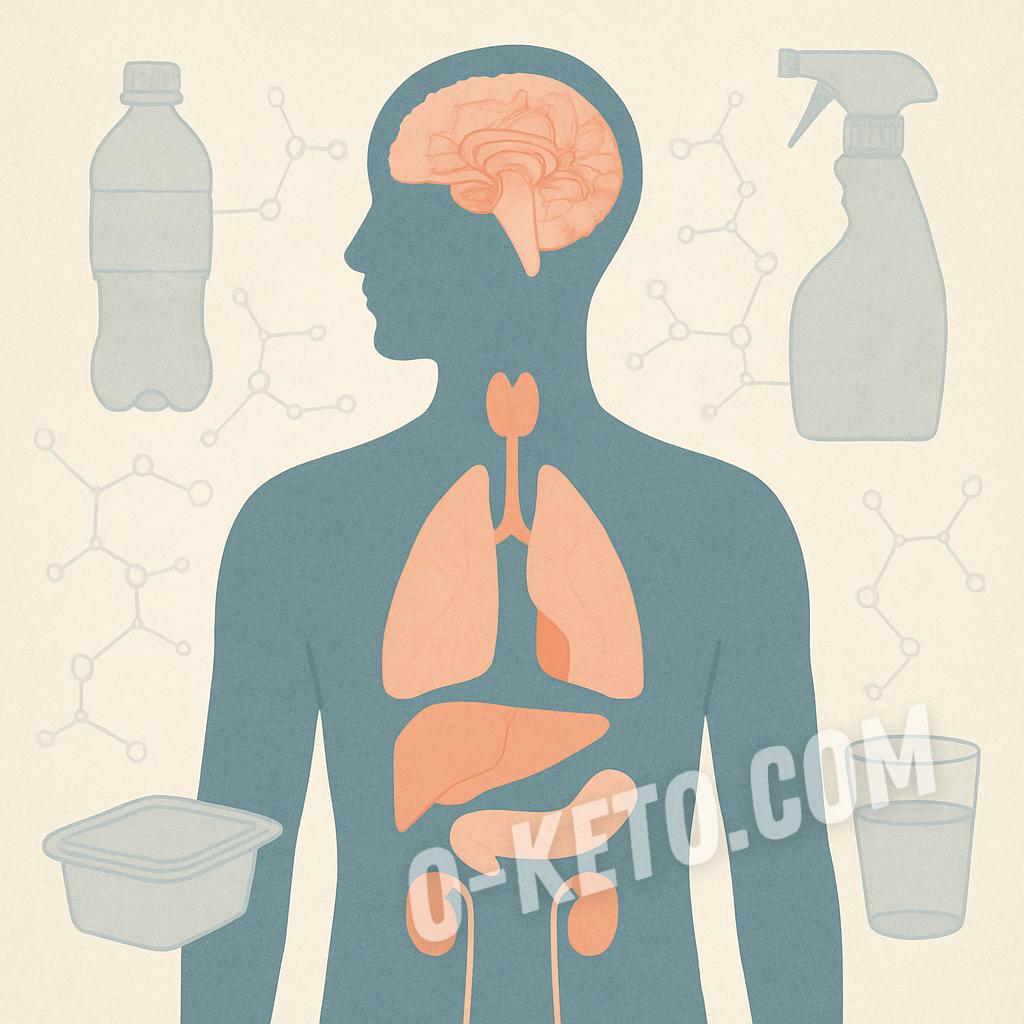
Endocrine disruptors are external chemicals or mixtures that may alter the function of the endocrine system and thereby affect development, reproduction, metabolism, or other physiological processes. The term describes a possible interference with hormonal signaling, not a diagnosis and not proof that every contact causes illness. Assessment must consider the particular substance, exposure level and duration, route of contact, and the person’s susceptibility.
How hormonal systems respond
This interference may be temporary or prolonged, and its significance cannot be inferred from the chemical’s name alone.
Hormones act at very low concentrations by binding to receptors and changing cell activity. An environmental chemical may mimic a hormonal signal, block a receptor, alter hormone synthesis or breakdown, affect transport, or interfere with the cells that receive the signal. The same chemical can have different effects in different tissues and at different life stages. A plausible mechanism helps formulate a biological hypothesis, but it does not show what risk follows from ordinary human exposure.
Where exposure may occur
Potential endocrine-disrupting chemicals may occur in some plastics, coatings, pesticides, flame retardants, cosmetics, household products, and contaminated water or food. Routes vary by substance and may include ingestion, inhalation, skin contact, or transfer from a work surface. A list of possible sources is not a list of dangerous foods. Actual concentrations, frequency, safety instructions, and the possibility of replacing the source are what matter.
Why “hormone-like” does not equal “dangerous”
Activity in a cell experiment or binding to a receptor may occur at concentrations that are not reached in the body. An observational human study also does not always establish causation: diet, age, occupation, social conditions, and other exposures can influence the result. A risk assessment therefore combines toxicology, epidemiology, dose, biological plausibility, and the quality of exposure measurement. The shortcut “a trace was detected, so disease will follow” is not scientifically sufficient.
Why dose and timing matter
Risk depends not only on whether a substance can interact with an endocrine pathway, but also on the dose received. Duration, age, pregnancy, liver and kidney function, metabolism, and mixtures of chemicals may matter. Some processes are especially sensitive during fetal development, childhood, and puberty, but this does not justify treating every household contact as critical. Assessment should separate a substance’s intrinsic hazard from the likelihood of meaningful exposure.
How to reduce unnecessary exposure
It is more useful to choose a few practical measures than to label every product safe or dangerous. Do not heat food in packaging unless the manufacturer allows it, follow instructions for household chemicals and pesticides, ventilate rooms, wash hands after handling chemicals, and replace damaged cookware or coatings. At work, follow occupational-safety rules and use appropriate protective equipment. These steps can reduce particular routes of exposure, but they do not justify promises of completely “detoxifying” the body.
How to read claims about endocrine disruptors
First identify the substance, how it was measured, and what comparison level was used. Then ask whether the source describes real human exposure or only a mechanism in an experiment. Labels such as “hormone-free” or “toxin-free” do not replace a composition, quality standard, or use assessment. Unusual or occupationally high exposure should be discussed with an occupational-health professional or clinician rather than judged from a social-media list.
Conclusion
Endocrine disruptor describes a possible effect on hormonal systems, not a universal explanation for chronic symptoms. Do not confuse detection of a chemical, biological activity, and proven harm at a particular exposure. A sensible approach is to reduce unnecessary contact, follow instructions, and assess risk by substance, dose, timing, and evidence quality.
Sources
- State of the science of endocrine disrupting chemicals — United Nations Environment Programme and World Health Organization
- Endocrine disrupting chemicals — World Health Organization
- Endocrine Disrupting Chemicals — European Environment Agency
- Endocrine disruptors: from scientific evidence to health protection — International Programme on Chemical Safety
If you have any questions about the term "Endocrine disruptors", you can ask them to AI. Please note, a low-cost OpenAI model is used. It may answer questions about disease treatment with errors!

 1 / 4
1 / 4


 1 / 4
1 / 4
 1 / 4
1 / 4
 1 / 4
1 / 4
