
"Psychiatry Yesterday (1950) and Today (2007): From Despair to Hope with Orthomolecular Psychiatry," Abram Hoffer, 2009
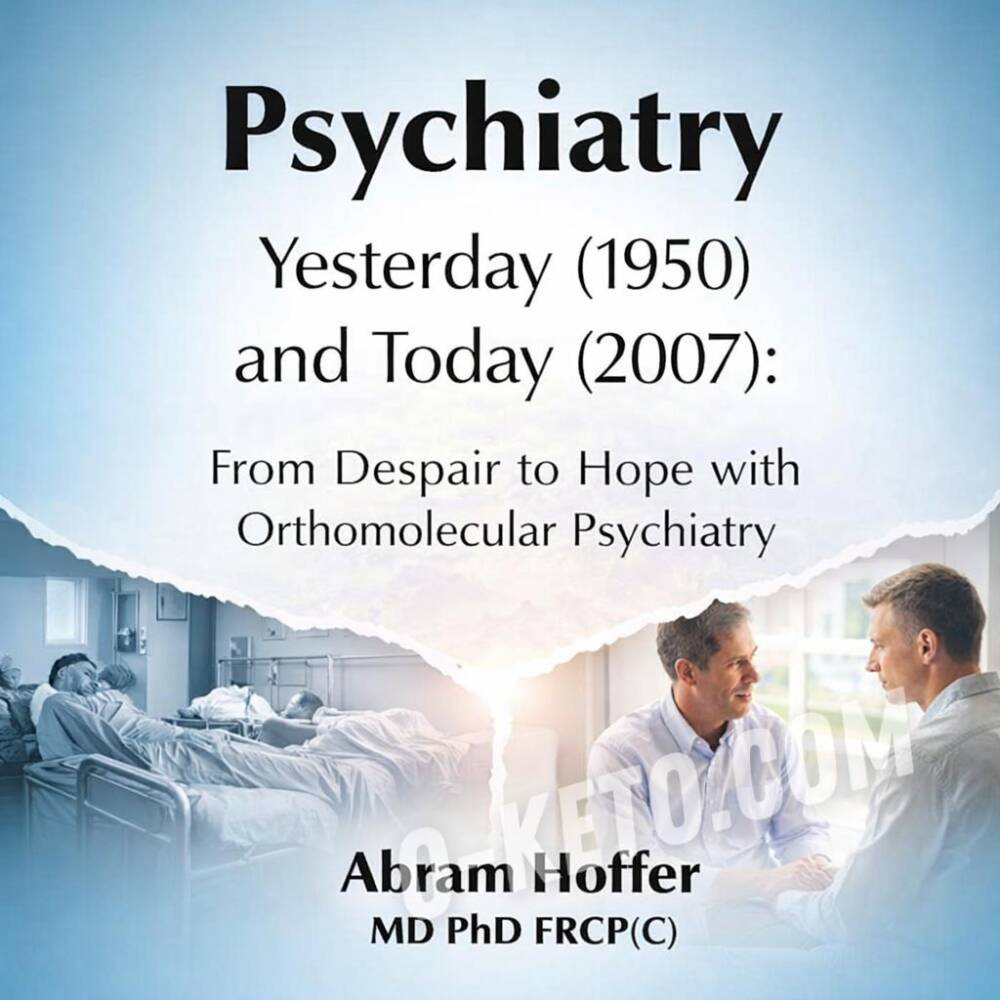
In this book, Abram Hoffer — one of the founders of orthomolecular psychiatry — summarizes over half a century of experience working with mental disorders, primarily schizophrenia, comparing the state of psychiatry in the 1950s and the early 21st century.
The author shows that despite the technological advancements in modern psychiatry, the actual recovery of patients has not improved, and in many ways has worsened: diagnoses have become more complicated, medication-based suppression of symptoms has replaced treatment of causes, and the number of chronic patients has increased. Hoffer consistently criticizes the DSM diagnostic system, institutionalization, the degradation of patient care conditions, and the neglect of the role of nutrition and brain biochemistry. In contrast, he describes the orthomolecular approach — the use of optimal doses of vitamins (primarily niacin), minerals, proper nutrition, adequate living conditions, respect for the patient's individuality, and social support.
The main conclus
24.01.2026. "Progesterone in Orthomolecular Medicine," Raymond Peat, 1993
In this work, Raymond Peat considers progesterone not as a "reproductive hormone," but as a universal protective and regulatory facto...
This book is a comprehensive collection of works and clinical observations by 65 leading specialists in the field of orthomolecular m...
In this book, one of the founders of orthomolecular psychiatry elaborates on the biochemical concept of schizophrenia and an approach...
This book is a systematic and practical introduction to orthomolecular medicine — an approach based on the use of optimal, rather tha...
20.01.2026. Orthomolecular Medicine: Healing Cancer, Abram Hoffer, Linus Pauling, 2004
The book is dedicated to the orthomolecular approach in the treatment of oncological diseases and considers cancer not only as a loca...
19.01.2026. "Ortho-Molecular Nutrition: New Lifestyle for Super Good Health," Abram Hoffer, Morton Walker, 1978
This book is one of the key practical expositions of the orthomolecular approach to health, based on the idea that for the normal fun...
18.01.2026. Nutrition and Mental Illness: An Orthomolecular Approach, Carl C. Pfeiffer, 1988
In the book, the author systematically presents the orthomolecular approach to mental disorders, considering them as a consequence of...
16.01.2026. "Mental and Elemental Nutrients: A Physician’s Guide to Nutrition and Mental Health," Carl S. Pfeiffer, 1975
The book is dedicated to the biochemical and nutritional foundations of mental health and examines psychiatric disorders as a result...
The book is a carefully curated collection of texts in which Linus Pauling articulates his key ideas — from fundamental chemistry and...
13.01.2026. "Healing the Mind the Natural Way: Nutritional Solutions to Psychological Problems," Pat Lazarus, 1995
The book is dedicated to the orthomolecular approach to mental health and advocates the idea that most psychological and psychiatric...
Section 1. Chapter 1 — Introduction to Psychiatry
Hoffer begins with his personal experience in psychiatry since 1950 and immediately highlights a key issue: psychiatry has shifted from treating causes to managing symptoms. He describes how diagnoses such as «schizophrenia» and «borderline personality disorder» are often used as labels that obscure the patient's real biochemical imbalances.
Through clinical examples, the author shows that patients deemed «incurable» often demonstrated significant improvement with the orthomolecular approach, while standard therapy led to chronicity, cognitive decline, and social degradation. It is emphasized that diagnosis does not equal prognosis, and psychiatry has lost its humanistic and scientific foundation, replacing it with pharmacological control.
Section 1. Chapter 2 — The Basic Treatment Elements
The author formulates four basic elements of effective treatment for mental disorders: shelter (a safe environment), optimal nutrition, civility (human treatment), and orthomolecular therapy. He emphasizes that medications alone do not heal if these conditions are not met.
Hoffer details how the deterioration of patient care conditions, reduced time spent in clinics, and the abandonment of rehabilitation diminish chances of recovery. A particular point is made that treating mental disorders is impossible without addressing nutrient deficiencies and metabolic disorders, and the effectiveness of therapy sharply declines in the absence of basic physiological support.
Section 1. Chapter 3 — Optimum Nutrition
In this chapter, nutrition is viewed as a key therapeutic factor rather than a secondary addition. Hoffer shows that the diets of patients in psychiatric institutions have historically been deficient in vitamins and trace elements, which directly worsened the course of illness and hindered recovery.
The author asserts that the brain is the most metabolically active organ, and any deficiencies (especially of B vitamins, vitamin C, and minerals) inevitably affect mental health. The orthomolecular approach suggests not «minimum norms» but optimal dosages necessary for the proper functioning of neurotransmitters, energy metabolism, and detoxification. The conclusion of the chapter is that without proper nutrition, psychiatry remains symptomatic and fundamentally limited.
Section 1. Chapter 4 — Civility
Hoffer emphasizes that human treatment is not an ethical embellishment of therapy but a direct healing factor. Humiliation, rudeness, and the disregard for the patient's individuality exacerbate psychotic symptoms, entrench fear, suspicion, and social isolation. In such conditions, even the most «modern» treatment methods lose their effectiveness.
The author shows that respectful communication, explaining what is happening, predictability of the environment, and involving the patient in the treatment process reduce symptom severity and increase the chance of recovery. Civility fosters a sense of safety and trust — a foundation without which neither biochemical nor psychological recovery is possible. The loss of this element has transformed psychiatry from a healing discipline into a system of control.
Section 1. Chapter 5 — Diagnosis
In this chapter, Hoffer harshly criticizes the modern diagnostic system, primarily the DSM. He points out that diagnoses describe behavior but do not explain causes, and their constant complication creates an illusion of scientific rigor without real progress in treatment.
The author emphasizes that most psychiatric diagnoses lack objective biological markers and therefore cannot serve as a reliable basis for prognosis. Moreover, labeling a diagnosis often reinforces the role of «chronic patient,» lowering recovery expectations for both the patient and the doctor. Hoffer concludes that diagnosis should aid in treatment, not justify therapeutic helplessness.
Section 2. Chapter 1 — Psychiatry Yesterday (1950)
Hoffer describes mid-20th century psychiatry as a system where patients were kept in isolation, often in harsh conditions, without effective treatment methods. The primary task of institutions was containment and control, rather than restoring the individual.
He emphasizes that despite the primitiveness of conditions, doctors of that time still understood that mental illness is a medical problem, not a personality defect. However, the lack of knowledge about brain biochemistry and nutrient deficiencies made real recovery a rare exception. This era is characterized by despair, both among patients and doctors.
Section 2. Chapter 2 — Psychiatry Today (2007)
According to Hoffer, modern psychiatry has outwardly become more humane and technological, but in essence has moved even further away from treating causes. Mass deinstitutionalization did not lead to freedom for patients but pushed many of them onto the streets, supplementing the psychiatric system with prisons and shelters.
The author shows that medication-based symptom suppression has replaced recovery-oriented therapy. Meanwhile, living conditions, nutrition, and the biochemical state of the patient are ignored. The result is an increase in chronic patients, lifelong pharmacotherapy, and a loss of faith in recovery. Hoffer contrasts this with the orthomolecular approach as a real alternative to the stagnation of modern psychiatry.
List of YouTube videos on the topic ""Psychiatry Yesterday (1950) and Today (2007): From Despair to Hope with Orthomolecular Psychiatry," Abram Hoffer, 2009":


