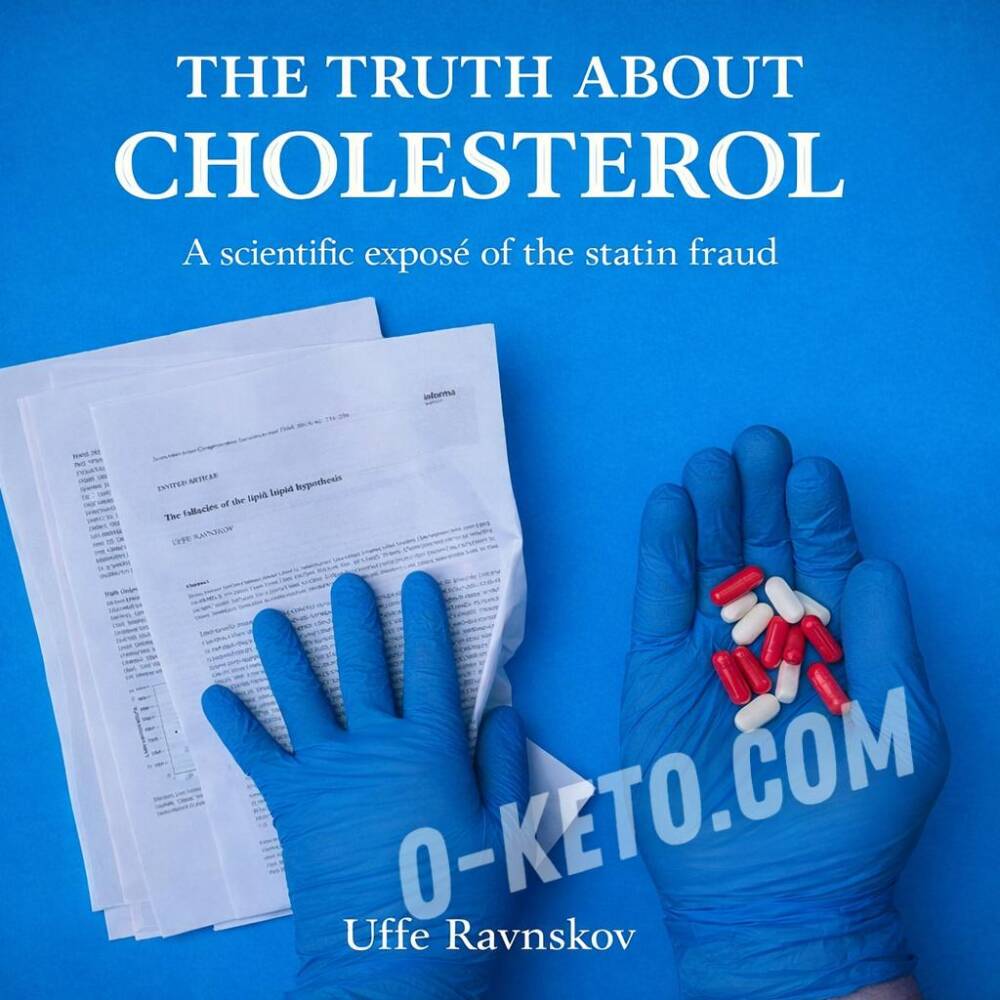
Chapter 1. Animal Trials
Animal experiments have long been used as evidence of the harm of cholesterol; however, their results cannot be accurately transferred to humans. In most experiments, animals were given unnatural diets with extremely high levels of cholesterol and oxidized fats, which in itself caused vascular damage. Different species of animals respond differently to cholesterol, and many of them are not prone to atherosclerosis under normal conditions. These studies are more indicative of the effects of toxic nutrition and stress rather than the role of cholesterol as a cause of disease.
Chapter 2. Dietary Studies
The link between saturated fat, cholesterol consumption, and heart disease is primarily based on observational studies. The author points out methodological errors: ignoring sugar, processed foods, smoking, and other lifestyle factors, as well as selective interpretation of data.
In several countries, high fat consumption has not been accompanied by an increase in cardiovascular mortality, which calls into question the direct causal relationship.
Chapter 3. Familial Hypercholesterolemia
Familial hypercholesterolemia is often cited as an argument for the dangers of high cholesterol; however, the actual data is ambiguous. Many people with this condition do not have increased mortality from heart disease, and the level of risk varies widely.
The author emphasizes that inflammation, vascular condition, and metabolic context play a crucial role, rather than the cholesterol level itself.
Chapter 4. Cholesterol as a Risk Factor
Upon detailed analysis, cholesterol proves to be a weak predictor of cardiovascular events. Heart attacks often occur in individuals with normal or low cholesterol, while many with high levels do not have heart problems. Cholesterol is viewed as a secondary marker of recovery and inflammation processes, rather than as a primary cause of disease.
Chapter 5. The Higher, The Worse?
The assertion that lowering cholesterol always improves prognosis is not supported by data. In older adults and in chronic conditions, higher cholesterol is often associated with better survival rates.
The author highlights the protective functions of cholesterol—its role in hormone synthesis, tissue repair, and infection protection—and warns of the risks associated with excessively lowering its levels.
Chapter 6. Randomized Controlled Trials
Randomized studies of diets and medications show that lowering cholesterol does not always lead to reduced overall mortality. Even with a decrease in cardiovascular events, overall survival often does not improve and sometimes the risk of other diseases increases.
The author concludes that the focus of medicine on cholesterol distracts from the true causes of cardiovascular disorders.
Chapter 7. How to Ignore Contradictory Evidence
The author demonstrates a typical tactic: when real observations contradict the "map" (accepted hypothesis), proponents of the hypothesis continue to believe the map rather than their eyes. An example is provided of the practice of citing "successful" studies while ignoring failed ones. Specifically, it is mentioned that in one clinical trial aimed at lowering cholesterol, the results for patients with pre-existing cardiovascular conditions were poor, but public arguments focus on a different design and group to maintain the overall conclusion about the benefits of lowering cholesterol.
Chapter 8. How to Exaggerate Minor Results
When there is no "mountain" of evidence, an attempt is made to create one from a "hill": small, questionable, or statistically fragile effects are presented as major conclusions. The author reviews examples of studies that are often cited in support of abandoning saturated fats, but where the design distorted the results: significant differences in groups regarding smoking, blood pressure, and medications, mass dropouts of participants, and substitutions of subjects during the observation—all of this makes the conclusions extremely unreliable. The role of factors that are more convenient to ignore (for example, stress as a strong modifier of both cholesterol and heart risk) is particularly emphasized, as they disrupt the simple "diet→cholesterol→heart attack" scheme.
Chapter 9. How to Explain Uncomfortable Results
If data directly "interfere" with the hypothesis, they are explained in a way that still makes them appear as confirmation. One tactic is to replace the direct meaning of the result with a secondary interpretation, hidden behind complex coefficients and statistical constructions, as well as to repeat convenient formulations in statements and reviews.
The author provides an example where observations that did not confirm the harm of high cholesterol in the elderly and even showed an increase in mortality with lowered cholesterol lead to a public conclusion about reduced risk with lowered cholesterol—without an honest discussion of the original contradiction.
Chapter 10. How to Lie Convincingly
This chapter discusses "plausible lies" in scientific packaging: selective presentation of countries/groups, reliance on a beautiful correlation picture, and the concealment of the fact that the effect weakens sharply when the full data set is considered. A key case is examined on how to show a connection only in part of the countries, even though data was available for many more countries, and how this helps to cement the desired causal conclusion in the minds of the public and doctors.
Ultimately, the reader is shown that manipulation does not necessarily look like forgery—it can appear as "rigorous science" if facts are filtered correctly.
Chapter 11. How to Ignore Alternative Explanations
The author reminds us of a basic principle of science: new qualitative data that contradicts the hypothesis should lead to its revision (falsification). But a less scrupulous path is to pretend that there are no alternative explanations or to declare inconvenient results as "unimportant," "incidental," "inappropriate," and then continue to interpret any observations in favor of the original idea. A separate emphasis is placed on the fact that when there are multiple interpretations, honest science is obliged to test competing hypotheses rather than defend a single one.
Chapter 12. How to Ignore Criticism
Criticism is neutralized not scientifically, but organizationally: through publication filters, peer review, labels ("biased," "not serious," "nothing new"), and the argument "all experts agree." The author describes how journals and reviewers can reject critical texts not based on content, but on convenience—such as claiming that "it is impossible to discuss all arguments in detail," or suggesting "to trust expert groups," without examining the facts. An additional tactic is simply not to respond to substantive letters and comments, leaving the audience with the impression that there was "no criticism."
Chapter 13. When Arguments Stop Working
The author shows that as data accumulates, traditional arguments in favor of the "cholesterol theory" lose their persuasiveness. When correlations are not confirmed and clinical results do not match expectations, proponents of the hypothesis begin to change formulations and criteria for success without changing the idea itself. Instead of revising the theory, it is adapted to new data, allowing previous recommendations to be maintained despite a weakening evidence base.
Chapter 14. Pharmaceutical Manipulations
This chapter examines the influence of the pharmaceutical industry on the formation of views about cholesterol. The author describes how studies funded by drug manufacturers more often demonstrate a "positive effect," how unfavorable data is minimized or excluded, and how clinical recommendations shift towards pharmacological control of indicators. It is emphasized that the goal is often not to improve overall survival but to achieve laboratory figures that are convenient for marketing drugs.
Chapter 15. The Real Cause
Ravnskov offers an alternative view: the key role in the development of atherosclerosis belongs not to cholesterol, but to chronic inflammation and damage to the vascular wall.
Cholesterol is seen as a participant in recovery processes, accumulating at sites of damage rather than being the primary "culprit." In this context, nutrition, stress, infections, nutrient deficiencies, and metabolic disorders take on much greater significance than the cholesterol level in the blood itself.
Chapter 16. New Evidence
In the concluding part, the author presents data from later studies that do not fit the classical model: the absence of a link between cholesterol and mortality in older groups, the weak effect of dietary cholesterol reduction, and the limited impact of medications on overall mortality.
These observations strengthen the argument for the need to revise basic dogmas and transition from a simplified "cholesterol" model to a more complex understanding of cardiovascular diseases.