



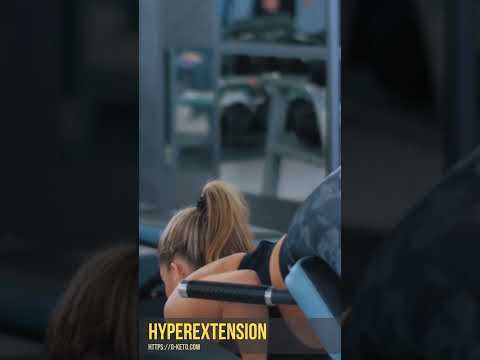
Hyperextension is an isolated exercise focused on developing the spinal extensors, glutes, and hamstrings.
This exercise helps strengthen the lower back muscles, improve posture, and reduce the likelihood of injuries when performing heavy compound exercises. It also helps alleviate back pain.
Hyperextension is performed on a specialized bench where the pelvis is secured and the torso is bent forward. The movement is accomplished by extending the spine and raising the torso, which engages the target muscles.
Muscles Worked During Hyperextension
Spinal extensors (lumbar muscles): the main muscles responsible for extending the torso.
Glute muscles: actively participate in the movement, especially during hip extension.
Hamstrings: stabilize the movement and extend the hip joint.
Stabilizing muscles: the core, obliques, and trapezius provide stability.
Execution Technique

Starting position:
- Lie on the bench so that the upper part of your thighs is on the pad and your pelvis is secured.
- Secure your heels under the rolls, keeping your legs straight.
- You can cross your arms over your chest, place them behind your head, or extend them along your body.
Incline:
- Slowly lower your torso down by bending forward at the hip joint.
- Stop when your torso is just below the level of the bench.
Lift:
- Engage your lumbar muscles, glutes, and hamstrings to return your torso to the starting position.
- Raise your torso to a straight line so that it is level with your legs.
- Avoid hyperextending to prevent straining the spine.
Variations
Classic hyperextension: performed without additional weight, suitable for beginners.
With additional weight: use a weight plate held on your chest to increase the load.
Hyperextension on a fitball: suitable for home workouts, focusing on balance and stabilization.
Reverse hyperextension: performed in the opposite position: the torso is secured while the legs are raised, focusing on the glutes.
Hyperextension on the floor: a simplified version without equipment.
Benefits
Strengthening the lower back: helps prevent lower back pain and reduces the risk of injuries.
Development of glute muscles: the exercise emphasizes loading the glutes, improving their shape and strength.
Improvement of posture: strengthening the spinal extensors contributes to posture alignment.
Preparation for compound exercises: a strengthened lower back enhances technique and safety during squats and deadlifts.
Suitable for all fitness levels: the exercise can be easily adapted with additional weights.
Common Mistakes and How to Avoid Them
Hyperextension: excessive torso lift creates strain on the lumbar region.
Lift your torso to a straight line with your legs.
Jerking movements: rapid execution reduces effectiveness and increases the risk of injury.
Perform the movement smoothly and in a controlled manner.
Incorrect torso position: rounding the back reduces the load on the target muscles.
Keep your back straight, with shoulders slightly pulled back.
Too much weight: this can overload the lower back.
Start with your body weight and gradually add resistance.
Improper foot securing: poor fastening reduces stability.
Ensure your heels are securely fastened under the rolls.
Tips for Beginners
- Master the technique without weight: this will help avoid mistakes and injuries.
- Don’t rush: perform the movement slowly, focusing on the target muscles.
- Watch your range of motion: don’t bend too low or rise too high.
- Regularity: perform hyperextensions 2-3 times a week to strengthen the lower back.
Comparison with Other Lower Back Exercises
Deadlift: better suited for developing overall strength and mass but requires advanced technique.
Bent-over barbell row: develops the back overall, including the lower back.
Plank: focuses on static core strengthening with minimal strain on the lower back.
Sources
- Impact of isolated lumbar extension strength training on reducing nonspecific low back pain, disability, and improving function: a systematic review and meta-analysis
- A randomized controlled trial of limited range of motion lumbar extension exercise in chronic low back pain
- Isolated lumbar extension exercise alone or in a multimodal program for low back pain and radiculopathy: a non-randomized controlled trial
- Muscular blood oxygen level-dependent MRI is beneficial to evaluate effectiveness of an exercise prescription
- EMG study of erector spinae and multifidus in two isometric back extension exercises


