



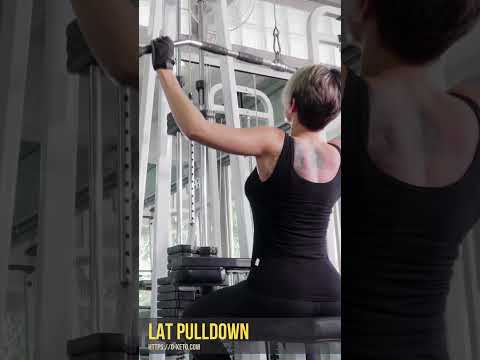
The lat pulldown is a primary exercise on the machine that simulates pull-ups. This exercise effectively develops the latissimus dorsi muscles of the back, which is especially beneficial for those who cannot perform pull-ups with their own body weight.
This exercise is performed on a cable machine. The athlete pulls the handle to the chest or behind the head, actively engaging the back muscles.
Different grip variations and hand positioning allow for focusing the load on different muscle groups.
Muscles Worked During the Lat Pulldown
Latissimus Dorsi: the main load is placed on these muscles, responsible for the width of the back.
Trapezius and Rhomboid Muscles: involved in stabilizing the shoulder blades.
Rear Deltoid Muscles: assist in pulling the handle.
Biceps: act as auxiliary muscles.
Forearm Muscles: hold the handle of the machine.
Execution Technique

Starting Position:
- Sit on the machine, securing your legs under the pads.
- Grip the handle with a wide grip (palms facing forward).
- Straighten your back, slightly leaning your torso back by 5–10 degrees.
Pulling the Handle:
- Pull the handle down to the upper part of your chest, squeezing the shoulder blades at the bottom.
- Elbows should be directed downwards and slightly back.
- Pause at the bottom for a second to feel the tension in your back.
Return:
- Slowly and controlled, return the handle to the starting position, fully extending your arms.
Variations
Wide Grip to the Chest: emphasizes the latissimus dorsi muscles.
Underhand Grip: increases the load on the lower part of the lats and biceps.
Pulldown Behind the Head: emphasizes the upper back, but requires good shoulder flexibility.
Neutral Grip: palms facing each other, evenly distributing the load.
One-Arm Pulldown: isolated work for each side of the back.
Benefits
Alternative to Pull-Ups: suitable for beginners who cannot perform pull-ups with their own body weight.
Controlled Load: the ability to adjust the weight makes the exercise safe and versatile.
Targeting the Lats: contributes to the development of back width, creating a V-shaped silhouette.
Grip Variety: allows for focusing the load on different parts of the back.
Less Strain on the Lower Back: unlike bent-over barbell rows, reduces strain on stabilizers and lumbar muscles.
Common Mistakes and How to Avoid Them
Moving Only the Arms: this reduces the activation of back muscles.
Focus on squeezing the shoulder blades.
Jerking Movements: fast movement reduces effectiveness.
Perform the pulldown smoothly and in a controlled manner.
Using Too Much Weight: worsens technique and increases risk of injury.
Use a weight that allows you to perform the exercise correctly.
Slouching: creates tension in the neck and back.
Keep your back straight and chest up.
Insufficient Range of Motion: if you don’t pull the handle to your chest, the load decreases.
Pull the handle to the upper part of your chest or slightly below.
Tips for Beginners
Start with a Light Weight: this will help you master the technique and avoid injuries.
Focus on the Shoulder Blades: squeezing the shoulder blades at the bottom improves back muscle activation.
Don’t Slouch: maintain good posture throughout the exercise.
Breathe Correctly: exhale when pulling the handle down, inhale when returning.
Comparison with Other Back Exercises
Pull-Ups: develop strength and mass, but require a high level of fitness.
One-Arm Dumbbell Row: works each side of the back, but requires torso stabilization.
Bent-Over Barbell Row: suitable for mass gain, but increases strain on the lower back.
Sources
- Grip width and forearm orientation effects on muscle activity during the lat pull-down
- A comparative electromyographical investigation of muscle utilization patterns using various hand positions during the lat pull-down
- High-Density Electromyography Excitation in Front vs. Back Lat Pull-Down Prime Movers
- Electromyographic Analysis of Back Muscle Activation During Lat Pulldown Exercise: Effects of Grip Variations and Forearm Orientation
- Kinematic and electromyographic comparisons between chin-ups and lat-pull down exercises


