





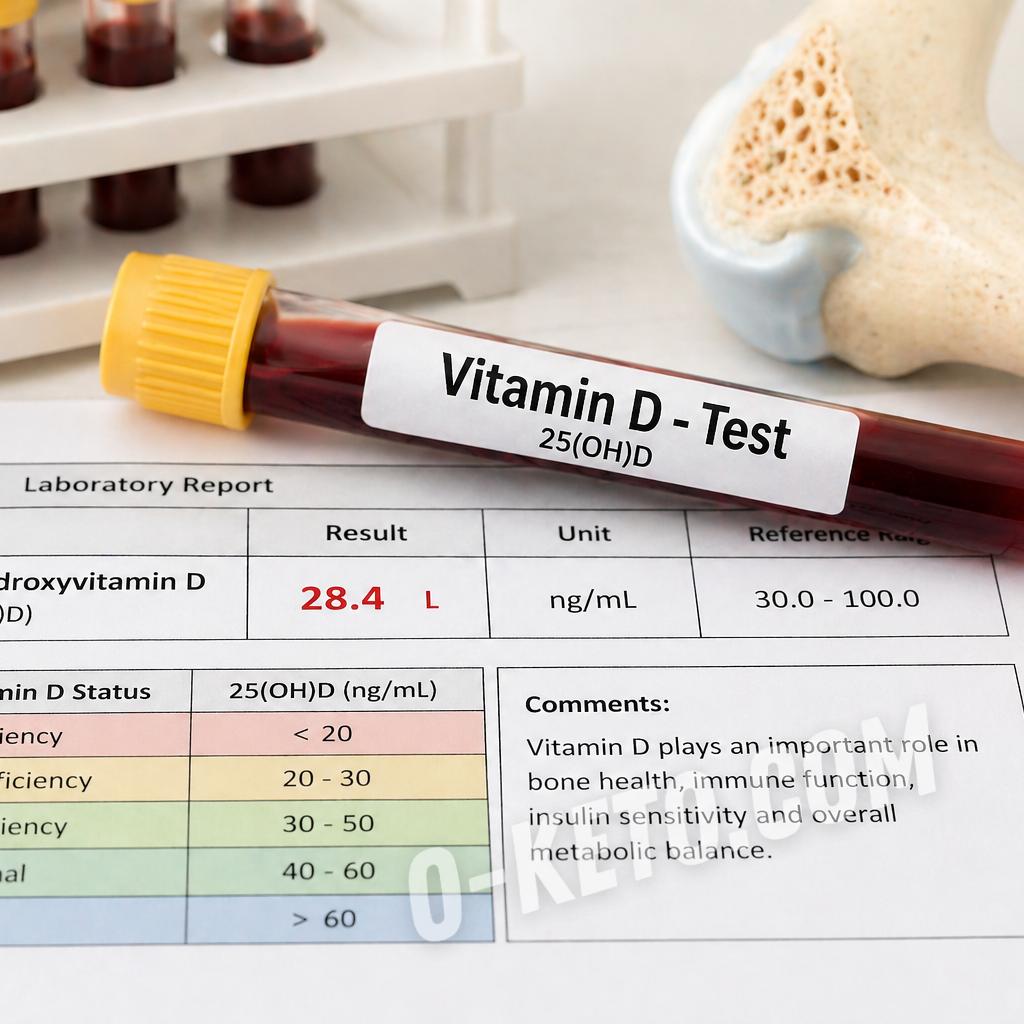

Vitamin D is often perceived as a nutrient for bones or immunity. In practice, it is one of the key regulators of metabolism, the hormonal system, and tissue sensitivity to insulin.
Its level reflects not just intake from food or sunlight, but the state of metabolism, liver function, kidney function, and overall inflammation levels.
What Vitamin D Actually Indicates

The analysis evaluates 25(OH)D — a form that reflects the overall reserve of vitamin D in the body:
- it is not the active form, but an indicator of resource availability;
- it shows how well the body is supplied for regulating processes;
- it influences insulin sensitivity, immunity, and hormonal balance.
Even with normal levels, there may be disturbances in its utilization at the tissue level.
Why Vitamin D Levels Decrease
The decrease in levels is related not only to a lack of sunlight.
Liver Dysfunction. The liver is involved in converting vitamin D into the form 25(OH)D. When overloaded (for example, with high triglycerides above 1.5–2.0 mmol/L), this process slows down.
Kidney Dysfunction. The kidneys convert vitamin D into its active form. Chronic stress and electrolyte disturbances worsen this process.
Chronic Inflammation. During inflammation, vitamin D is consumed more quickly and utilized less effectively.
Magnesium Deficiency. Magnesium is necessary for activating vitamin D. With its deficiency, even normal levels of 25(OH)D may not work effectively.
Specific Ranges and Their Significance
- below 20 ng/ml (50 nmol/L) — pronounced deficiency;
- 20–30 ng/ml — insufficient level;
- 30–50 ng/ml — conditional norm;
- 40–60 ng/ml — optimal range;
- above 60–70 ng/ml — high level requiring context.
For example, a level of 25–30 ng/ml is often accompanied by reduced insulin sensitivity and increased fatigue.
But even with normal levels, disturbances may occur if the system cannot utilize vitamin D.
Specific Examples of Interpretation
Example 1:
Vitamin D — 28 ng/ml
Insulin — 14 µU/ml
Triglycerides — 1.7 mmol/L
- insufficient vitamin D level;
- decreased tissue sensitivity;
- liver is overloaded;
- vitamin D is consumed faster and activated less effectively.
Example 2:
Vitamin D — 42 ng/ml
Magnesium — low
Complaints of fatigue
- formally normal level;
- magnesium deficiency blocks activation;
- vitamin D does not fulfill its functions;
- symptoms persist despite “normal” levels.
How to Read Vitamin D Correctly
This indicator cannot be assessed in isolation.
Connection with Magnesium:
- low magnesium — vitamin D is not activated;
- when magnesium is below optimal, effectiveness drops sharply.
Connection with Insulin:
- low vitamin D + high insulin (12–18 µU/ml) — decreased tissue sensitivity;
- vitamin D is involved in regulating carbohydrate metabolism.
Connection with Triglycerides:
- high triglycerides — liver overload;
- conversion of vitamin D worsens.
Connection with Lifestyle:
- low sun exposure;
- chronic stress;
- lack of fats in the diet;
- mineral deficiencies.
Vitamin D is not just a nutrient, but a regulator of metabolic resilience. It reflects the body’s ability to maintain a balance between immunity, hormones, and energy metabolism. It should be assessed not in isolation, but as part of a system: liver, kidneys, magnesium, insulin, and overall metabolic state. Only such an approach allows for a true understanding of the picture.
Sources
- Vitamin D for the Prevention of Disease: An Endocrine Society Clinical Practice Guideline
- Vitamin D: Health Professional Fact Sheet: National Institutes of Health Office of Dietary Supplements
- Role of Magnesium in Vitamin D Activation and Function
- Essential Nutrient Interactions: Does Low or Suboptimal Magnesium Status Interact with Vitamin D and/or Calcium Status?
- Combined Vitamin D and Magnesium Supplementation Does Not Influence Markers of Bone Turnover or Glycemic Control: A Randomized Controlled Clinical Trial


