


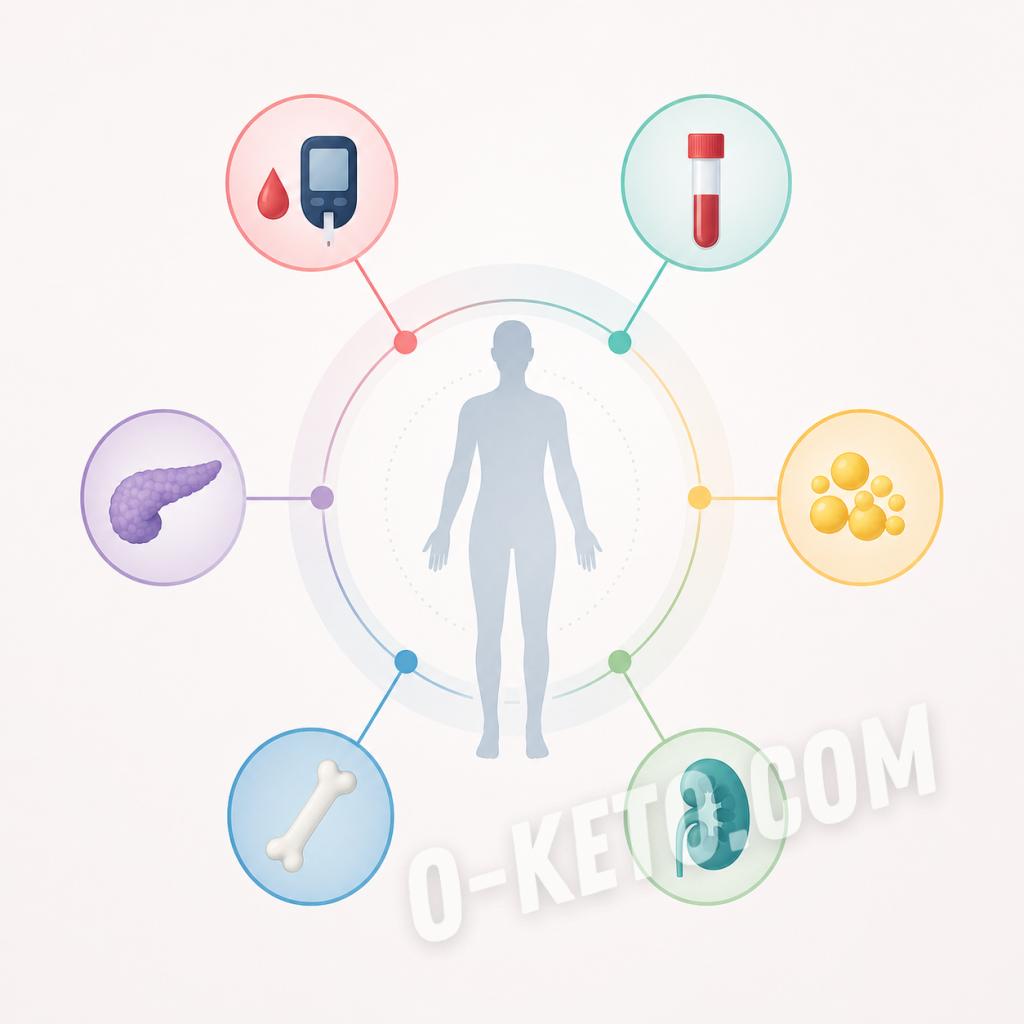

Blood tests are often considered separately: glucose, insulin, triglycerides, vitamin D, uric acid. But in reality, none of these indicators exist in isolation. They all reflect one system — energy metabolism. Only in conjunction do they provide an understanding of what is actually happening in the body.
Why you can’t look at indicators separately
Each marker is just a part of the overall picture:
- glucose shows the rate of energy utilization;
- insulin indicates the strength of the signal needed for this;
- HbA1c reflects the stability of the system over time;
- triglycerides show where excess energy goes;
- uric acid indicates the load on metabolism and excretion;
- vitamin D reflects the system’s ability to regulate.
If you look at them separately, you may not see a problem even with deviations.
The main principle of interpretation. It is important not to look for “one bad test,” but to observe the direction of the system:
- is the load increasing;
- is there compensation;
- where is energy going — into use or accumulation;
- is the body coping without overload.
Even small deviations in several indicators are more important than a strong deviation in one.
How the indicators are related to each other

Everything starts with glucose — the central source of energy.
Step 1. Decreased utilization. Glucose rises to 5.3–5.6 mmol/L — muscles use it less effectively.
Step 2. Insulin compensation. Insulin increases to 12–18 μU/mL to maintain the level.
Step 3. System instability. HbA1c rises to 5.6–5.8% — fluctuations appear.
Step 4. Energy redistribution. Triglycerides rise above 1.5–2.0 mmol/L — excess is stored as fat.
Step 5. Metabolic overload. Uric acid rises above 350–420 μmol/L — excretion worsens.
Step 6. Regulation failure. Vitamin D decreases below 30–40 ng/mL — the system loses stability.
These are not separate disorders, but a single chain.
What the system looks like in normal conditions
- glucose — 4.6–5.0 mmol/L;
- insulin — 4–8 μU/mL;
- HbA1c — 5.2–5.4%;
- triglycerides — up to 1.0–1.2 mmol/L;
- uric acid — up to 300–320 μmol/L;
- vitamin D — 40–60 ng/mL.
This is a state in which energy is used efficiently, and the system is not overloaded.
What early dysfunction looks like
- glucose — 5.2–5.4 mmol/L;
- insulin — 10–14 μU/mL;
- HbA1c — 5.5–5.7%;
- triglycerides — 1.3–1.7 mmol/L;
- uric acid — 320–380 μmol/L;
- vitamin D — 25–35 ng/mL.
At this stage, symptoms are often absent, but the system is already working under overload.
What pronounced overload looks like
- glucose — 5.5–6.0 mmol/L;
- insulin — 14–20+ μU/mL;
- HbA1c — 5.7–6.0%;
- triglycerides — above 1.7–2.5 mmol/L;
- uric acid — above 380–450 μmol/L;
- vitamin D — below 25–30 ng/mL.
This is already a systemic disorder of energy metabolism.
Conclusion
The metabolic map is a way to see not just individual numbers, but a holistic system. It allows us to understand where the dysfunction begins: at the level of utilization, signaling, processing, or regulation. This approach enables us to identify problems earlier than they become diseases.
Sources
- Interpreting Normal Values and Reference Ranges for Laboratory Tests
- Interpreting Clinical and Laboratory Tests: Importance and Implications of Context
- Diagnosis and Classification of Diabetes: Standards of Care in Diabetes—2026
- ACC Consensus on ASCVD Risk Reduction in Hypertriglyceridemia: Key Points
- Hypomagnesemia: A Clinical and Nutritional Update
- Hyperuricemia
- Vitamin D for the Prevention of Disease: An Endocrine Society Clinical Practice Guideline


