
The barbell calf raise is one of the primary exercises for training the calf muscles. It helps to increase strength, size, and definition of these muscles.
This exercise is used in both bodybuilding and functional training to strengthen the lower body.
The barbell calf raise is a movement where the athlete rises onto their toes while holding the barbell on their shoulders, similar to squats. The main movement occurs at the ankle joints, with the barbell adding extra load.
Muscles worked during the barbell calf raise
Calf muscles: the primary muscle group actively involved in the exercise.
Solus muscles: located beneath the calves, responsible for shape and stability.
Stabilizing muscles: maintain balance, including core and glute muscles.
Execution Technique

Starting position:
- Set the barbell on your shoulders as you would for squats (you can use a squat rack).
- Stand upright, feet shoulder-width apart, toes parallel.
- Keep your back straight and chest up.
Calf raise:
- Slowly rise onto your toes, fully contracting the calf muscles.
- Pause at the peak of the raise for 1-2 seconds to enhance muscle contraction.
Return:
- Slowly lower back down onto your entire foot, avoiding sudden movements.
- Do not relax at the bottom to maintain tension in the muscles.
Variations
Using a platform. Position the front of your feet on an elevation (e.g., a step platform) to increase the range of motion.
With narrow or wide foot placement. A narrow stance emphasizes the outer part of the calf muscles, while a wide stance focuses on the inner part.
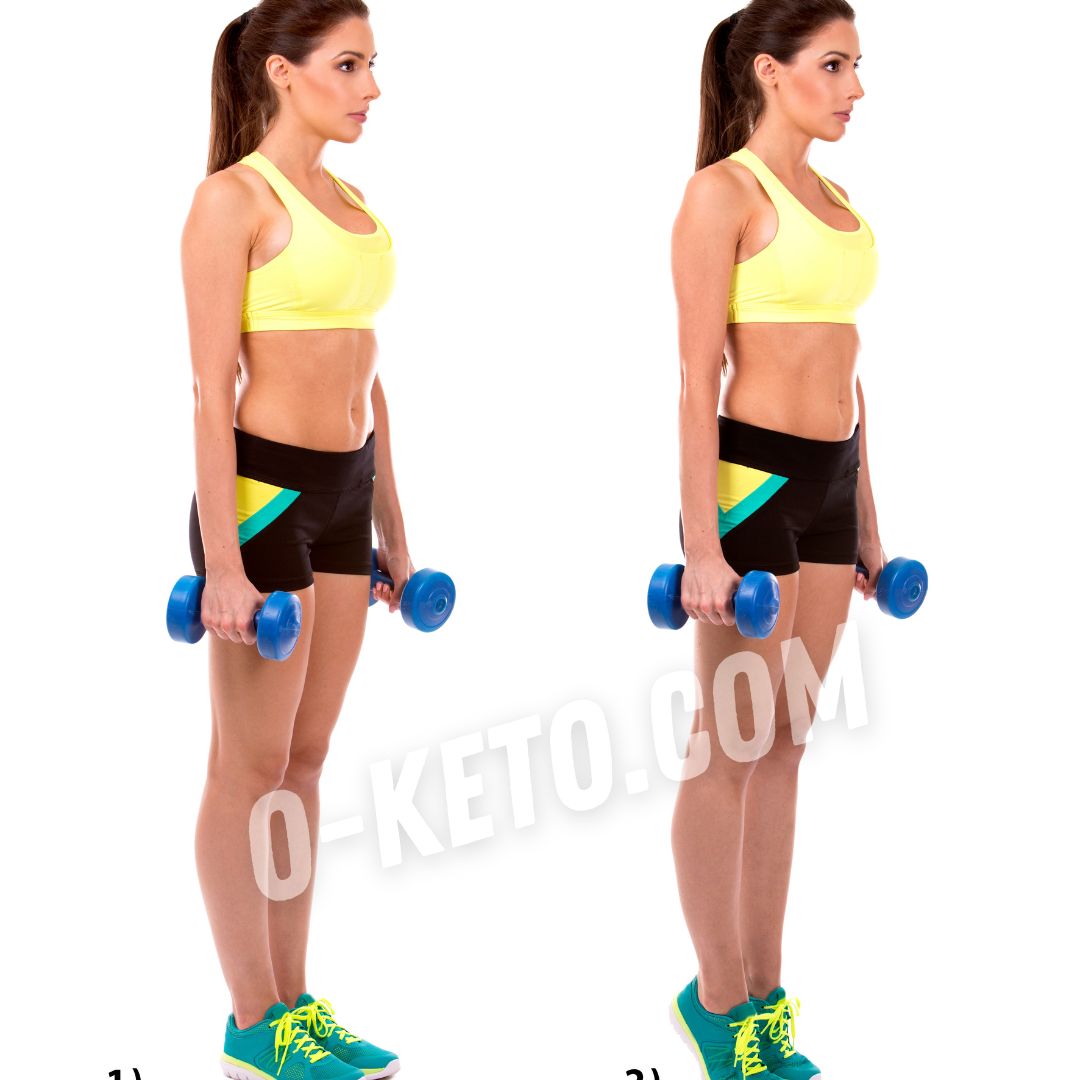
With dumbbells. This allows you to perform the exercise without a rack and barbell, making it easier to control balance.
With single-leg variations. This increases muscle activation and helps eliminate imbalances between sides.
Benefits
Development of calf strength. This exercise makes the legs stronger and more resilient.
Increased size and definition. Regular execution promotes muscle mass growth in the lower legs.
Improved functionality. Strong calf muscles contribute to better performance in running, jumping, and other movements.
Minimal equipment. The exercise can be performed both in the gym and at home (if a barbell is available).
Common mistakes and how to avoid them
Excessive weight: too much weight can compromise execution technique.
Choose a weight that allows you to perform the exercise correctly.
Lack of control: performing the exercise too quickly reduces effectiveness.
Move slowly and deliberately.
Improper posture: slouching or leaning forward overloads the lower back.
Keep your back straight and chest lifted.
Incomplete range of motion: not raising or lowering enough diminishes effectiveness.
Rise onto your toes as high as possible and lower almost to the point of touching your heels to the floor.
Lack of a platform: without elevation, the range of motion is limited.
Use a step or block to increase the range.
Comparison with other calf exercises
Seated calf raise machine: places less load on stabilizers but restricts natural movement.
Dumbbell calf raises: easier to perform without a rack, but hard to use heavy weights.
Deadlifts on toes: incorporates calves into a compound movement but does not isolate them.
Sources
- Myoelectric activity of the gastrocnemius during plantar flexion in a standing versus seated position and with a neutral or dorsiflexed ankle: A pilot study
- Multi- and Single-Joint Resistance Exercises Promote Similar Plantar Flexor Activation in Resistance Trained Men
- Greater Gastrocnemius Muscle Hypertrophy After Partial Range of Motion Training Performed at Long Muscle Lengths
- Knee position affects medial gastrocnemius and soleus activation during dynamic plantarflexion: no evidence for an inter-muscle compensation in healthy young adults
- Different Foot Positioning During Calf Training to Induce Portion-Specific Gastrocnemius Muscle Hypertrophy