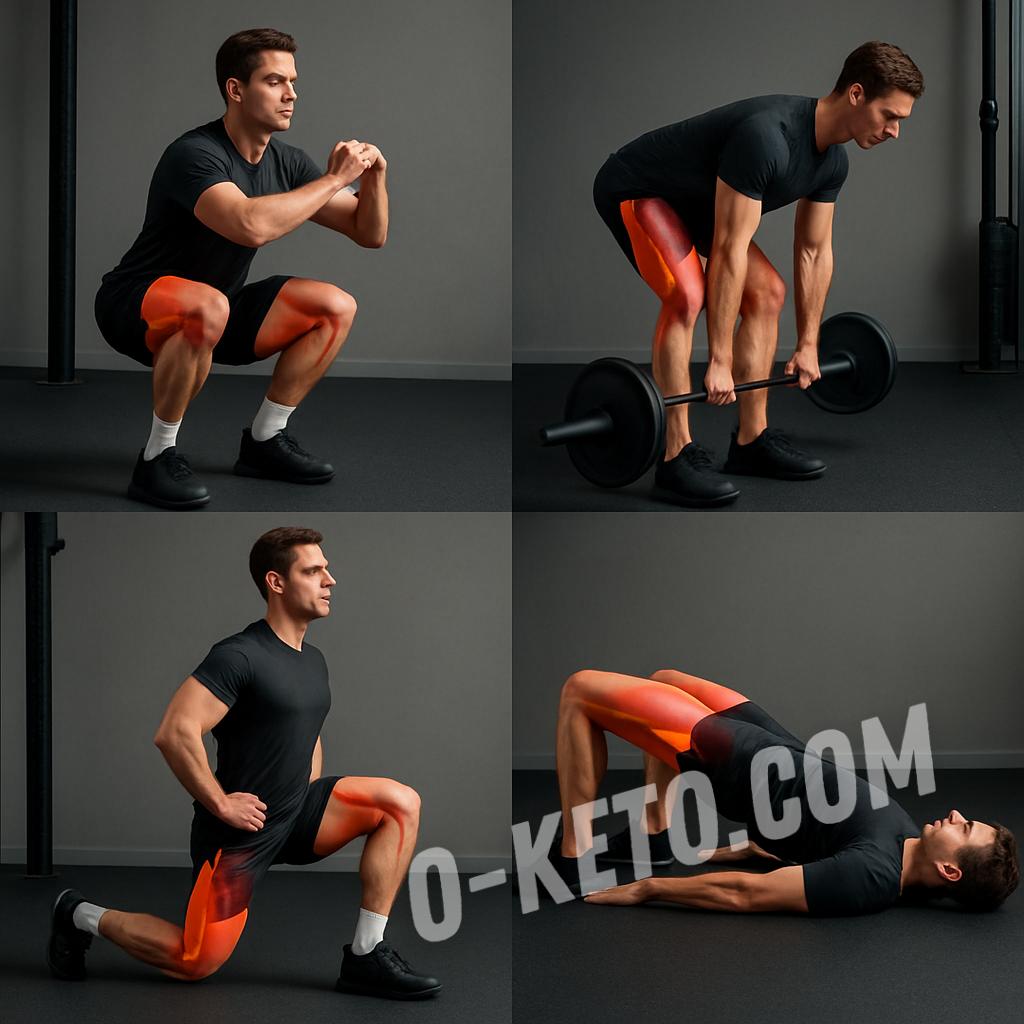

In leg exercises, it’s easy to get confused: squats are called glute exercises, lunges – for everything at once, deadlifts – for the hamstrings, and glute bridges – for the butt. In reality, it’s more nuanced. One exercise can involve the quadriceps, hamstrings, adductors, and glutes simultaneously, but the emphasis will depend on which joint is doing the main work: the knee, the hip joint, or both at once.
To understand training, it’s useful to look not at the name of the exercise but at the movement. The quadriceps extend the knee. The hamstrings extend the hip and flex the knee. The gluteus maximus powerfully extends the hip, while the gluteus medius and minimus help abduct the hip and stabilize the pelvis. Therefore, squats, lunges, Romanian deadlifts, glute bridges, and abductions have different training meanings.
Main Logic: Knee or Hip Joint
In the lower body, the main strength movements often consist of two tasks: extending the knee and extending the hip. The more an exercise requires knee extension, the more the quadriceps are engaged. The more the movement revolves around the hip joint, the more the glutes, hamstrings, and part of the adductors are involved.
| movement | main task | where the emphasis is usually stronger |
| knee extension | straighten the leg at the knee | quadriceps |
| hip extension | pull the hip back or extend the hip joint | gluteus maximus, hamstrings, part of the adductors |
| knee flexion | bend the leg at the knee | hamstrings and other muscles of the posterior thigh |
| hip abduction | move the hip away from the midline of the body | gluteus medius and minimus, tensor fasciae latae |
| pelvic stabilization on one leg | keep the pelvis from tilting | gluteus medius and minimus |
Therefore, the question “which exercise trains the glutes” is better replaced with a more precise one: which part of the glutes is working, in what movement, and alongside which muscles. This makes it clearer why two externally similar exercises can feel completely different.
Quadriceps: Anterior Thigh and Knee Extension
The quadriceps is not one muscle but a group of four heads on the anterior thigh. Its main overall function is knee extension. When you stand up from a squat, straighten your leg in a leg press, or rise onto a platform, the quadriceps help straighten the knee joint.
The peculiarity is that the rectus femoris is part of the quadriceps but crosses the hip joint. Therefore, it participates not only in knee extension but also in hip flexion. This is important for understanding exercises where the hip is actively lifted forward or where the position of the pelvis changes the feeling in the anterior thigh.
The quadriceps tends to receive more load when the exercise has the following characteristics:
- the knee bends significantly and then actively extends;
- the torso remains relatively vertical;
- the movement resembles squatting down and rising up;
- the heel remains stable, and the knee does not “run away” from the movement.
This does not mean that squats or lunges become only quadriceps exercises. The glutes and hamstrings also help, but if the knee performs a larger range of motion, the anterior thigh usually receives a noticeable contribution.
Hamstrings: The Posterior Thigh in Two Roles
The hamstrings refer to a group of muscles on the posterior thigh, often called the hamstrings. This group also includes the semitendinosus and semimembranosus muscles. In training, it’s important to understand them not just as “the muscles on the back of the thigh,” but as a group that can work across two joints.
For most exercises, the two roles of the posterior thigh are important:
- to extend the hip at the hip joint, helping to pull the hip back and lift the torso from a bend;
- to flex the knee, as in leg curls lying down, sitting, or standing.
Therefore, Romanian deadlifts, bends, and hyperextensions feel different than leg curls on a machine. In pulling movements, the hamstrings help extend the hip and stabilize the pelvis, while in leg curls, the main task is to flex the knee. These are different training stimuli, although the muscle group is the same.
If the exercise revolves around tilting the pelvis back and forth, and the knees remain slightly bent and almost do not change angle, the posterior thigh usually receives more stretching load. However, if the knee actively flexes against resistance, the emphasis shifts to another function of the hamstrings.
Glute Muscles: Maximus, Medius, and Minimus
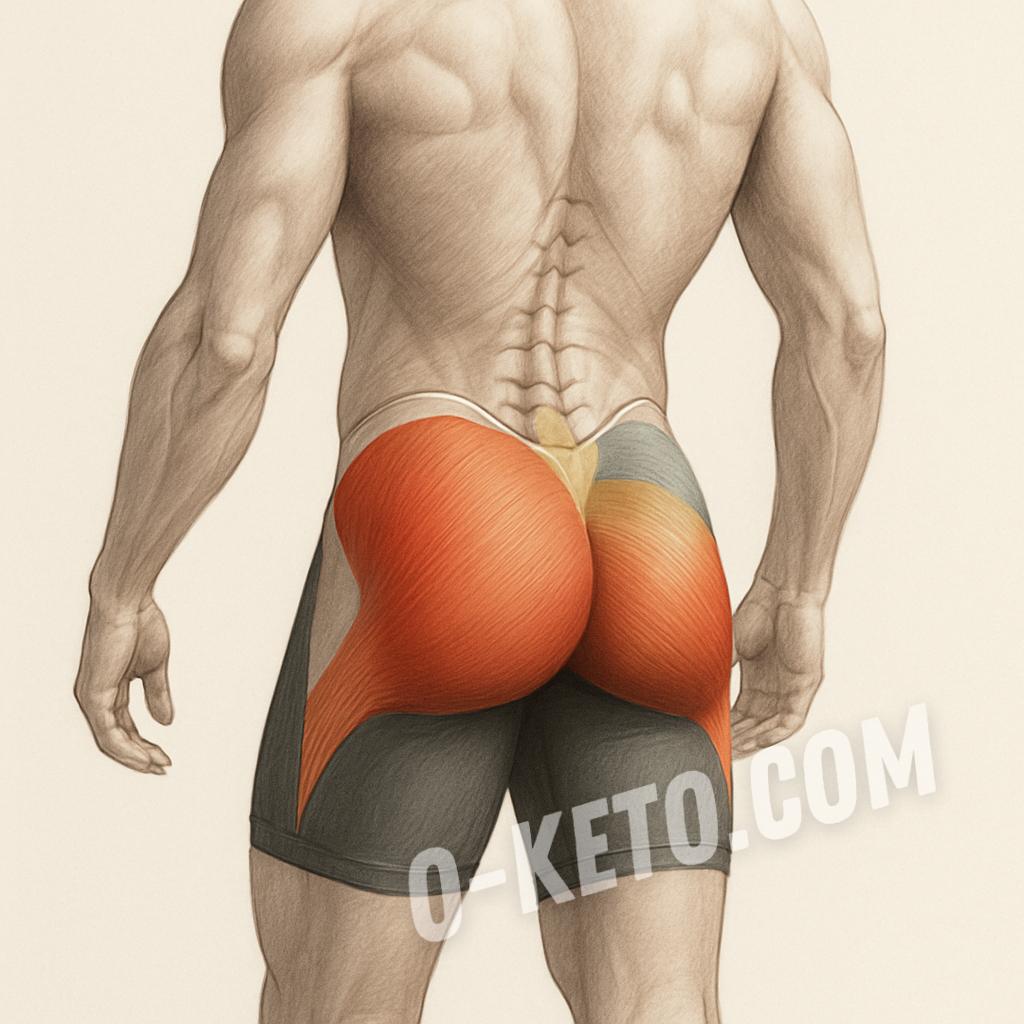
The glute muscles should not be perceived as one general “glute.” They have different layers, different fiber directions, and different tasks. The gluteus maximus is more related to powerful hip extension, while the gluteus medius and minimus are especially important for hip abduction and pelvic control.
| muscle | where it is located and what it does | where it is often felt in exercises |
| gluteus maximus | the largest and most superficial; extends the hip, participates in external rotation, upper fibers help with abduction, lower fibers with adduction | glute bridge, hip thrust, squat, lunge, rise from a bend |
| gluteus medius | lies on the side and partially under the gluteus maximus; abducts the hip, posterior fibers help with external rotation, anterior fibers with internal rotation | abductions, lateral steps with a band, one-leg work, pelvic stabilization in lunges |
| gluteus minimus | deeper than the gluteus medius; helps abduct the hip and stabilize the hip joint | abductions, lateral stabilization, exercises for pelvic control |
Because of this, different “glute” exercises solve different tasks. The glute bridge and hip thrust are more like powerful hip extension. Hip abductions to the side load the lateral glute area more. Lunges and Bulgarian squats mix hip extension, knee extension, and pelvic stabilization.
Squat, Lunge, Deadlift, and Bridge: Where the Emphasis Changes
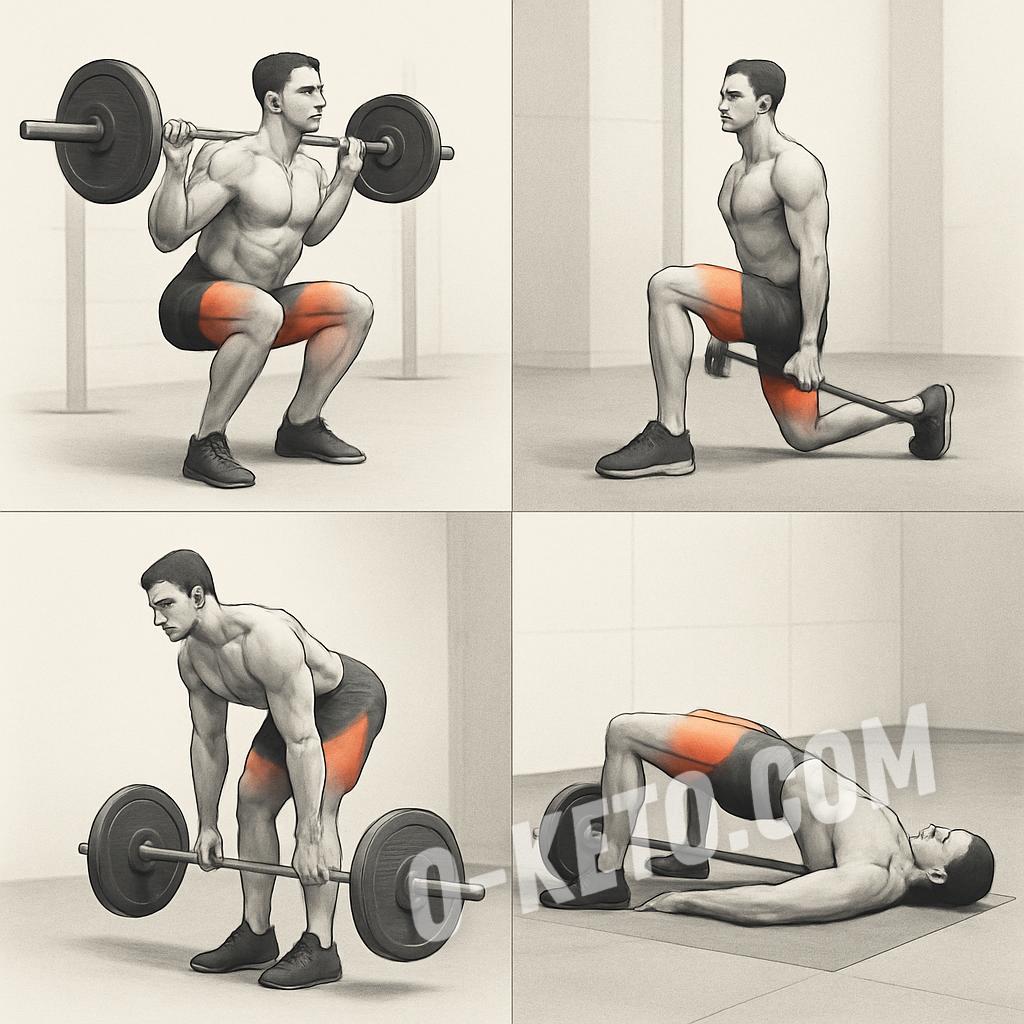
The name of the exercise does not always honestly indicate what exactly is being trained. The emphasis depends on the amplitude, torso tilt, foot position, depth, stability, and whether a single or double support is used.
| exercise | what works noticeably | why |
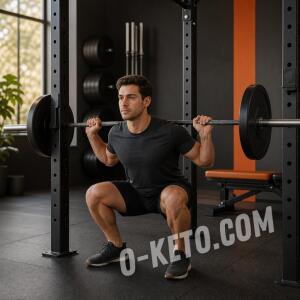
| squat | quadriceps, gluteus maximus, adductors, core muscles | there is both knee extension and hip extension; the deeper and more stable the squat, the more the hip joint works |
| lunge | quadriceps of the front leg, gluteus maximus, gluteus medius and minimus as stabilizers | one leg bears the main load, so it needs to not only rise but also stabilize the pelvis |
| Romanian deadlift | hamstrings, gluteus maximus, back extensors as stabilizers | the movement mainly occurs through the hip joint, while the knee changes angle little |
| glute bridge and hip thrust | gluteus maximus, partially hamstrings and adductors | the main task is to extend the hip, especially at the top of the movement |
| hip abduction | gluteus medius and minimus, tensor fasciae latae | the main task is to move the hip to the side and control the position of the pelvis |
| leg curl | hamstrings, semitendinosus, and semimembranosus | the main task is to flex the knee, not to lift the torso from a bend |
Therefore, for a complete leg workout, it’s usually not enough to choose one “best” exercise. Squats, deadlifts, lunges, bridges, and abductions cover different functions. This is the essence of a well-designed program: not just to get tired but to give the muscles different types of work.
How to Change Emphasis in Exercises
A small change in technique can significantly alter where the exercise is felt. This does not make one variation correct and another incorrect. The question is what task you want to solve.
Guidelines can be as follows:
- if you need more quadriceps, choose movements with pronounced knee flexion and extension more often;
- if you need more gluteus maximus, add exercises for hip extension: hip thrust, glute bridge, pulling variations, deep squats with good technique;
- if you need more posterior thigh, use movements with pelvic tilting and leg curls;
- if you need more gluteus medius and minimus, add abductions, lateral steps, side planks, and one-leg exercises;
- if in lunges the pelvis tilts to the side, the problem may not be “weak legs overall,” but insufficient control of the lateral glute group.
It’s important not to confuse the feeling with the quality of work. Muscle burning can help orient, but it does not always show the whole picture. For example, the gluteus medius can actively stabilize the pelvis in a lunge, even if a person feels the quadriceps or gluteus maximus more intensely.
Why Glutes Don’t Always Grow from Squats Alone
Squats do indeed involve the gluteus maximus, especially when there is sufficient depth, pelvic control, and stable feet. However, in a squat, the load is shared among several large groups. The quadriceps extend the knee, the glutes and adductors help extend the hip, and the core maintains position.
If the goal is to develop the glutes more specifically, different types of stimuli are usually needed:
- powerful hip extension, such as hip thrust or glute bridge;
- stretching load in the hip joint, such as Romanian deadlifts or lunges;
- one-leg work, where the glutes stabilize the pelvis;
- hip abduction, where the gluteus medius and minimus are more involved.
Thus, the program becomes not just a collection of popular exercises but a system: one movement loads hip extension, another the knee, a third lateral stabilization, and a fourth knee flexion.
Conclusion
The quadriceps, hamstrings, and glutes work not according to the names of exercises but according to joint movements. The quadriceps are especially important where knee extension is needed. The hamstrings and other hamstring muscles work in hip extension and knee flexion. The gluteus maximus is responsible for powerful hip extension, while the gluteus medius and minimus help abduct the hip and stabilize the pelvis.
When looking at exercises through this logic, it becomes easier to plan training. Squats, lunges, deadlifts, bridges, and abductions do not compete with each other but address different tasks. This is what helps train the legs and glutes consciously, without a random set of exercises and without expecting that one movement will do all the work at once.
Sources
- Anatomy, Bony Pelvis and Lower Limb, Hamstring Muscle — StatPearls, NCBI Bookshelf
- Anatomy, Bony Pelvis and Lower Limb, Gluteus Maximus Muscle — StatPearls, NCBI Bookshelf
- Comparison Between Back Squat, Romanian Deadlift, and Barbell Hip Thrust for Leg and Hip Muscle Activities During Hip Extension — Journal of Strength and Conditioning Research
- Hip thrust and back squat training elicit similar gluteus muscle hypertrophy and transfer similarly to the deadlift — Journal of Applied Physiology
- American College of Sports Medicine Position Stand: Resistance Training Prescription for Muscle Function, Hypertrophy, and Physical Performance in Healthy Adults