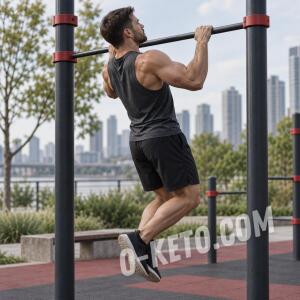
In upper body training, it’s easy to focus only on the large muscles: pectorals, lats, deltoids, biceps, and triceps. However, the quality of presses, pulls, chin-ups, and bicep curls often depends on more subtle factors: how the scapula moves, how stable the shoulder joint is, what the rotator cuff is doing, and in what position the forearm is.
If these factors are not taken into account, the exercise may look correct externally but may not load the intended muscles. In a press, a person thinks about their shoulders, but the limitation comes from the scapula. In a pull, they try to “engage their back,” but the shoulder moves forward. In bicep curls, the position of the wrist changes, and with it, the contribution of the biceps, brachialis, and brachioradialis changes.
The shoulder is not just one joint
When people say “shoulder joint,” they usually refer to the place where the head of the humerus connects with the scapula. However, arm movement overhead, pulling towards oneself, or abducting the arm to the side involves the entire shoulder complex. This includes the shoulder joint, clavicle, scapula, and thoracic cage.
This is important for training for a simple reason: the arm does not move in the air separately from the scapula. If the scapula does not glide well, does not rotate, or is not stabilized, the shoulder joint receives more unnecessary load.
In upper body movements, the following links are usually involved:
- the shoulder joint, where the shoulder flexes, extends, abducts, and rotates;
- the acromioclavicular joint, which helps the scapula and clavicle adjust to the movement of the arm;
- the sternoclavicular joint, through which the clavicle connects the shoulder girdle to the torso;
- the scapulothoracic glide, which allows the scapula to move along the thoracic cage.
Therefore, in presses and pulls, not only the “shoulder” is working. The entire shoulder girdle is involved. The better it is coordinated, the easier it is to load the target muscles, and the less the exercise turns into a struggle with discomfort.
The scapula in presses and pulls: why it is so important
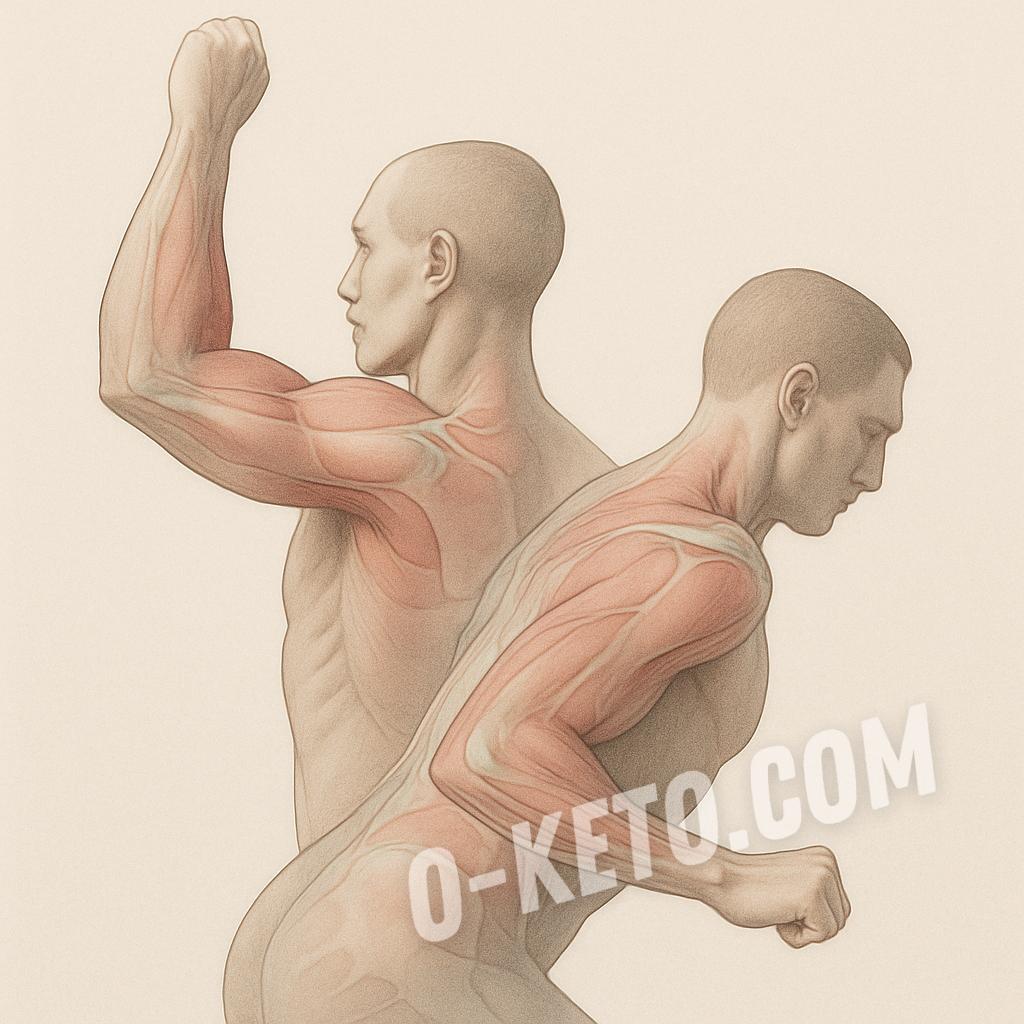
The scapula is a movable platform for the shoulder joint. It holds the glenoid cavity into which the head of the humerus fits. If the platform is unstable or moves at the wrong time, the shoulder joint has to compensate.
In presses, the scapula helps the arm to safely lift and hold the load. In pulls, it participates in adduction, lowering, rotation, and control of the shoulder girdle. In chin-ups and vertical pulls, scapular depression and control are particularly important to prevent the movement from turning into shoulder elevation towards the ears.
In simplified terms, you can remember the following:
- in presses, the scapula should help the arm move, not get stuck in a rigid fixation;
- in pulls, the scapula should participate in the movement, not remain passive;
- in chin-ups, the shoulders should not constantly rise towards the ears;
- in deltoid exercises, it is important to distinguish between the movement of the humerus and compensation by the torso and neck.
This does not mean that one should think about the scapula every second of the set. However, if the exercise is regularly felt in the front of the shoulder, neck, or traps instead of the target area, it is worth looking not only at the weight but also at the mechanics of the scapula.
The rotator cuff: small muscles with a big task
The rotator cuff of the shoulder is a group of muscles that help keep the head of the humerus in the joint and control shoulder rotation. They do not appear as the “main” muscles of the workout, but without them, presses, pulls, and abductions become less controllable.
| muscle | main role | why it’s important in training |
| supraspinatus | helps initiate shoulder abduction | important in movements where the arm moves to the side |
| infraspinatus | participates in external rotation of the shoulder | helps control the shoulder in pulls, presses, and abductions |
| teres minor | participates in external rotation and stabilization | supports the shoulder during loaded movements |
| subscapularis | participates in internal rotation of the shoulder | helps maintain the front of the shoulder joint |
The main idea of the cuff is not to “pump small muscles,” but to provide centering and control for the shoulder. When large muscles pull the humerus strongly, the cuff helps maintain the position of the joint. Therefore, shoulder warm-ups, external rotations, light pulls, and control of amplitude are not a decorative part of the workout, but preparation for the stabilization system.
Deltoids, trapezius, and serratus anterior: who helps the shoulder
The deltoid muscle creates the visible shape of the shoulder and participates in moving the arm forward, to the side, and backward. But it does not work in isolation. For the arm to rise and fall in a controlled manner, the scapula needs muscles that move and hold it.
Three groups are particularly important:
- the trapezius muscle helps raise, lower, adduct, and rotate the scapula;
- the serratus anterior helps the scapula glide along the thoracic cage and participates in its upward rotation;
- the rhomboid muscles help adduct the scapula towards the spine and hold it during pulling movements.
If the serratus anterior and lower parts of the trapezius are weak, a person may compensate for movement with the upper trapezius, neck, or excessive lumbar arch. Therefore, when training the shoulders, it is useful to think not only about lifting dumbbells but also about how the scapula behaves.
Pronation and supination: not just palm up and palm down
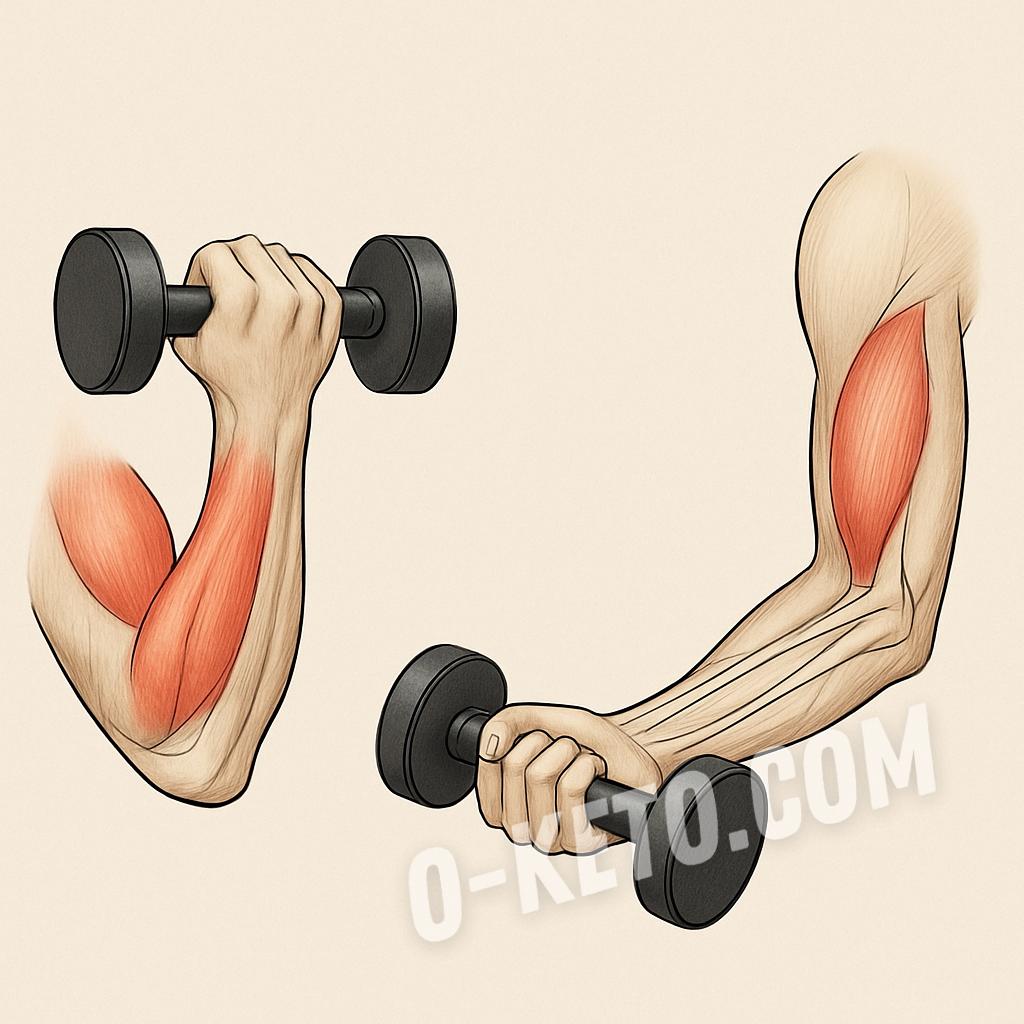
Pronation and supination are often explained too roughly: palm down and palm up. For everyday understanding, this is sufficient, but in training, it is important to know that it is not the wrist itself that rotates, but the forearm at the radioulnar joints. The radius changes position relative to the ulna, and because of this, the orientation of the palm changes.
This is especially important in bicep curls, chin-ups, and pulls. When the palm is facing up, the biceps of the shoulder gets a more advantageous position for elbow flexion and supination. When the grip is neutral, the brachioradialis becomes more engaged. When the forearm is pronated, the contribution of the biceps to elbow flexion may feel different, and part of the load shifts to other flexors.
| forearm position | example | what changes |
| supination | dumbbell curls with palms up, chin-ups with an underhand grip | biceps gets a more advantageous position |
| neutral position | hammer curls, neutral grip in pulls | brachioradialis and overall work of elbow flexors are felt more |
| pronation | reverse curls, pulls with an overhand grip | the contribution of the biceps changes, the forearm muscles and brachialis become more significant |
Therefore, the phrase “do a bicep exercise” is incomplete. It is necessary to specify the grip, the position of the forearm, and the trajectory. The same curl with a supinated, neutral, and pronated grip gives different sensations and different emphases.
Biceps, brachialis, and brachioradialis: why grip changes the exercise
Elbow flexion is not only performed by the biceps. The biceps of the shoulder participates in elbow flexion and supination of the forearm. The brachialis lies deeper and helps flex the elbow regardless of how the palm is oriented. The brachioradialis is particularly noticeable in neutral and some pronated positions.
The practical conclusion is simple: different grips do not just “diversify” arm training. They change the mechanics:
- classic curls with supination better highlight the role of the biceps;
- hammer curls engage the brachioradialis more and give a different emphasis to the forearm;
- reverse curls limit the advantageous position of the biceps and load the forearm muscles more;
- in pulls, the grip affects not only the wrist but also the position of the shoulder, elbow, and scapula.
If the goal is to develop the arms while not irritating the elbows and shoulders, it is useful to alternate variations but not turn the workout into chaos. It is enough to understand why a specific grip is chosen.
Common mistakes in upper body training
Most mistakes are not due to the fact that a person “does not know anatomy,” but because they describe the exercise too generally. As a result, the shoulder, scapula, elbow, and forearm move as they please.
The most common mistakes include:
- considering the press as an exercise only for the shoulder or chest and not taking into account the movement of the scapula;
- doing pulls only with the arms, without controlling the scapula and shoulder position;
- ignoring the rotator cuff until the shoulder starts to hurt;
- calling any wrist position pronation or supination without understanding the movement of the forearm;
- choosing the grip randomly and then being surprised that the biceps, forearms, or shoulders feel different than expected.
Good technique starts with a more precise language. If it is clear what exactly should move, it is easier to see where compensation begins.
How to apply this in practice
Before upper body training, it is not necessary to conduct a full anatomy lesson. A few guidelines that help keep the movement conscious are sufficient.
The working order can be as follows:
- first, understand whether it is a press, pull, arm raise, elbow flexion, or forearm rotation;
- then check where the scapula is and whether the shoulder is moving forward or upward without control;
- after that, choose the grip: supinated, neutral, or pronated;
- then select a weight at which the movement remains manageable;
- finally, assess where the load was actually felt and whether there was any pain in the shoulder, elbow, or wrist.
If the movement is controlled, the muscles work more clearly. If the technique falls apart at the beginning of the set, increasing the weight usually only reinforces compensations.
Conclusion
Upper body training is not just about the chest, back, shoulders, and biceps. Behind every press, pull, and curl lies the coordinated work of the shoulder joint, scapula, rotator cuff, elbow, and forearm. The more precisely you understand these links, the easier it is to choose an exercise for the task.
The shoulder needs mobility and stabilization, the scapula needs controlled movement, the rotator cuff needs regular preparation, and the forearm needs conscious grip choice. Then exercises become not just a set of habitual movements but a clear system for strength, muscles, and more precise technique.
Sources
- Anatomy, Rotator Cuff — StatPearls, NCBI Bookshelf
- Anatomy, Shoulder and Upper Limb, Glenohumeral Joint — StatPearls, NCBI Bookshelf
- Scapulohumeral rhythm and associated spinal motion — Clinical Biomechanics
- Scapular positioning in athlete’s shoulder: particularities, clinical measurements and implications — British Journal of Sports Medicine
- Anatomy, Shoulder and Upper Limb, Forearm Brachioradialis Muscle — StatPearls, NCBI Bookshelf