


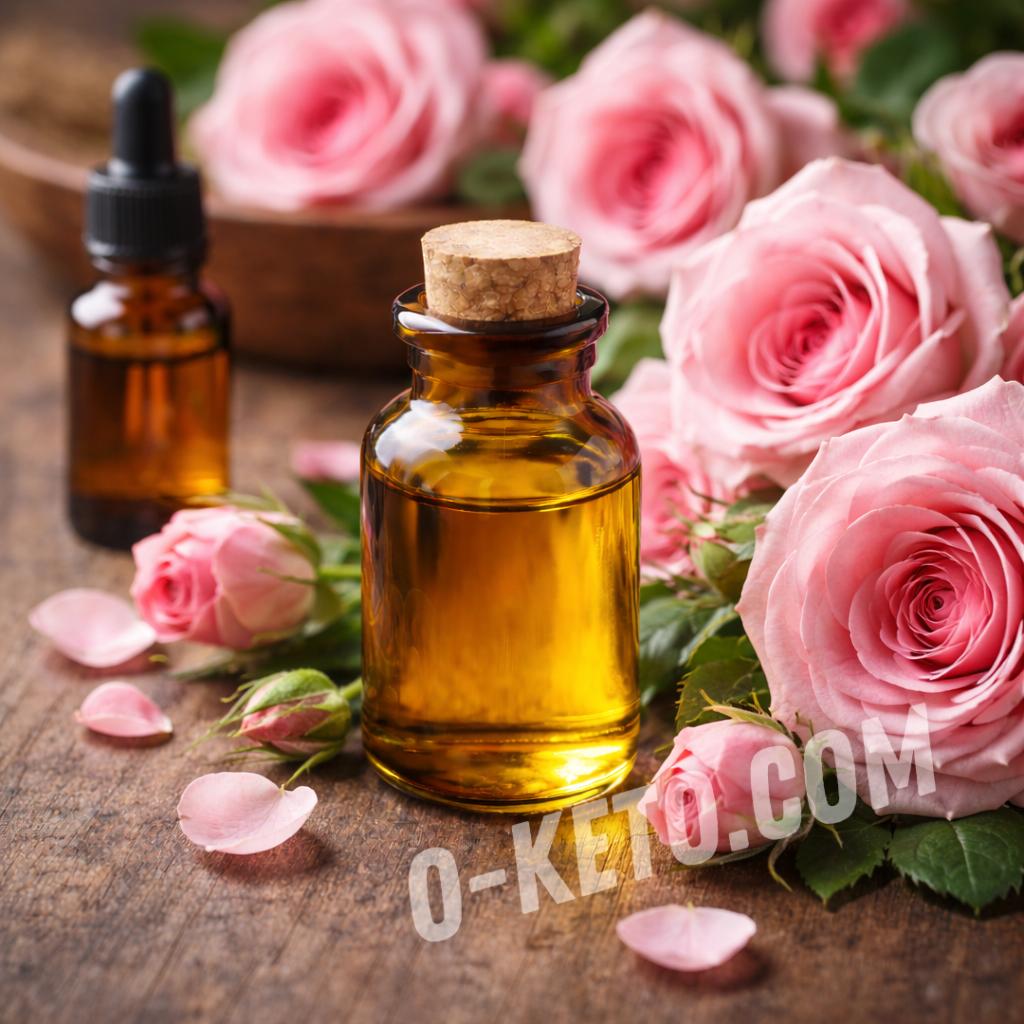

Rose essential oil from Rosa damascena is obtained from fresh petals of the Damask rose. It is one of the most expensive aromatic materials: the petals are picked by hand, usually early in the morning, while the aromatic compounds are better preserved in the raw material. Large amounts of flowers are needed for a small amount of oil, so genuine rose oil is always costly.
The aroma is deep, floral, honeyed, warm, with a light spicy and waxy note. It is used in perfumery, aromatic blends, cosmetics, and skin-care oils. It is not a food product and not a keto diet ingredient; in a nutrition context, it mainly matters as a reminder that essential oils should not be confused with ordinary edible plant oils.
How the oil is obtained
Classic rose essential oil is produced by steam distillation of the petals. Rose absolute is also sold: it is extracted with solvents and has a denser, sweeter, more perfumery-like profile. Both materials are valued, but they are different products, so the label should be checked carefully before buying.
The main production regions are connected with long traditions of growing Damask rose: Bulgaria, Turkey, Iran, Morocco, and several other countries. Quality depends on the variety, climate, harvest time, freshness of the petals, and careful distillation.
Aromatic profile
Rose oil rarely smells like a simple bouquet. It can include fresh petals, honey, tea rose, light greenery, spice, and soft powderiness. On skin and in blends, the aroma opens gradually: the floral part is brighter at first, followed by warm sweetness and a rounder base.
Because the aroma is strong, the oil is used in very small amounts. One drop can change an entire diffuser blend, massage oil, or cream base. Too much often makes the scent heavy and intrusive, so rose is best handled with restraint.
How to use
In aromatic blends, rose oil pairs with lavender, neroli, bergamot, sandalwood, patchouli, geranium, ylang-ylang, jasmine, and Roman chamomile. It softens sharp citrus notes, rounds out woody accords, and adds floral depth to evening compositions.
For skin care, essential oil should not be applied undiluted. It is added to a carrier oil, cream, or balm at a low concentration. This format is suitable for dry, mature, or sensitive skin when a gentle aromatic element and a pleasant care texture are desired. The exact concentration depends on the base, the area of application, and individual response.
For a first trial, it is easier not to mix many aromas at once. One drop of rose in a small amount of neutral base, or one drop in a diffuser blend that already contains simpler oils, is enough. This makes it easier to understand whether rose overwhelms the other notes or makes the aroma too dense.
What not to confuse it with
Rose essential oil is not the same as rose water, hydrosol, or cosmetic fragrance. Hydrosol is milder, contains the water-soluble aromatic fraction, and is more often used as a spray or toner component. A fragrance oil may smell like rose, but its composition does not have to match natural oil. For skin care and aromatic blends, this difference matters.
How to choose
Genuine Rosa damascena oil is usually sold in small dark-glass bottles. The label should show the Latin name, country of origin, extraction method, and a clear statement that it is essential oil, not a fragrance oil. A very low price for rose is a reason to check the composition carefully.
Rose oil is often diluted or blended with cheaper aromatic materials. Sometimes this is stated honestly as a product in a carrier oil, for example jojoba. Such an option may be convenient for home skin care, but it should not be evaluated as pure essential oil.
Limits and safety
Essential oils are concentrated aromatic substances. They should not be swallowed, added to food, applied to mucous membranes, or used on skin without dilution. Before first use, it is better to test a small area of skin and wait for a reaction.
Pregnancy, breastfeeding, childhood, allergy tendency, and chronic conditions require an especially cautious approach. If there is any doubt, the oil should not be used independently. Moderation is also important in a diffuser: short room aromatization is usually easier to tolerate than many hours of continuous diffusion.
How to store
Keep the bottle tightly closed, away from light, heat, and moisture. It is better stored in a box or cabinet, not near the stove and not on a windowsill. During long storage, the aroma can change: heavier waxy or sour notes may appear. If the smell becomes unpleasant, the oil should not be used in skin care.
Rose oil is chosen not for loud promises, but for its complex aroma and precise role in a blend. It is appropriate where noble floral depth, softness, and very delicate dosing are needed.


